'It's hard to know I was left to cry': Mary Tighe on being born in a mother and baby home
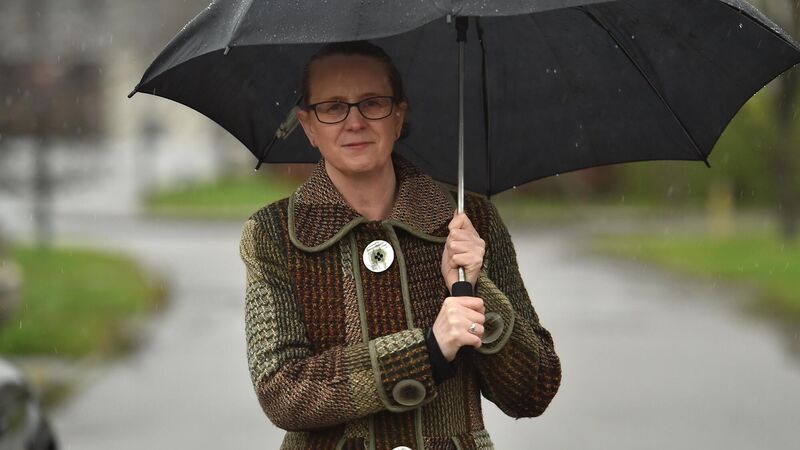
Mary Tighe, who lives in East Cork, was born in a mother and baby home. Picture: Dan Linehan
WORKING as a doula, Mary Tighe offers non-judgmental emotional support – and informational support – to parents during pregnancy, labour and post-natally.
“It’s my passion. It’s very fulfilling, beautiful work and I feel lucky and honoured when families invite me in at such a special time in their lives,” says the 49-year-old who lives in East Cork.
For Mary a GentleBirth instructor and co-founder of national doula agency DoulaCare Ireland (www.doulacare.ie), it’s “so important that a mother is emotionally supported and minded during labour and after her baby arrives”.
So it’s particularly poignant that she herself was born in St Patrick’s Mother and Baby Home in Dublin.
Mary knows the factual details of the timeline surrounding her birth in August 1971, how her birth mother arrived at the home in May, consented to her baby’s adoption in early September and left in mid-September. “I wasn’t placed with my [adoptive] parents until October 29, so I was in the home for six weeks without my birth mother. Knowing what I know now about what babies need to thrive, that really hurts.”
Her work makes her acutely aware of what newborns need to thrive – to be held, to have lots of skin-to-skin contact. “If babies are left to cry, it increases levels of cortisol, the stress hormone. It’s hard to know that as a small baby I would have been left to cry, that I was this lost soul, that there was no-one to mind or love me. As a tiny baby, you rely on your senses, you have this person you’re connected with, you know their smell – and then you’re taken away from them! It must be so terrifying.”
Mary’s heart breaks for her birth mother, a lone parent in a mother and baby home in 1970s Ireland. Accessing her files from the agency that placed her for adoption, the social worker told Mary that at one point her birth mother “had spoken about being eager to discuss the possibility with her parents of bringing me home”.
Discovering this, Mary says: “I just bawled. It made me really sad to know she did want to do this and couldn’t.”
Six weeks after Mary gave birth to her first child, Sadbh, another realisation struck her to the core. “It was around the six-week mark that my birth mother left me. Looking at Sadbh, I imagined having to leave this beautiful baby and not be able to see or hold her again. Every bone, fibre and nerve of your body would want to stay with that child. It must have been so difficult for my birth mother – she was going against every instinct. I feel so sad and sorry for what she had to go through.”
When Mary thinks about her origins, about how it might have been and about how it was, she has very mixed emotions. It would have been “amazing” if her birth mother had been able to keep her. But she muses: “I don’t think she’d have been able to be my mother openly. Possibly I’d have been brought up as her sister. And what a shock it’d have been then to find out she was my mother.”
And she has had such a positive adoptive experience with mum Teresa and her late dad, Dessie. “My [adoptive] parents are my parents. My mother was there to kiss me when I fell and hurt my knee, to hang on every word when I came in from school. My dad brought me to the village every Sunday to buy my comic. When I was older and split up with my boyfriend, my mother was there to feed me. I was very loved by them.”
For a long time, Mary didn’t think she had issues around being adopted – until she heard author Joanna Trollope being interviewed. Researching for a novel, Trollope had talked with many people who’d been adopted. “She said she’d noticed similar traits among them – around rejection. They found it hard to settle to the one thing. It sounded like me. I was fluttering from job to job at the time.”
It was the catalyst for seeing that how her beginnings played out may have impacted. “I started thinking: ‘Who am I? What’s my past?’ I grew up with my lovely parents and extended family but I knew there were also relatives by blood and part of me wanted to get in touch.”
She started searching in the late 1990s and finally got to see a social worker in 2003. “They found my birth mother and wrote to her, but she didn’t want contact. The social worker felt ‘she’d buried this very deep and hadn’t looked at it in 30 years’. I was very upset.
"I remember going to Tesco and thinking anyone here could be my birth mother and I don’t know who they are.
"It felt like being rejected. Logically I understood, but my heart felt differently. I just wanted to know: Is there anybody out there who looks like me? It’s very visceral: Where are you from? Who are your people?”
From adoption support forums, Mary learned that contact from the agency that had engaged in the adoption of her baby could be deeply triggering for a birth mother. She decided to independently pursue her information search. Supported by her adoptive mum, husband and closest friend, she spent a day in the records office in Dublin and found a birth cert for her mother, discovering she was from Sligo. “Finding this information felt quite empowering.”
But pregnancy and child-rearing (Sadhb’s now 14, Odhran 10) postponed the search, though this phase also brought fresh realisations. “Becoming a mum – here was my flesh and blood for the first time. I didn’t think it was so important but oh my goodness it was. To think these are my children – it was amazing.”
Her origins informed her parenting. “I breastfed on demand, we co-slept, I carried my babies in a sling, tried to parent gently. I hated to hear them cry. It was very instinctive – I had to give them what I didn’t have. It became my world.”
Having her children also made her aware of the gaps. “When Sadbh was born, everyone was saying ‘she looks like this auntie, this side of the family’. It really hit me: I didn’t have that continuity. That instinct to name them, to bring them into the family, I couldn’t do that.”
Mary has since obtained her birth mother’s marriage cert and an address she believes is still current. She wrote to her recently by registered post and knows the letter was received. “It’s a very respectful letter with nothing identifying in it. I’m mindful that the social worker said she’d told her husband at the outset but they never talked of it again. Now it’s wait and see. I’ve decided if she doesn’t make contact, that’s OK. I’m going to keep searching for another family member, a cousin, uncle, who might want to make contact. I realise the clock is ticking.”
Mary did not contribute to the recent Mother and Baby Homes report. Nor has she been able to read it. “Every time I go to it, I get such a lump in my throat. I’ve kind of left it. When I’m in a different space I’ll come back to it.”
If you’d asked her in 2006, when she originally trained as a doula, whether the career she’s passionate about is also a way to heal her own past, she’d most likely have said no. She’s very mindful that when supporting parents it is about them and their journey. But now she thinks it’s possible there is a healing for her as well. “There is a sense of that healing – it is very healing.”


CONNECT WITH US TODAY



Be the first to know the latest news and updates