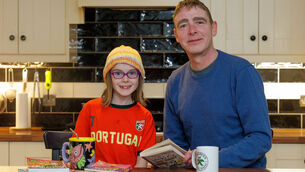
It's all about the children this Christmas

Picture: iStock
FOR all of us, this will be a Christmas like no other. Many adults are finding it difficult, so how can we make sure that our children cope and that we all enjoy the magic of the festive season without so many of our usual traditions?
This Christmas, the message from Anne Looney, professor and executive dean at Dublin City University Institute of Education , is simple: children should be front and centre.
“We have to make sure that the excitement of Christmas in whatever form we can have it is focussed around them,” she says.
it’s really important parents don’t pass the disappointment they’re feeling onto their children.
Laura Earnshaw is founder of myHappyMind, an award-winning programme that helps to build resilience in children. She says it is important parents do not pass the disappointment they're feeling onto their offspring. “If parents sat around talking about how miserable it’s going to be this year, then of course children are going to absorb that.”
“This buffering by parents is very important because children do absorb and pick up our emotions incredibly successfully, even if we don’t realise,” says Laura. “They’re incredibly astute at picking up how we might be feeling. And so our role as parents is very much one of protecting them from some of that, if we can.”
Laura says we need to learn, as parents, to really get back to basics on what matters most and to remember that all children really want is time with their loved ones.
She suggests talking in terms of what we can do to make Christmas really special, focusing on what we can control and what we can still celebrate.
This positivity is echoed by Anne Looney, who says that RTE’s and the Ark cultural centre have teamed up to help children to put on their own home - produce d play.
“You may not be able to go to school to see a Christmas play, but you can put it on at home and parents can video it for grandparents,” says Anne.
Children are resilient, and their teachers and schools will be making every effort to do some of what they normally do during this time of the year, she says. "But at home, we’ll have to make a real effort. The assurances that Santa Claus can still come need to be made over and over again.”
Anne believes it’s important for children to see light in the darkness and says that the people living in her estate decorated every tree in the vicinity. “We’ve suddenly become a winter wonderland and it’s a very positive thing for children.”
She suggests giving children an opportunity to light things up, “to put lights in the garden and go out and switch them on each evening and make that into a ritual.”
She also suggests building on the great cooking fest of 2020 and encouraging children to get involved in Christmas baking.
Laura recommends thinking about innovative ways for the family to reflect on all we have to be grateful for. In her book, she talks about viewing gratitude through three different lenses: gratitude for experiences, gratitude for other people and gratitude for ourselves.

She encourages parents to ask: 'How can I emphasise all of these amazing things that we have to be grateful for, that don’t require big gatherings... but that are right under our nose?'
One way of doing this is to create a gratitude tree, says Laura. This involves children drawing an outline of a tree trunk and every time they think of something they’re grateful for, they draw a leaf and they write it on the leaf, so this tree majestically grows in front of your eyes.
Use Christmas 2020 as an opportunity to think about how we create new memories she adds, and involve your children in this because they are incredibly creative and they come up with great ideas.
She suggests encouraging them to think about the random acts of kindness they can do for others this year. “What are some of the random acts of kindness we can encourage our children to do this Christmas to not only make it special for them but for them to make it special for others?”
Ireland has a strong awareness of people who need support at Christmas, says Anne, “that is part of an Irish Christmas tradition, whether it’s the Aware Christmas Run or St Vincent de Paul collection. I see no reason why we shouldn’t continue that and remind our children of that. This may be the Christmas to tell them that there are people who need help and support but it is also the Christmas to remind children of their agency, to encourage them to reach out to people in their own neighbourhood.”
She believes is important to give children that sense of responsibility “because I think that’s probably something that children lost during lockdown, a sense that there are things that they can do, rather than just there are things that they need to know about.
“Tell them that there are people who struggle at Christmas but give them the tools to do something about it – to make a donation, to fundraise, to send the card, to write the letter.”
If your child is particularly upset about missing some of your cherished Christmas traditions, then it is crucial to acknowledge their emotions, says Laura.
She believes that it can be helpful to discuss the challenges of Covid with our children, so that they can recognise “that this is happening to all of us, it’s not just a rule that’s stopping me from going to see Santa, it’s a rule stopping everyone.
“What’s really important is that a child feels heard,” she says. “And they feel that their emotions are legitimate and that they are valid. Often parents in a situation like that would say: ‘Oh don’t be so ungrateful, aren’t you lucky you’ve got this, or you’ve got that'. And, actually, that’s not the right way to deal with it because we never want children to feel as if their emotions aren’t valid.”
If you don’t validate your child’s feelings and you don’t help them come to accept those feelings, then they’re not going to get excited about planning something different, says Laura.
“It’s about guiding them through that process. Firstly, feeling acknowledged in their feelings. Secondly, getting them to a place of acceptance, so helping them to see rationally... that there’s not much we can do because we’re bound by the rules. It’s only then that you can move to that third stage which is around what are our alternatives.
“It’s super-important to go through step one and two first in order for them to get excited about step three.”
Parents will do their best for their children, as they do every year, says Anne. “This this year there is a real need to make Christmas all about the children.”
“If you as a parent can be fully present with your children, says Laura, “if you can focus on gratitude, if you can create really good memories, you’ll have a wonderful Christmas.”


CONNECT WITH US TODAY



Be the first to know the latest news and updates