Appliance of Science: When is a fossil not a fossil?
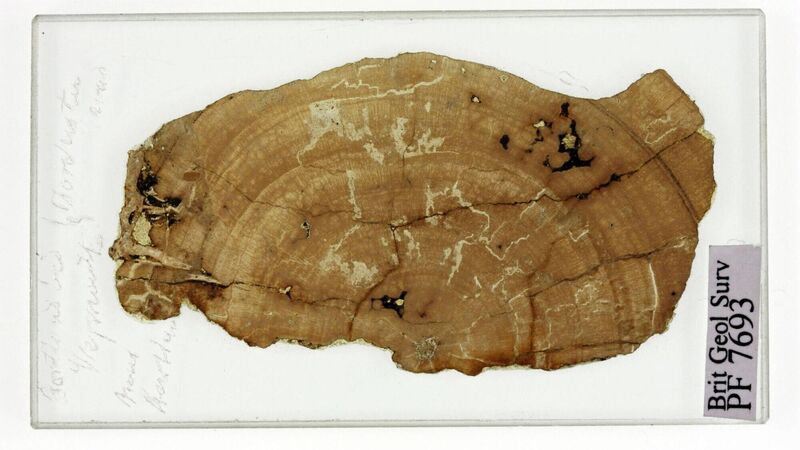
A polished section of fossil wood from the cabinet of Reverend John Henslow, Charles Darwin's mentor at Cambridge, comprising a 150 million years old tree.
We probably all have an idea of what a fossil is, something to do with bones and bits of animals, and plants, that lived a very long time ago. But do you know how old it needs to be to be called a fossil, and what makes a fossil a fossil?
A fossil is the preserved remains, or impression of an ancient organism. The organism in question could be an animal, plant or even a microorganism, like a bacteria.
How old does it have to be to be considered a fossil? That depends on the exact definition of a fossil; Commonly, a fossil refers to any trace of life from a prior geological age. That would mean a fossil has to be at least 10,000 years old (from the Pleistocene era or earlier). However some people maintain that a fossil is any remains that have been mineralised and this process can happen in a much shorter time frame. Of course, many people refer to non-mineralised remains as fossils too, such as organisms preserved in amber or pollen grains. So how old does a fossil have to be to be considered a fossil? I guess you have to choose your definition before you choose your timeframe and it is open to many different interpretations.
Fossils are made in a process called fossilisation but its occurrence is quite rare as it needs a very specific set of conditions. Usually when an organism dies it completely decomposes over time so no trace of it is left behind. However, sometimes an animal can be buried under sediment and rock after it dies. The soft parts of the body usually decompose; but under just the right conditions, the bones get encased in sediment that compresses to form a rock mould and then the bones may be dissolved away by water seeping through. If minerals in the water replace the bone as it gets dissolved they can eventually create a replica of the original bones. These replicas are made of rock and are referred to as fossils. This type of fossilisation, referred to as mineralisation or petrification, is the most common, but fossils may also be created by other processes, like freezing or encasing the organism in tar or resin.
When we think of a fossil, the first thing that comes to mind is probably the bones but fossils can be made of many other things too. Trace fossils are fossilised remains of imprints left from living things, like footprint. Trace fossils can help us learn more about the behaviour and location of extinct animals or plants. Leaf prints and even fossilised animal burrows are also classified as trace fossils.
Another example of trace fossils is coprolite, which is fossilised faeces. In 2014, a large piece of coprolite was auctioned off in California. The six-million-year-old poop sold for a whopping $10,370 dollars; but even more remarkable was that this fossil turned out to be fake.
Last week a new record was set as a T-rex fossil, called Stan, was sold at auction for 31.8 million dollars, the highest ever paid for any fossil.
The oldest fossils that have been found are not from dinosaurs. They relate to ancient bacteria, fossilized remains of their by-products. These bacteria are some of the earliest forms of life on our planet and the fossils are thought to date back 3.7 billion years.


CONNECT WITH US TODAY



Be the first to know the latest news and updates