Early recognition of stroke in children is vital 
We talk to parents whose children’s recovery from stroke was accelerated by swift medical attention in CUH 
Early recognition of stroke in children is vital 

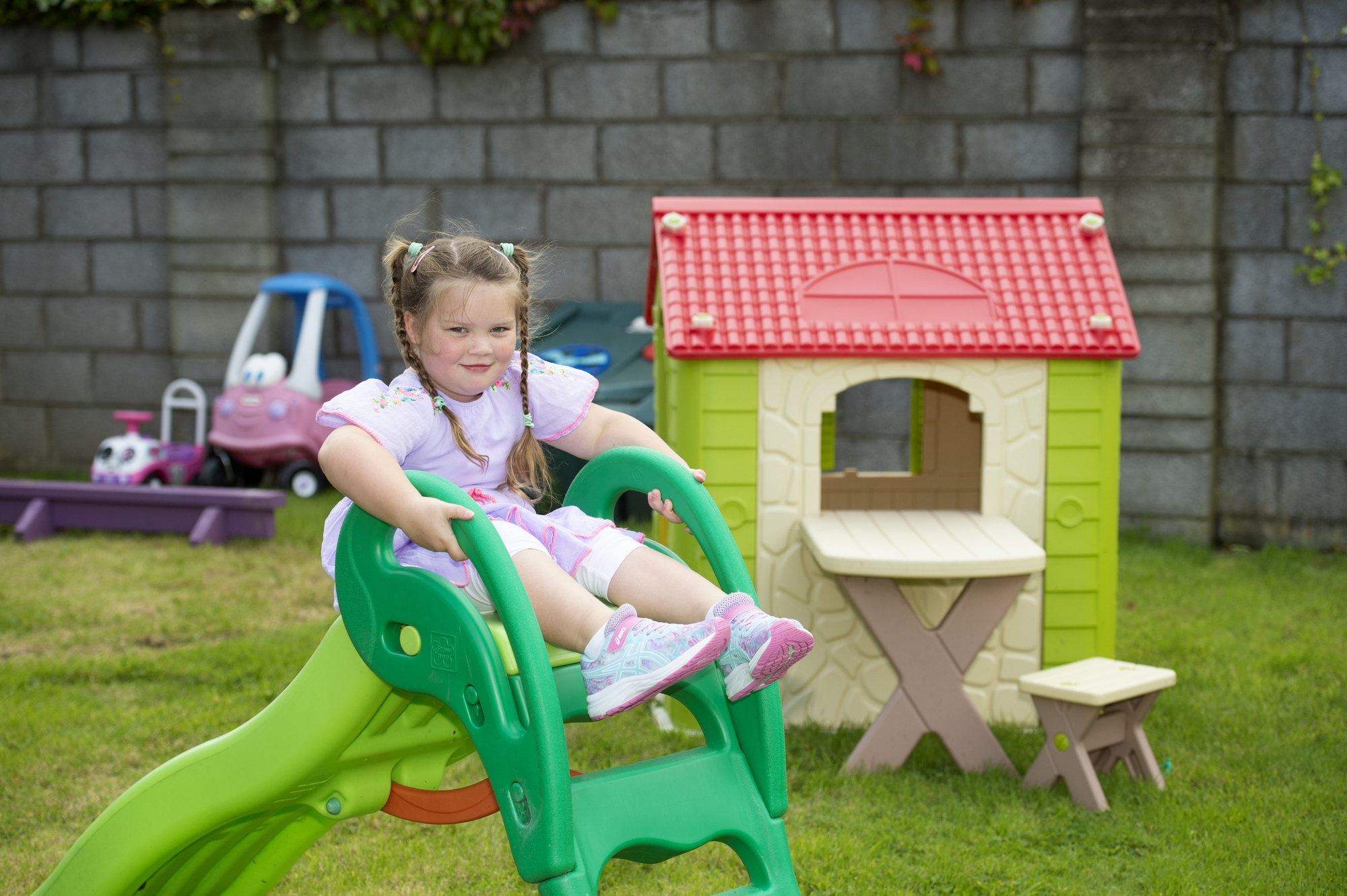
Four-year-old Molly Montgomery, who had a stroke last November, playing in her garden in Douglas, Cork. Picture: Dan Linehan


Niamh Montgomery had just returned from shopping with her toddler on a Tuesday morning last November when the crèche called about her other daughter, Molly. The three-year-old – who’d scootered to school that morning – had collapsed in the playground.

“She’d very little movement in her left side. She couldn’t stand or put weight on her left leg. I’m a pharmacist and I thought: is it stroke? But then I thought ‘she’s three – it can’t be that’ and put it out of my head,” says Niamh, who reached the crèche – across the road from the family home in Maryborough Woods, Cork – in minutes.

Upon arrival, Niamh saw Molly in great form. 

“She seemed like someone drunk – giggling, laughing – I thought she was messing”. 

Seeing no facial drooping, Niamh thought Molly might have fallen – “she races round, 100 miles an hour all the time” – and that her left leg and arm were ‘dead’.

At CUH, x-rays and CT scan returned clear. Then came the shock MRI result: Molly had suffered two strokes. “The previous stroke had affected the left side of her brain, meaning the right side of her body would be affected. We’d never seen any clinical signs of it, so we don’t know when she had that first stroke,” explains Niamh, adding that Molly’s a very physically able child. “She walked at nine months and was swimming at three years.”

Doctors wondered whether they should administer thrombolysis – treatment to dissolve dangerous blood clots. But if the stroke had been due to dissection [tear in artery], thrombolysis could cause Molly more damage. It was a lot to weigh up – eventually, doctors took a conservative approach and didn't carry out this procedure. 

Molly then underwent cerebral angiogram, which showed up vasculitis – inflammation and narrowing of blood vessels in the brain. “This narrowing produces blood clots, which caused the stroke,” says Niamh.

 Four-year-old Molly Montgomery playing in her garden in Douglas, Cork. 
Four-year-old Molly Montgomery playing in her garden in Douglas, Cork. 

The condition can be caused by an autoimmune disease – like lupus or rheumatoid arthritis, which Molly doesn’t have – or by infection, for example, chickenpox. Mollie had been vaccinated against chickenpox as a one-year-old. “It could have been caused by a virus – we may never know,” says Niamh.

On high-dose steroids for five days, Molly began getting movement back after day one. “It was like Lourdes, like winning the lotto. Up to then, there’d been talk of getting aids in the house, a special chair so she wouldn’t fall over – we were going down a very serious road.”

Between November 2019 and beginning of lockdown, Molly was observed weekly at CUH – her pulse, blood glucose and sugars and blood pressure checked. She got occupational therapy for her left hand. “She still has a tremor in her hand. She calls it her ‘shaky hand’. Her balance isn’t what it was – you see it if she’s climbing rocks or doing something uneven.”

Niamh and husband Keith don’t know if Molly will go on long-term immunosuppressant therapy. “We don’t want her to be on drugs for life if it’s unnecessary – but we don’t want her to have another stroke that could be catastrophic.”

Back at crèche for three weeks now, Molly adores it. Her recovery has been fabulous, says Niamh. “She was very unlucky to get the stroke – but very lucky to have few side-effects.”

Rare condition

Dr Niamh McSweeney, consultant paediatric neurologist at CUH, says it’s a big shock to parents when told their baby or older child has had a stroke. “They don’t think it can happen,” she says.

Yet, every year Cork University Maternity Hospital (CUMH) sees about three cases of neonatal stroke, defined as occurring anytime from 28 weeks gestation to 28 days post-natally. “It happens in about one in 2,500 to one in 4,000 cases,” says Dr McSweeney.

Dr Niamh McSweeney, consultant paediatric neurologist, Cork University Hospital. 

Paediatric (childhood) stroke affects anyone older than 28 days up to 18 years – in CUH, the paediatric neurology team look after children aged up to 16, after which they’re transferred to the adult service.

“In CUH, our figures for paediatric stroke would be low,” says Dr McSweeney, who confirms incidence rate per year as five per 100,000.

Women often blame themselves when their baby experiences neonatal stroke, yet it’s outside their control, says Dr McSweeney, explaining that pregnancy itself is a “highly-coagulable state” – there’s greater likelihood of clot. “A clot in the placenta can travel and cut off blood supply [to baby]. Another contributing factor might be the baby has underlying congenital heart disease or a clotting abnormality, which would be rarer.”

While most stroke-affected babies present with symptoms within 24 hours, sometimes symptom-presentation is delayed. “You might notice delay in developmental milestones. Early hand preference is another red flag – babies don’t generally show hand preference before one year, though it can be normal for some to do so. But if they’re neglecting one side, it could indicate weakness. Another sign’s a fall-off in head growth.”

Thankfully, neonatal stroke carries a very low five-year recurrence rate of 1%.

“It’s highly unlikely they’ll have another stroke unless they have congenital heart disease or a clotting problem,” says Dr McSweeney.

However, up to two-thirds have long-term consequences, for example, delayed milestones and cognitive/behavioural impact. One-quarter can develop epilepsy, depending on how big the stroke was and where in the brain it occurred. “Sometimes we can be very positive because it only affected a small area,” says Dr McSweeney.

Treatment-wise, babies aren’t given Aspirin. Instead, the approach is rehabilitative, linking in with services like Enable Ireland, keeping close eye on the child’s development and setting up physiotherapy, occupational therapy and speech and language input to ensure the little one fulfils their potential.

In the case of paediatric stroke, Dr McSweeney says a common cause is arteriopathy, where there’s a problem with blood vessels. In such cases, medics ask if the child’s had a recent infection. “We always ask about chickenpox. They might have had it that year and there could be a transient narrowing in the vessel that causes inadequate blood supply to the brain,” she explains.

Congenital heart disease, other cardiac problems, chronic disease (kidney/rheumatological disease, lupus), acute infection (meningitis, head and neck infection) and trauma, such as by falling, which could cause a tear in an artery can all contribute to paediatric stroke.

Low iron

Dr McSweeney says she has also seen a few cases of stroke in previously healthy children, who were found more likely to have iron-deficiency anaemia than children who don’t have stroke.

When Cork-based parents-of-three Zulfiqar Ahmed and Mehwish Shaikh saw their three and a half-year-old daughter, Hani, vomit several times one night in March 2018, they knew something was very wrong.

At CUH, tests revealed very low iron levels, which medics treated. A little later, however, Hani suffered a stroke, leaving her unable to move or speak. She underwent thrombectomy – surgical procedure to remove blood clots from arteries/veins.

“It was a really horrible time,” says Hani’s mum Mehwish, who confirms the surgery was successful and her daughter responded well. Hani’s now in school, though closely and regularly monitored at CUH and she’s receiving various therapies.

As with adults, early recognition of stroke in kids is vital. What complicates this is the many ‘stroke mimics’ there are when it comes to children – they could, in fact, be presenting with migraine, meningitis or a seizure with transient weakness on one side that resolves.

Prognosis depends on what caused the stroke and how quickly the child recovered. The five-year recurrence rate is higher than in neonatal stroke – five to 19%. And in over 50% of cases, there’s long-term impairment – for example, weakness on one side, epilepsy, learning/memory difficulties, movement disorder.

“With rehabilitation, the level of weakness can be improved. We’ve had cases that have done very well where we didn’t find the underlying cause,” says Dr McSweeney.

“Children surprise us all in their ability to cope, in their capacity to overcome seemingly insurmountable challenges. With some kids, you think they’ll be left with a remarkable deficit – yet they do great.”

Warning signs 

A red flag for paediatric stroke is any symptom that comes on suddenly, warns Dr McSweeney, who explains what to look out for:

  • Weakness down one side, affecting any combination of face, arm or leg.
  • Problems speaking: difficulty getting the words out, slurred/unclear speech, difficulty expressing oneself and/or understanding others’ speech.
  • Loss of vision in one side or double vision, dizziness, lack of coordination, numbness, altered feeling on one side of body.
  • Severe ‘thunderclap’ headache – patient says ‘it’s the worst headache of my life’; seizures; altered level of consciousness, drowsiness, confusion, behaving differently (more withdrawn or hyper).

For more information on stroke, and supports for survivors and families, visit Headway and the Irish Heart Foundation.


x

Celebrating 25 years of health and wellbeing

More in this section

Lifestyle

Newsletter

The best food, health, entertainment and lifestyle content from the Irish Examiner, direct to your inbox.

Cookie Policy Privacy Policy Brand Safety FAQ Help Contact Us Terms and Conditions

© Examiner Echo Group Limited