At full stretch: How to stay flexible through the years
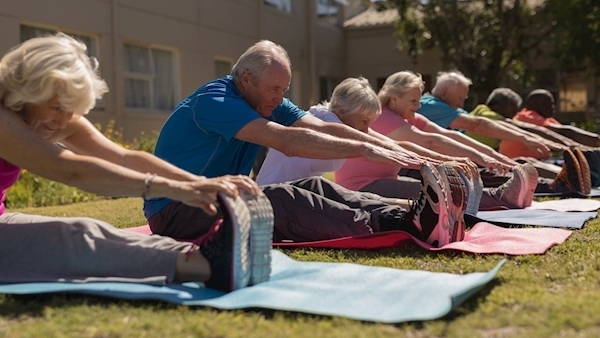
Flexibility naturally declines with age but there’s a lot you can to stay supple through the decades, says Peta Bee.
Exercise to hold back the years
CAN you touch your toes or do you find your fingers reach only as far as your knees? Flexibility declines sharply with age and the natural suppleness of youth will quickly disappear if efforts aren’t made to preserve it. The effects can be profound — as we move less freely, the risk of injury rises and our posture deteriorates.
Ageing takes its toll on our flexibility and, after 40, our body’s connective tissue — skin, tendons and ligaments — becomes less elastic and more prone to snapping.
A 2013 study from the University of Western Ontario showed that the average drop in flexibility of hip and shoulder joints to be about six degrees each decade from a person’s mid-50 onwards. And the outcome can be limiting — the less flexible we are, the worse our posture and the more inhibited our movement patterns. Breathing, digestion and stress levels can all worsen when we become stiff and inflexible.
Suzanne Wylde, the author of Moving Stretch (Lotus) says the longer you ignore it, the worse things get. “When we are tight it puts more wear and tear on our joints,” says Wylde. “And declining flexibility is compounded by inactivity because as we move less, we develop more tightness and restriction — causing more aches and pains.”
Research has shown how a lack of flexibility can present more serious long-term risks. A study in the AJP Heart and Circulatory Physiology journal [2009] revealed how a lack of flexibility in the trunk, hamstrings and lower back may be an indicator of how stiff your arteries are — and thicker, stiffened artery walls can lead to high blood pressure.
But it is possible to prevent a decline in flexibility and stay bendy and supple into old age. And it’s not all about straightforward stretches. Here’s how to do it:
Your first step should be to do some stretching for at least 10 minutes on a daily basis. Cork-based personal trainer Ray Lally, aka the Happy Fitness Guy, says general stretching of the main muscles we use (or don’t use) every day — the hamstrings that get tight when we sit, the calf muscles that ache when we’ve been standing, and our arms and shoulders that get tense from hunching over a desk — is a good idea.
“Spend 5-10 minutes focusing on these areas with general deep stretches,” he says. But you can try classes that incorporate active stretching such as Pilates, Tai Chi and other martial arts or calisthenics classes. Regular massage if you can as it will help you to achieve deeper stretches.
It’s not just stretching muscles that helps to keep you flexible. You also need to release tension from the fascia, the dense, fibrous connective tissue that encompasses all muscles and bones. “In small amounts, fascial tissue is protective, but it accumulates if we put our bodies through intense exercise, or have injuries, and it can eventually become restrictive, limiting our ability to move freely,” explains Wylde.
Last year, a study in the Journal of Anatomy reported that “age-related changes in fascia thickness may be a contributing factor of restrictions in joint range of motion.”
Resistance stretching classes that aim to provide a myofascial release (“myo” referring to muscle and “fascia” being the connective tissue) are something of a gym trend and involve intense and powerful super stretches. Try them at Live and Breathe Pilates in Dublin or at Golden Egg Holistic (goldeneggholistic.com) in Portlaoise, Co Laois.
“This deep tissue work elongates and aligns muscles, softens fascial restrictions and leaves us with a delicious feeling of spaciousness,” says Steph Grey, founder of Live and Breathe Pilates.
Classical ballet dancers perform up to 50 different stretching exercises every day, each designed to target specific muscles and many of the basic exercises are included in workouts such as the NYCB (New York City Ballet) gym classes and hugely popular workout video. But any barre or dance class will also help to improve flexibility — try Rebel Barre (rebelbarre.rocks) or Platinum Pilates (platinumpilates.ie) in Dublin and Flex In the City in Cork (flexinthecity.ie).
Studies have shown ballroom and other forms of dancing are particularly good at boosting flexibility. Last year a three-month trial at the Queensland University of Technology found that older adults who took part in ballet-style classes experienced greater flexibility and improved posture after 10 sessions.
Foam rollers are ubiquitous in gyms and are believed to help create a more supple and flexible body. “We don’t really know precisely how a foam roller works, but it seems to target the fascia that surround muscle, resulting in better feedback between muscle and brain,” says Dr Lewis Macgregor, a lecturer in physiology and nutrition sport at the University of Stirling, Scotland, who has researched the use of rollers. “It certainly seems to be a useful tool as part of a warm-up especially when used in combination with stretching.”
For a study published last June in the journal Sports Medicine, Lewis found that it required less effort for subjects to perform a leg weights exercise after two minutes of foam rolling than after two minutes of rest. However, the effects of improved flexibility are short-lived. “A foam roller provides a short-term hit with the effects lasting up to 30 minutes,” Macgregor says. “There’s some evidence of a cumulative effect if you roll every day providing benefits that last two weeks, but if flexibility is your aim, you should roll and repeat at least twice a day.”
The healthier your connective tissue, the more responsive your body will be to stretching and flexibility work. And cartilage, tendons and ligaments that are well hydrated are more likely to stay refreshed and elastic. “Dehydrated tissue ultimately means tighter fascia and muscles,” says Wylde.
Making sure you drink water regularly will help to keep your connective tissues healthier over time and stretching will also enhance hydration of the tissues. They work in combination like a dream.
It sounds counter-intuitive, but strength training helps to build flexibility. As we age, our levels of lean muscle mass drop and it can result in a more stooped posture. “With poor posture, muscles can shorten and flexibility declines,” says Lally.
Lifting weights will preserve some of your muscle mass and strength training also “takes your body into a different range of motion,” Lally says. All in all, better mobility and flexibility are the result.
Everyone thinks of yoga as the optimal route to bendiness. And it’s certainly a route to improvements in suppleness. “Where it generally falls down is in its inability torelease fascia,” Wylde says. “Although yoga is a useful route to better mobility.”
There are some forms that do target fascial release as well as muscle flexibility. Best of all is Yin yoga which involves very slow-paced moves such as forward bends and low lunges are held for about two minutes (though sometimes as long as five).