selfie tells a thousand words
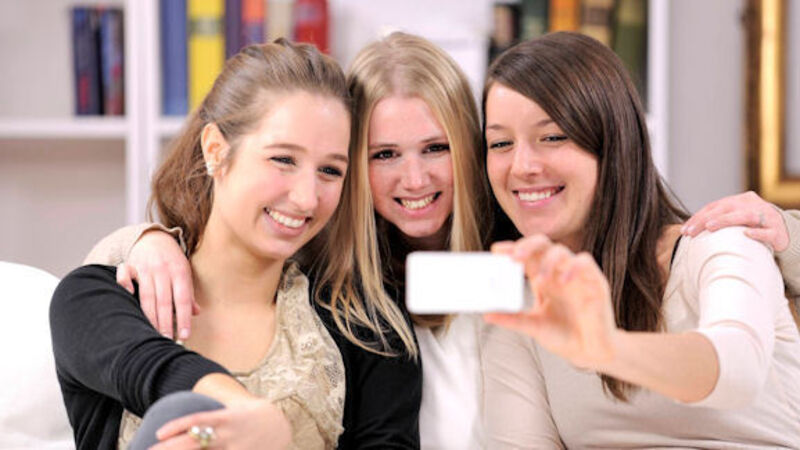
Sexiness is sucked-in cheeks, pouting lips, a nonchalant cock of the head and a hint of bare flesh below the clavicle. Snap! Afterwards, a flattering filter is applied. Outlines are blurred, colours are softened, a sepia tint implies a simpler era of vinyl records and VW camper vans.
This is the work of an instant. Tap and you are ready to upload: to Twitter, to Facebook, to Instagram, each portrait accompanied by a self-referential hashtag. Your image is retweeted and tagged and shared. This is the selfie: the self-portrait of the digital age. We are all at it. Just type ‘selfie’ into the Twitter search bar. Or look at Instagram, where 90m photos are posted with the hashtag #me.
Adolescent pop poppet, Justin Bieber, constantly tweets photos of himself with his shirt off. Rihanna has treated her fans to Instagrammed selfies while at a strip club , her buttocks barely concealed by a tiny denim thong, and of her posing, with two oversize cannabis joints, in Amsterdam. Reality TV star Kim Kardashian posted a picture of her face covered in blood after undergoing a ‘vampire facial’. The selfie-obsessed model and actress, Kelly Brook, banned herself from posting (her willpower lasted two hours).
This week, Claudine Keane model and wife of football captain Robbie, got in on the act when she uploaded a selfie, posing in her undies in her LA bathroom.
The political classes have started doing it too. US President Barack Obama’s daughters, Sasha and Malia, took selfies at his second inauguration. In June, Hillary Clinton’s daughter, Chelsea, tweeted a joint picture of them, taken on her phone at arm’s length.
The trend has even reached outer space: in December, Japanese astronaut, Aki Hoshide, took what might be the greatest selfie of all, at the International Space Station. The image encompassed the sun, the Earth, two portions of a robotic arm, a spacesuit and the deep darkness of the infinite beyond.
“The selfie is revolutionising how we gather autobiographical information about ourselves and our friends,” says Dr Mariann Hardey, a lecturer in marketing at Durham University, who specialises in digital social networks. “It’s about continuously rewriting yourself. It’s an extension of our natural construction of self. It’s about presenting yourself in the best way … [similar to] when women put on makeup or men who bodybuild to look a certain way: it’s an aspect of performance that’s about knowing yourself and being vulnerable.”
Although photographic self-portraits have been around since 1839, when daguerreotype pioneer, Robert Cornelius, took a picture of himself outside his family’s store in Philadelphia, it was not until the invention of the compact digital camera that the selfie boomed in popularity.
Images tagged as #selfie began appearing on the photo-sharing website, Flickr, as early as 2004. But it was the introduction of smartphones — most crucially the iPhone 4, introduced in 2010 with a front-facing camera — that made the selfie go viral. An estimated 1.6m Irish people now own a smart phone.
Recently, the Chinese manufacturer, Huawei, unveiled plans for a new smartphone with “instant facial-beauty support” software that reduces wrinkles and blends skin tone.
But if selfies are an exercise in recording private memories and charting the course of our lives, why do we share them with hundreds and thousands of friends and strangers online?
To some, the selfie is the ultimate symbol of the narcissistic age. Its instantaneous nature encourages superficiality — or so the argument goes. One of the possible side-effects is that we care more about how we appear and, as a consequence, social acceptance comes only when the outside world accepts the way we look, rather than endorsing the work we do or the way we behave off-camera.
The desire for a pictorial representation of the self dates back to early, handprint paintings on cave walls 4,000 years ago. It follows that in a fast-paced world of ever-changing technology, the selfie is a natural evolution of those hands dipped in paint.
In an article published on the website, ReadWrite, earlier this year, American writer, John Paul Titlow, argued that selfie users “are seeking some kind of approval from their peers and the larger community, which, thanks to the internet, is now effectively infinite”.
Indeed, although many people who post pictures of themselves on the internet believe that it will only ever be seen by their friends on any given social network, the images can be viewed and used by other agencies.
There are porn sites devoted to the ‘amateur’, naked selfie and concerns have been raised that jilted lovers can seek their revenge by making available online explicit images of their exes.
Gail Dines, the author of Pornland: How Porn Has Hijacked Our Sexuality, says “because of porn culture, women have internalised that image of themselves. They self-objectify, which means they’re actually doing to themselves what the male gaze does to them.”
Dines says that although men can “gain visibility” in a variety of ways, for women the predominant way to get attention is through their sex appeal. It is true that many female selfie aficionados take their visual vernacular directly from pornography (unwittingly or otherwise): the pouting mouth, the pressed-together cleavage, the rumpled bedclothes in the background hinting at opportunity.
The idea that young women are self-objectifying by posing semi-pornographically for selfies is, says Marian Hardey, a dangerous one.
“When we’re talking about what is acceptable for women, in terms of constructing an image, we need to be very careful of not heading down into the territory of ‘she was wearing a short skirt, so she was asking to be raped’. We should avoid that argument, because it’s probably an extension of more patriarchal demands.
“Women should be allowed to portray themselves in a way they feel enhanced by. Who didn’t experiment with cutting their hair off and dying it pink when they were younger? This is just a natural progression of experimenting with the changing interfaces of being young and one of these interfaces, yes, is sexual identity.”
A selfie can be a more authentic representation of beauty than other media images.
In an article for Psychology Today, published earlier this year, Sarah J Gervais, an assistant professor of psychology, wrote that: “Instagram (and other social media) has allowed the public to reclaim photography as a source of empowerment… [it] offers a quiet resistance to the barrage of perfect images that we face each day. Rather than being bombarded with those creations… we can look through our Instagram feed and see images of real people.
“Instagram also allows us the opportunity to see below the surface. We capture a glimpse into the makings of people’s daily lives. We get a sense of those things that make the everyday extraordinary.”
The appeal for celebrities like Bieber, Kardashian, et al, is that the expansion of social networking has enabled them to communicate directly with their fanbase and to build up large, loyal followings among people who believe they are getting a real glimpse into the lives of the rich and famous.
“If you’re going for a younger audience, you’re expected to engage with every media channel available to you,” says leading PR, Mark Borkowski. “Every aspect of Rihanna’s life is about her letting people in... . But it becomes unstuck if it’s not real. A selfie has to be ‘the real you’. It works if you can give people a manageable piece of reality, which is who you are.”
Beyond that, a judicious use of selfies can make good business sense, too: Alexa Chung and Florence Welch have both used selfies to post daily updates on what they are wearing, thereby cementing their position as modern style icons and guaranteeing, no doubt, the continuation of a series of lucrative fashion deals. (Chung, for one, has designed a womenswear line for the fashion brand, Madewell, for the last three years.) The website, ‘What I Wore Today’, began as a site that featured young entrepreneur, Poppy Dinsey, posing for a daily selfie, in a different outfit for every day of the year.
It became an internet hit and has expanded to allow users to upload their own images, as well as generating advertising revenue by featuring online links to clothing retailers.
For most, snapping a self-portrait is just a bit of harmless fun. But before you upload your latest clever/smart/ironic selfie, remember that once posted it is out there for public delectation. Future employers can see it. Marketers can use it. A resentful former lover could exploit it.
You can use digital technology to manipulate your own image as much as you like. But the truth about selfies is that once they are online, you can never control how other people see you.


CONNECT WITH US TODAY



Be the first to know the latest news and updates