Why Richard Malone is a man of many talents
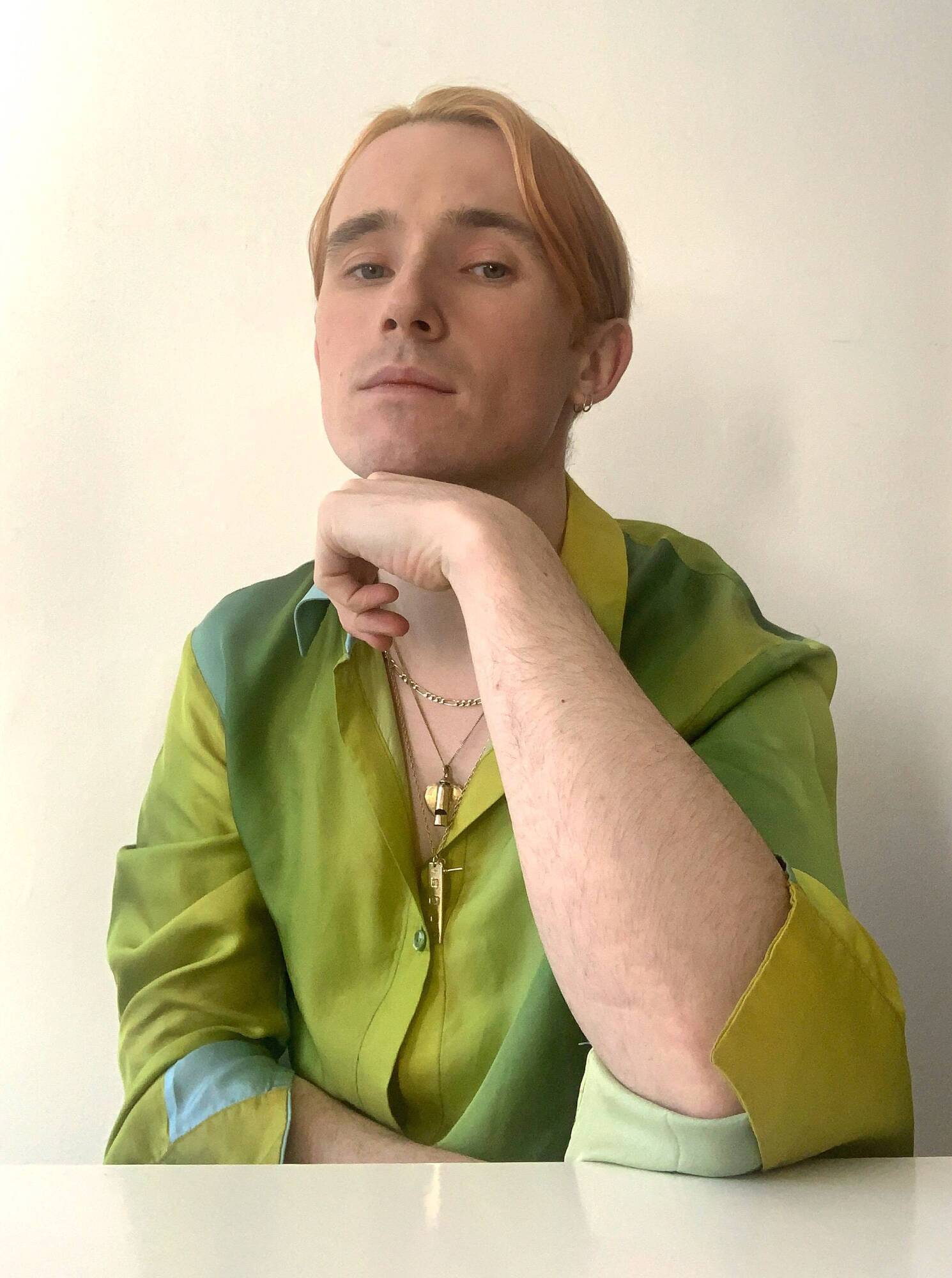
His clothes have been worn by some of the coolest women in fashion, from Tilda Swinton to Róisín Murphy, now the Irish designer is turning his attention to the world of art
Why Richard Malone is a man of many talents

'I don’t like putting what I do in boxes.'

"I don’t like putting what I do in boxes, which a lot of people find frustrating, but it’s why I like having this job,” says renowned Irish designer Richard Malone. “I get to do things that crossover.”

The Wexford native is known for his dramatic proportions, functional separates, heartfelt commitment to sustainability, and visceral shows at fashion week. He is used to working outside the box, having designed for and collaborated with the likes of Tilda Swinton, Róisín Murphy and Björk.

But his resistance against simple definition will be on full display again when ‘Making and Momentum: In Conversation With Eileen Gray’ opens at the National Museum in Dublin later this month.

The London-based Malone curated the exhibition as a cross-generational dialogue with the work of the namesake female artist, also from Wexford, with the project spanning sculpture, ceramics, wall-hangings, handwoven rugs, and more from other Irish artists including unseen work from Malone.

A deeply personal project (he grew up hearing about the trailblazing artist), he saw it as an opportunity to collate work inspired by and in conversation with one of his artistic heroes and fellow Wexford native. Gray, a pioneer of the modernist movement in architecture and furniture design, has long been an inspiration for Malone.

Richard Malone at E-1027, the site of the opening of Making and Momentum: Eileen Gray In Conversation.

One can expect the likes of Niamh O’Malley and her angular sculpture with sensual flourishes and the architecture and furniture by Gray. The space will be decorated with the sinuous lines of ceramicist Sara Flynn’s pots, rugs made by Mourne Textiles with hand-sewn details by Malone, and artworks from Mainie Jellet’s richly decorative archive.

The exhibition first showed in July at E-1027, Gray’s white, L-shaped villa nestled along the craggy coast of Roquebrune-Cap-Martin in the French Riviera. Originally built in the 1920s, the project marked the reopening of the house, after years in disrepair and undergoing a two-decade-long multi-million euro restoration.

Niamh O’Malley said, “the project appealed from the outset because of Richard’s evident attentiveness in his own work” and the interdisciplinary approach studying the “relationship between and shared concerns, of art, craft, and design” deeply engaged her.

To study the installation alongside the original furniture, as one could during the French installment of the project, is to witness a successful marriage between aesthetics and identities across artistic boundaries, resisting a monolithic interpretation and celebrating the rich history of Irish art and craftsmanship.

“There were a lot of people who wanted to be in the exhibition that make work that looks like Eileen Gray’s, but that’s not right - the point of occupying this space is that people have these individual languages that work together,” he said of the selection process.

An abstract creation made from recycled jersey, wadding, powder-coated steel, and cotton by Richard Malone at Making and Momentum: Eileen Gray In Conversation.

The next chapter of the exhibition will be in Wexford in 2022, where Gray’s work will be displayed locally for the first time. For Malone, this journey was imperative. Although Gray spent much of her life in France, she always said, “Ireland is a huge part of her identity”.

In addition to the exhibition, Malone is pursuing a series of online workshops and outreach projects with schools and community centres to suffuse the significance of skill-sharing.

“The culture of Ireland is in things like weaving, dyeing, coastal communities, and natural ways of farming. They’re experts, they need to be celebrated,” he said.

Malone, who first learned about Gray from his grandmother, Nellie, said he was attracted to her work not only for its visual merit but the symbolism of an internationally renowned queer designer and architect from the same place as him.

Far from a glamorous upbringing in cosy enclaves of west London like much of fashion’s elite, Malone hails from Enniscorthy, County Wexford. He moved to Ardcavan, just outside Wexford town, at an early age, where he lived with his family and grandmother.

Old trade

While many in fashion have come from tiny pockets across the globe and spent their formative years watching fashion television, Malone was far removed from high fashion growing up in working-class environments in Wexford. The extent of his knowledge at the time, he said, was John Rocha for Debenhams. 

It was through the pages of tabloids that he was first introduced to the imaginative worlds of Alexander McQueen and John Galliano for Christian Dior. In part, the attraction to fashion stemmed from his lineage of tradespeople: his father is a painter-decorator and signmaker, his uncles were builders, woodworkers and carpenters, and his late grandmother was a seamstress.

Having completed his Leaving Certificate at the tender age of 17, Malone pursued a foundation art course in Waterford that taught him about painting, casting, and dyeing. The next step was a sculpture course in Carmarthen, Wales, which ushered him to the realisation that studying fashion at Central Saint Martins would be the next logical step. In university in London, Malone excelled in both academics and the practical side of dressmaking. He was the recipient of the LVMH Grand Prix scholarship and the Deutsche Bank Award for Fashion.

Richard Malone by Pascal Gambarte.

In 2015, less than a year after graduating, Malone appeared for the first time on the London Fashion Week schedule as part of the Fashion East show. The emerging talent incubator programme has launched the careers of many vaunted names such as Kim Jones (the creative director at Dior Men and Fendi womenswear), Jonathan Anderson (of JW Anderson and Loewe renown), and Mowalola Ogunlesi (the design director for Yeezy x GAP).

Lulu Kennedy, fashion’s fairy godmother and the brainchild behind the initiative, first discovered Malone’s work at his graduate show. She was captivated by his “unique and special talents,” she told the Irish Examiner in 2019.

Despite his outsider status, Malone has scaled the fashion industry nimbly with his blend of soft-spoken demeanour and unwavering sense of sense, wicked sense of humour, and unbridled talent.

Misgivings

Throughout our call, Malone is unafraid to speak openly about the misgivings of the industry - from classist, uneducated members of the press to the danger of nostalgia, the institutions and prizes that dominate the industry. He is almost peerless in his ferociously independent spirit and his ability to interrogate the powers that be.

Does he find adopting this attitude a challenge?

“I don’t find it difficult because it’s not something I place value or time thinking about, it’s the way that I am. Building something that isn’t reliant on those things is important to me.”

However, it is not a philosophy rooted in negativity. Based on his candour, one gathers that Malone is keenly aware that “it’s fine to take a sponsorship or work with someone but you can still have an argument against them because nothing is perfect.” He concludes that action speaks louder than words and that a nuanced take produces a better outcome.

It is these qualities that have projected him to have the career that best fits him, one that does not rely on extravagant profit margins but slow, steady growth that satisfies his desire to create widely across disciplines and also responsibly.

Sculptures by Niamh O'Malley at 'Making and Momentum: Eileen Gray In Conversation.

Ida Petersson, the Buying Director at Browns Fashion in London, shared that despite launching Malone’s work on their website last October during the height of the pandemic when the retailer saw a decline in customers gravitating towards going-out styles, his recycled leather pieces were some of their top sellers, alongside his outerwear options which include jackets and trousers. 

Describing Malone’s work as intelligent, sculptural, avant-garde yet always functional, highlighting its sensitivity to the wearer, Petersson remarks that “Richard’s commitment to sustainability is incomparable, setting him apart from so many others. He is such a force in the conscious space, which is truly inspiring. Beyond using recycled materials and deadstock fabrics, Richard is also shifting the consumer perspective on buying and is focusing on made-to-order alongside his wholesale business.”

As a business, Malone doesn’t engage with the trappings of influencer marketing or gifting. The work is often purchased by a cohort of women in creative fields such as art and architecture, film and furniture, music and literature. Some of them include Björk, the singular Icelandic singer, and Rachel Thomas, the senior curator at the Irish Museum of Modern Art. Additionally, museums like the Museum of Modern Art (MoMA) in New York and the Design Museum in London have acquired pieces of his work for their respective permanent collections.

Richard Malone A/W 21.

The Irish designer, who counts four stockists (Browns, Farfetch, and Selfridges in London, and Joyce in Hong Kong), said “my clothes are difficult to sell in a shop. They’re not straightforward clothes because that’s not what I’m interested in.”

Instead, the dizzyingly creative, swirling architecture of a Richard Malone piece expresses the wearer’s desire to circumvent convention and stylishly navigate the staid conditions of contemporary luxury fashion with couture-like precision and sharp focus on tailoring and drapery.

From his days spent interning at university, Malone gathered that design teams at large luxury brands tend to invent a prototypical customer who might not necessarily exist.

“A lot of fashion is about making assumptions about women, men, or whomever, and what they’re going to buy but a lot of these people don’t exist. It’s like they’ve never asked that person what they wanted,” he said, adding that the prototypical luxury avatar is a “career-driven, self-made 50-year-old woman who has all the time in the world to shop.”

Where, he asks rhetorically, does she find the time?

For his part, he said, “we don’t make much of anything but I know there’s a handful of women that are interested in it who will buy the clothes. It’s not constant because people don’t buy clothes constantly.” According to Malone, his brand (a term he dislikes) has never produced more than 25 of anything.

Against the recommendation of fashion consultants who insist upon designers perfecting a single product that continually attracts the same customer, Malone withstands the temptation of creative complacency in favour of experimentation. Whether it comes in the form of an asymmetrically ruched dress or a high-shouldered blazer, he can delight the customer with something new rather than something they saw last season.

It is apparent in his recent autumn/winter 2021 collection which featured his signature deconstructed coats alongside meticulously tailored trousers with ties at the calf and detachable pannier-hip aprons; a belted dove-grey woollen coat riffing on medical uniforms; and, for the first time, crisp white structured shirts.

Richard Malone A/W 21.

The broad approach contrasts bold, exaggerated shoulders with nipped waists and coalesces tactility and colour in interesting ways. As much embedded in the clothes as it is the business, sustainability is the foremost principle for Malone. The designer takes an unprecedentedly honest approach sharing his credentials with the public.

Value

From organic, plant-derived dye to working with Econyl, regenerative nylon made from ocean waste to reworking deadstock and offcuts to rethink our perceived value of clothing, the practice of sustainability is identifiable with beautiful design as tenets of the Richard Malone business.

Over the last number of years, Malone has worked exclusively with weavers or mills that have regenerative initiatives like a regenerative farm in India that can sustain land that became barren from mass production. Moreover, on a human level, the dyers and weavers involved with the business are paid over four times the fair trade average, the tailors and cutters in London receive £25 an hour, minimum. 

Of course, Malone has the luxury as a small label to move agilely and share his innovations with the world. But beyond that, he desires to build a better future by keeping people informed. “It’s our job to clean up a bit of the mess that is the industry.”

In between launching the Gray exhibition in Ireland, Malone will put on his first catwalk show in over a year at London Fashion Week in September after three seasons of releasing fashion films in addition to working on a wide variety of projects such as furniture design and a collaboration with a heritage brand to be released later this year. 

Despite his discombobulating schedule, he remains resolute in his philosophy: “Everything I do ties into coming from a low-income family and understanding that people work to deliver a good product for people. For something to be sustainable or worthwhile, you need to give yourself a license to make these things because someone somewhere might see it and think ‘I can do that too.’”

  • Making and Momentum: In Conversation with Eileen Gray, September 4, 2021, at the National Museum of Ireland.

x

More in this section

Lifestyle

Newsletter

The best food, health, entertainment and lifestyle content from the Irish Examiner, direct to your inbox.

Cookie Policy Privacy Policy Brand Safety FAQ Help Contact Us Terms and Conditions

© Examiner Echo Group Limited