The rise and rise of Irish designer Richard Malone
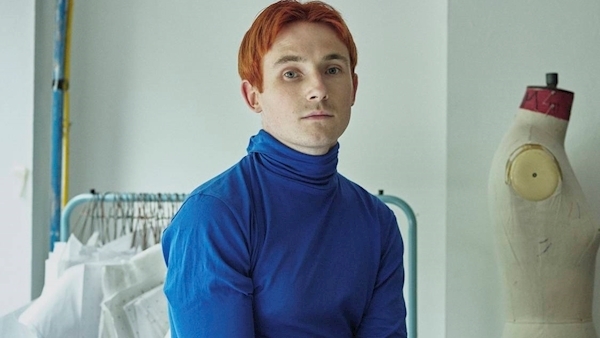
Richard Malone is outspoken about the issues in the fashion industry. From sustainability to politics to prejudice, he talks candidly with .
At the end of a fashion show, designers typically appear briefly for a photo and to receive the rapturous applause of well-wishers. Not Richard Malone.
At his London Fashion Week shows, the Wexford-born designer appears in a blink-and-you’ll-miss-him lightning bolt, retreating into the backstage area as quickly as he left it. But backstage, Malone doesn’t hold back. Similarly, in interviews, Malone doesn’t shy away from conversation.
Reticent he is not but the focus is on his work.
Malone is from a working-class background, something he counts as formative in his experience as a designer. He’s the second person in his family to go through third level education.
He didn’t receive grants when he studied fashion design at London’s prestigious Central Saint Martins — where he graduated from the BA Womenswear in 2014 — he took out a student loan.

“That environment shaped me,” he said.
“Everyone in fashion is from middle or upper-class backgrounds so my situation is quite unique. It’s important for me to retain that outsider perspective. I feel quite lucky to be from where I am because of that because it’s taught me a lot.”
Malone first showed at London Fashion Week in February 2015. He presented in an off-schedule happening in a small retail space at Old Street Underground Station.
From his first collection to now, the focus has remained the same. He designs magical clothes, at first, swirling architectural creations that can be moulded to the wearer’s desire. Now, he fashions measured and artful approaches to tailoring, distinctly his own, with soft shoulders, rounded cocoon-like sleeves, and nipped waist.
The idea behind his work is to present an alternative to normcore but also keeping with an effortless pragmatism. Everything comes with pockets. Everything is machine-washable.
He credits his working-class background for this perfunctory approach to fashion.
“I’ve seen people appropriate working-class culture in high fashion which isn’t right and what I hope to do is elevate that into something that is beautifully evolved but also respecting where it came from,” he said.
It wasn’t long before he caught the eye of Lulu Kennedy, the maven behind Fashion East, a designer incubator programme that provides support and mentorship for emerging talents, and a chance to show at London Fashion Week.

“We saw Richie’s unique and special talents from the very beginning. He greatly admires women and it’s evident in his work; his collections are intelligent, considered and make you feel empowered,” Lulu Kennedy told the Irish Examiner.
With credit to Kennedy, Malone made his official London Fashion Week debut in February 2016.
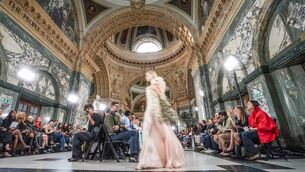
For autumn/winter 2019, presented in London in February, Malone evoked the spirit of bad taste in the environs of a birthday party.
The colour palette was inspired by the tonal browns of ‘bad, mum lipstick’, while the patterns resembled paper plates and bunting. As ever, a rebellious spirit ran throughout, with mad hairstyles and faux-fur stoles made from recycled dog beds.
Malone counts architect Farshid Moussavi among his fans. She said: “I came across images of Richard’s graduation show two years ago and fell in love with a quilted tartan dress and jacket. I contacted him and asked if he’d remake them for me and he did and we have remained in touch since.”
It is not only prominent public figures that have lent themselves to Malone’s work.

“The women that inspire me aren’t always women who even wear my clothes and who are in the fashion industry. I have a great relationship with my grandmother. Growing up I was surrounded by my mother, her sisters — I had mainly female role models.”
Malone is practical, acutely aware of the value of knowledge through experience rather than speaking freely but unnecessarily on subjects he’s not familiar with.
In our conversation, from feminism to sustainability, the subjects Malone touches upon is rooted in a lived experience. He doesn’t shy away from openly referencing certain fashion houses because he dislikes the smoke and mirrors of fashion.
“I never agreed with those things,” he says.
Malone was one of the most vocal proponents during the Repeal the 8th campaign.
“We approached newspapers with the open letter I wrote [advocating for a Repeal vote] and many weren’t necessarily keen on publishing a male perspective. But I said it was about equality and equality is about both sexes.”
British Vogue eventually published the letter.
Despite being in one of the most fickle industries in the world, he exhibits a proud morality in his approach.

“I have always been a believer of: ‘Speak up if you have something to say.’ For me, actions always speak louder than words. It’s so easy nowadays to become an Instagram activist but it’s not good enough.”
In April 2018, Selfridge’s offered Malone a window space in which to hold an installation. Malone transformed the space to spotlight the Repeal the 8th movement. The retailer put a stop to proceedings, stating: “Selfridge’s is a politically neutral space for everyone,”
Malone said: “To be honest, it severed my relationship with them but it was worth it because it’s more important to have a voice than a store’s endorsement of your clothes.”
He laments the current state of the fashion industry, the problems created by luxury fashion houses, mass-production, and over-consumption.
During his second year at Central Saint Martins, he was offered an internship at Louis Vuitton, he moved to Paris.
“It gave me a deeper understanding as to how much waste is involved in luxury fashion houses. I watched them making things that wouldn’t be sold but were made for the smoke-and-mirrors of fashion.
It appalled me and when I went back to college I was surprised that none of my classmates knew that this was going on.”
Malone would have to concede to producing new clothes, it’s intrinsic to his craft and he produces two collections per year, but he does make allowances elsewhere. He is one of the many designers tackling fashion’s negative influence on the environment.
He experiments with using recycled ocean waste as fabric, including recycling bottles to make beautiful woven fabrics. He developed technical jerseys using recycled and regenerated fishing nets which cause pollution in our oceans.
Moreover, he works with econyl, a regenerative nylon composition that can be continually reused and repurposed. Several of Malone’s fabrics are produced in a factory in Tamil Nadu, Southern India, where a community of women dye all the yarn, spin, and hand-weave the fabric.
The business supports the skillset of the local women by reinvesting profit in housing and education.
He said: “It amazes me how young designers aren’t committing to sustainability. You can’t be a modern or contemporary designer if you are not sustainable.”
On the subject of Irish design, Malone is critical.
There needs to be a new narrative in Irish design. I’m sick of seeing — if you’re from a working-class background you have to create workwear and puffer jackets; if you make menswear you make workwear; if you make womenswear you make these big fluffy things.
He continues, drawing on what he saw when he tutored at Irish colleges.
“There has never been ‘the best tailor from Ireland’, we’ve never had that. Some designers are too invested in old-fashioned ideas of Irishness but it’s not just about being Irish, it’s about finding a language and pushing it forward, applying what you know and making something exceptional.”
He’s right — Irish designers lack authority when it comes to having a design handwriting. Few come close, the wunderkinds Simone Rocha and Jonathan Anderson are exceptions to the rule. Malone, too, should consider himself integral to the conversation for his case studies in elevating working-class dress codes.
His own design handwriting stretches further than the medium of fashion. In 2017, he was commissioned by the Museum of Modern Art in New York to create a piece for their exhibition, ‘Items: Is Fashion Modern?’ their first fashion acquisitions since Issey Miyake in 1967.
The National Gallery of Victoria, Australia, has purchased a catwalk look for their permanent collection.
Last year, Malone curated his own exhibition at the NOW Gallery in London, ‘Rinse, Repeat’, inviting viewers to glimpse inside his creative process. Later this year, he’ll be featured in an exhibition at the Irish Museum of Modern Art.
“The joy is not creating products. I’d much rather have some pieces in permanent collections in places like MoMA. I don’t want to sell hundreds of thousands of products. I want to design and if one day I decide I want to do sculpture, I’ll do that. I’ve never seen myself as a brand. Fashion design is how I find myself expressing myself now.”
CONNECT WITH US TODAY



Be the first to know the latest news and updates