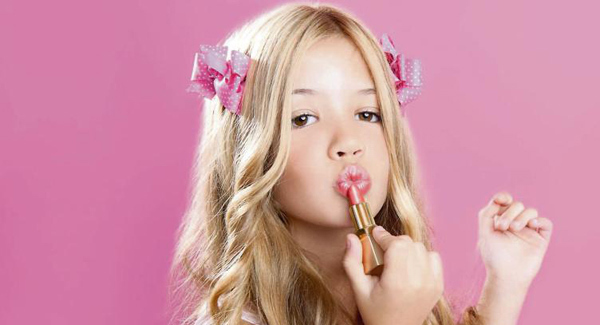
Is aiming toys and clothes at specific genders harmless?
Not so, according to Kardashian, who has said that North “likes to keep it pretty simple”. “She’s not that girly”, Kim told Lucky magazine. “She doesn’t like pink or purple.”
Yet, according to apocryphal wisdom, all girls love pink. In 2007, a colour experiment conducted by neuroscientists at Newcastle University seemed to corroborate this belief when the study found that women tended to prefer colours on the red-purple spectrum, while men preferred blue-green.
The authors of the study speculated that women could have evolved in such a way because they needed to spot ripe berries and fruit in the traditional female role of the ‘gatherer’, or to recognise ill-health in a child due to a feverish complexion.
A paper published in the British Journal of Developmental Psychology in 2011 came to a similar conclusion, saying that their research demonstrated that “young girls go indeed have a special affinity for the colour pink”.
However, they were quick to add, this only appeared in the second half of their second year, when children begin to understand whether they are a boy or a girl and become “gender detectives”, “looking for ways to conform to the appropriate stereotype”.
It wasn’t always this way. Jo B. Paoletti, the author of Pink and Blue: Telling the Girls from the Boys in America, says it wasn’t until after the First World War that gender-specific clothing began to gain popularity, and even then it wasn’t as straightforward as one might assume.
An article in a trade publication called Earnshaw’s Infant’s Department published in June 1918 said: “The generally accepted rule is pink for the boys, and blue for the girls.
The reason is that pink, being a more decided and stronger colour is more suitable for the boy, while blue, which is more delicate and dainty, is prettier for the girl.”
This still held true in 1927 when Time magazine printed a chart showing which colours were more suitable for boys and girls according to some of the most popular clothing stores in the US.
Filene’s of Boston told parents that pink was preferable for boys, as did Marshall Field in Chicago, Best & Co in New York, and Halle’s in Cleveland.
The coding of colour according to sex as we know it today, wasn’t established until the 1940s, and quickly fell out of favour in the 60s and 70s, when researchers of sexual identity began to argue that gender was less a biological fact than something that was learned through social cues.
The feminist movement was also taking hold.“One of the ways [feminists] thought that girls were lured into subservient roles as women is through clothing,” Paoletti says. “If we dress our girls more like boys and less like frilly little girls... they are going to have more options and feel freer to be active.”
While researching her book, Paoletti found that, in the 1970s, the Sears Roebuck catalogue had no pink toddler clothing, for two years, and gender neutral clothing remained popular until the mid-1980s.
Big corporations were spending more money on marketing and advertising, and began to understand that the more they ‘individualised’ merchandise, the more goods they could sell.
Nappies were produced in pink and blue, and, as Jeanne Maglaty writes in Smithsonian magazine: “The pink fad spread from sleepers and crib sheets to big-ticket items such as strollers, car seats and riding toys. Affluent parents could conceivably decorate for baby No. 1, a girl, and start all over when the next child was a boy.”
Then, in 1989 The Little Mermaid was released, the first ‘Princess Movie’ made by Disney since Sleeping Beauty in 1959. Coupled with increased television advertising and a growing consumerism among young children, a worldwide phenomenon was born.
In her book, Princess Recovery: A How-To Guide to Raising Strong, Empowered Girls Who Can Create Their Own Happily Ever Afters, Jennifer L Hardstein calls this the ‘Princess Syndrome’.
She argues that girls are internalising the message that “their worth is based on is how they look and the things that they have” and that this conditioning has “ a huge impact on a girl’s self-confidence and make it hard for children to understand as they grow up, that intelligence, generosity and passion are more important values”.
Becky Francis, author of a study examining the social messages of toys entitled Gender, Toys and Learning, has expressed her own fears, saying “I worry the toys children are given in early years are already helping shape their futures”, while the communications manager for the Independent Association of Prep Schools in the UK, Hannah Webster, wrote an op-ed in Attain magazine where she outlined her belief that encouraging the belief that only girls wear pink could actually be harmful.
“If we designate a particular colour to a gender, it leads us to designate all manner of other things by gender too,” she said. “The result is girls and boys read different kinds of books, play with different kinds of toys, study different subjects, consider different occupations, have different roles within the workplace and family and are ultimately valued differently by society,” she said.
“What is pernicious about this is that everyone is then attributed roles and characteristics regardless of their individual identities and talents. And this then occurs before a child is even born.”
This could explain our continuing problem with “horizontal gender segregation” in employment, with men still more likely than women to be employed in the technology sector, in science, in maths, and in engineering.
This doesn’t seem that surprising when one remembers the Teen Talk Barbie doll in the 1990s who sprouted such gems as “Math is hard”, “Pink is my favourite colour”, and “Wanna go shopping?”; (parodied to great effect in the Malibu Stacey episode of The Simpson’s), or the recent controversy around the I Can Be A Computer Engineer Barbie book in which Barbie, who is supposed to be coding a computer game, says: “I’m only creating the design ideas… I’ll need Steven and Brian’s help to turn it into a real game!”
The response to I Can Be A Computer Engineer was irate and instantaneous, prompting Mattel to apologise and withdraw the book.This reaction is encouraging — showing a greater awareness of the dangers of gender stereotyping.
Campaign groups such as Let Toys be Toys and Pinkstinks have been pushing the anti-genderissation of toys agenda for a number of years now, and thanks to the work of the Let Books be Books campaign, Ladybird has confirmed it will no longer publish any books specifically targeted at either sex.
Emma Moore, the co-creator of Pinkstinks, has received abuse for her work, and is regularly accused of being a “right-wing kill-joy”, but is very clear that she doesn’t want to ban girls from dressing up as princesses — or object if they have a preference for pink.
She just wants the social conditioning from the moment of birth to stop, and for boys and girls to feel free to choose whatever colour they like to wear and whatever toys they want to play with — without fear of reprimand for failing to conform to gender expectations.
Recently a letter that is said to have been included in a 1974 box of Lego was posted online. Although the authenticity of the note has not been confirmed, there can be no doubting the relevance of the message contained.
“To Parents: The urge to create is equally strong in all children. Boys and girls. It’s the imagination that counts. Not skill. You build whatever comes into your head, the way you want it. A bed or a truck. A dolls house or a spaceship.
“A lot of boys like dolls houses. They’re more human than spaceships. A lot of girls prefer spaceships. They’re more exciting than dolls houses.The most important thing is to put the right material in their hands and let them create whatever appeals to them.”