Kaye Donachie: British artist brings her dreamlike work to Lismore Castle
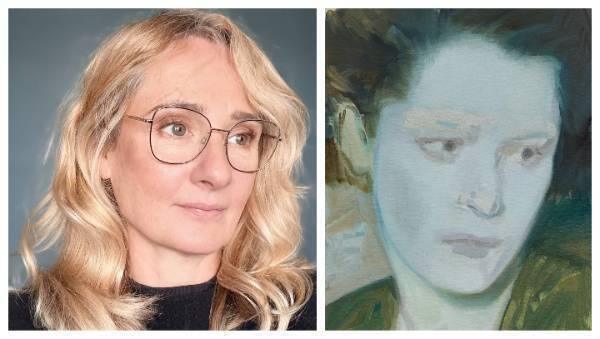
Kaye Donachie, and one of her pieces at the Salon exhibition at Lismore Castle Arts. Picture of work: Kaye Donachie, Courtesy Maureen Paley, London
The British artist Kaye Donachie is best known for her dreamlike, atmospheric paintings. She is one of the 42 artists whose work is currently on display at Salon, an exhibition curated by Matthew Higgs, at Lismore Castle Arts in Co Waterford.
Donachie is no stranger to the venue, which hosted her solo exhibition, Into the Thousand Mirrors, in 2021. “It was wonderful to return and see my work within the context of Salon,” she says. “I've always been interested in how paintings behave in relation to one another rather than as isolated objects. They create conversations that you couldn't predict in the studio.”
Donachie was born in Glasgow and grew up in Lowestoft in East Suffolk. She studied Fine Art at the University of Central England in Birmingham before moving to London to complete an MA in Painting at the Royal College of Art in 1997. She has lived there ever since, working from a space at Studio Voltaire in Clapham.
“It's a lively community of artists,” she says. “My own studio is quiet and self-contained. I’m surrounded by books, photographs, drawings and paintings in progress.”
Donachie’s work is largely driven by research. “I collect material from literature, poetry, biographies, films and archival photographs, then work through those sources in drawings and monoprints.
"When I make a painting, it becomes less about describing an historical figure than about creating an emotional space where different histories, memories and imagined narratives can co-exist.”
Her influences are wide ranging, and include writers and performers as well as visual artists. “The people who draw me back again and again are often women: Virginia Woolf, Emily Dickinson, Mina Loy, Claude Cahun, Maria Lani, Lee Miller, Corinne Michael West and Iris Tree.
"What interests me is not simply their biographies, but the way they consciously shaped their own identities and creative lives. They become points of departure rather than subjects to represent.
“But painters such as Henri Matisse, Édouard Manet and Gabriele Munter have been enduring influences too, particularly in their sensitivity to colour, touch and the psychological possibilities of space.”

Donachie is almost exclusively a figurative artist. “Figuration gives me a familiar language that I can then move beyond,” she says.
“The figural becomes a kind of armature, a way of thinking about emotion, memory and presence. I’m not interested in portraiture as documentation. Through painting, the figure gradually becomes something more open — a place where biography, imagination and feeling can meet.”
Her subjects are often “composites assembled from different biographies, archival photographs, literary references and remembered images,” she says. “They're rarely portraits of one person. I'm interested in women whose lives demonstrate a strong sense of artistic or intellectual independence.
"But once they enter the painting, they become something else. They're no longer historical portraits so much as protagonists — figures that carry traces of different people and different times. I want the paintings to remain open, to shift and unfold over time.”
Donachie returns often to the written word. “Literature has always been key to the way I think about painting, and vice versa. Writing offers another way of thinking about painting.
"A sentence, like a brushstroke, can evoke an entire emotional world without fully explaining it, while a poem can hold an extraordinary emotional intensity within a very condensed form. Many of my exhibition and painting titles come from poetry. Once those words are lifted from their original context, they begin to function almost like paintings themselves — suggestive, fragmentary and open to reading.”
Donachie’s paintings tend to be modest in size. “The scale is really about intimacy,” she says.
“I like paintings that ask you to come closer and spend time with them. They don't reveal themselves immediately, they unfold slowly. Scale doesn't determine emotional intensity. A small painting can hold just as much presence as a much larger one if every brushmark carries its own weight.
"I tend to work quickly, trying to complete a painting in a day. I then make changes or discard those that don’t work, or those that don’t have a particular quality or intensity.”
Donachie once described her aim as an artist as being to produce paintings that each feel as if “it's been made in one breath, and has a lightness to it". Is that still her intention?
“Yes, absolutely,” she says. “A painting often develops over quite a long period. I want it to retain a sense of effortlessness, as though it has arrived almost naturally.
"That lightness isn't about speed, but about distillation — removing anything unnecessary until the painting feels balanced and inevitable. I'm always trying to hold onto that freshness, so that the final painting still carries the energy and immediacy of its earliest marks.”
- Salon runs at Lismore Castle Arts, Co Waterford until October 25. Further information: lismorecastlearts.ie