Claire Halpin: A collage of European history at Glucksman gallery in UCC
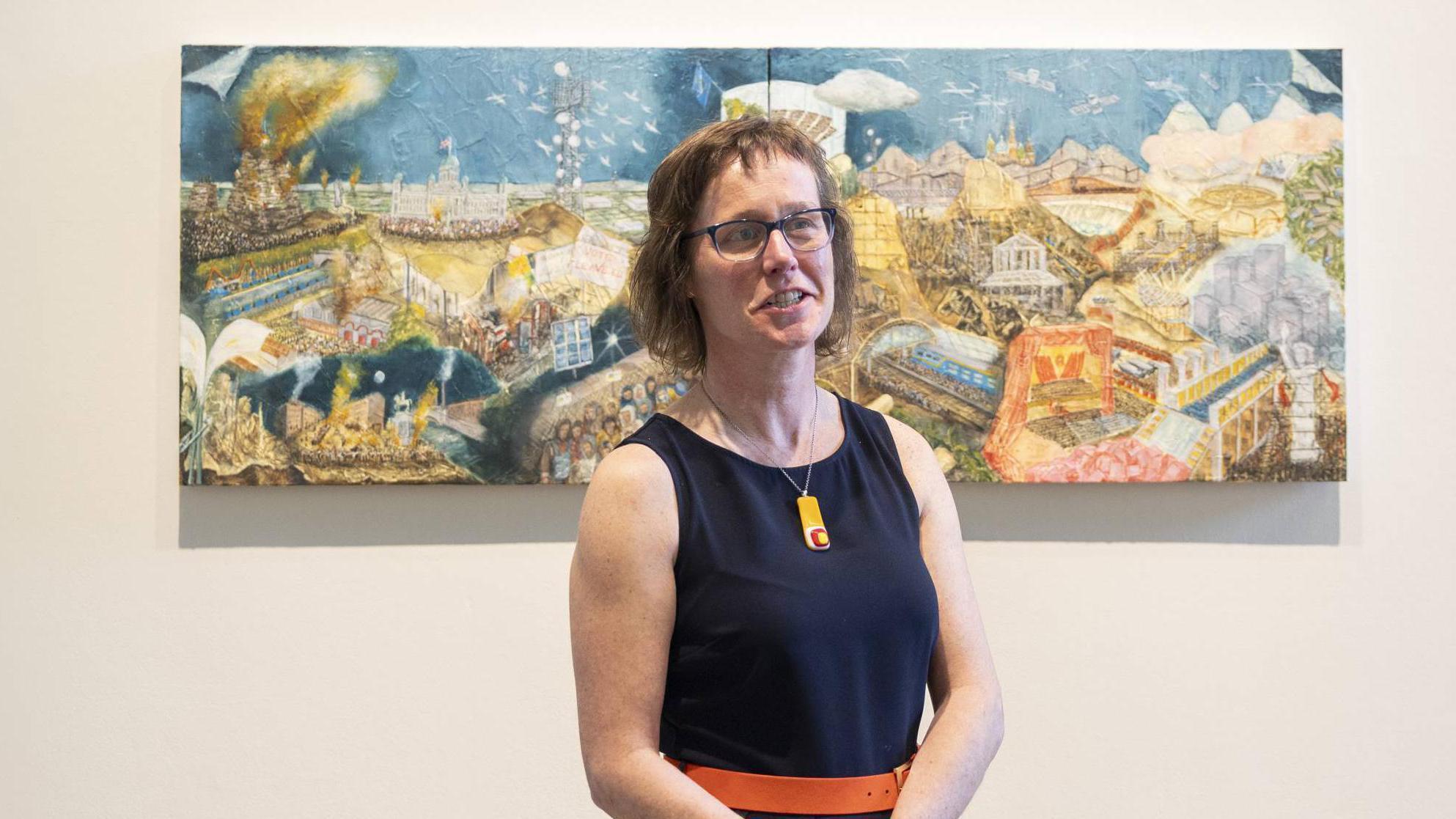
Claire Halpin at the Panorama Europa exhibition in West Cork. Picture: Clare Keogh
Claire Halpin is delighted to have had the opportunity to revisit her painting .
The artwork is the centrepiece of an exhibition of the same name that has just opened at the Glucksman Gallery at UCC, featuring tapestries, paintings, sculptures and drawings by a band of contemporary Irish artists that includes Rachel Fallon, Isabel Nolan and Michael Canning.
The Glucksman, in partnership with UCC’s Jean Monnet Centre of Excellence for EU Integration & Citizens’ Rights, commissioned in 2024, and Halpin had barely finished the painting before its unveiling at UCC in October that year.
“It’s wonderful to see it again,” she says. “To see how it sits alongside all these great artists whose work I deeply admire, and also to see the overlap in how we reference art history.
"I think it's a beautifully curated exhibition. Fiona Kearney and Katie O'Grady have woven together a lot of very dense artworks, while giving them the space for people to engage and make their own connections.”
Halpin’s brief for — to represent geographic, historic and cultural relationships across Europe — was challenging, to say the least, and from the start she was eager to involve others in her research.
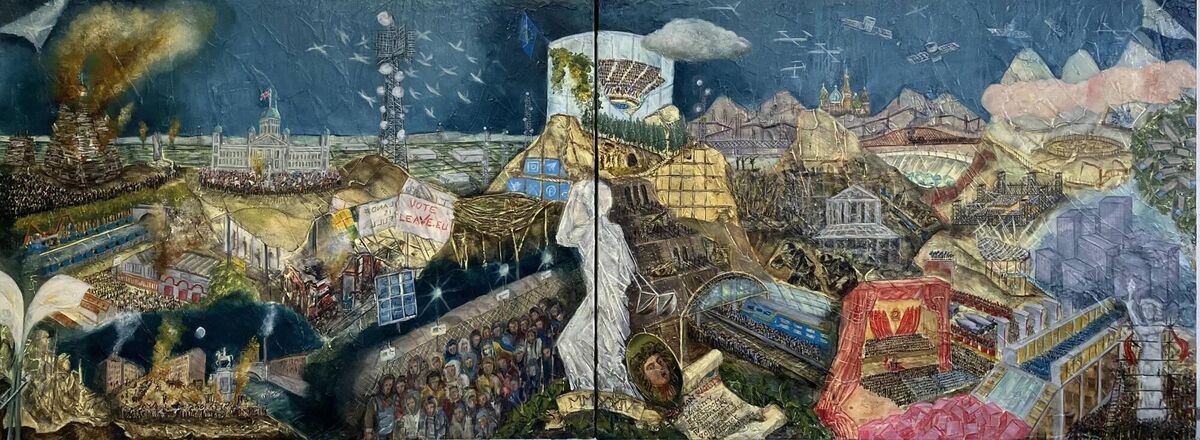
“We ran two public workshops, where we posed questions that were specifically related to human rights within Europe,” she says. “There was, for instance, that idea of Ukraine being a country that was accessing the European Union while Northern Ireland was leaving, and that in itself brought up complex questions.
“We did collage exercises, taking visuals from different magazines, such as , which I tend to use a lot as a source of imagery. I pieced together the material generated in the workshops with my own art historical imagery when I began work on the painting.”
Halpin worked on full time over six months in the summer and autumn of 2024, composing an ambitious narrative of war, public protest and totalitarian gatherings across two large canvas panels.
“The diptych is a format I've used before,” she says. “It allows me to view the painting as these open pages in a book, almost. You'll notice in the painting, the way the composition goes, it's like a concertina. There’s that idea of what is concealed in the folds, and what is revealed.
“How do we read history? takes a lot from the compositional devices of Renaissance paintings, where everything happens in the same space and time.”
Halpin is a native of Dublin. She studied art at Dublin Institute of Technology from 1992 to 1996 before completing a Masters in Art and Design in Aberdeen, Scotland in 1998. Today, she still lives in Dublin, in the north-east inner city, and works out of Talbot Studios on Talbot St.
Painting is her first love, but teaching, she says, is her bread and butter. “I work in a lot of different schools. This morning, for instance, I'm bringing a group of fourth class students from Central Model Senior National School to the Lab Gallery.
“Every second week since September, we’ve either gone to see an exhibition or we’ve looked at artworks in the classroom. Last week, because the weather was so good, we walked up and down O'Connell Street and looked at its history through public art.
"It's very much about connecting the students with their city, connecting them with their area, but also for them having what I would call a cultural citizenship, so they're aware of art spaces in the city and feel a sense of belonging to those.”
Halpin also works with older people living with dementia. “I do that through the Highlanes Gallery in Drogheda,” she says.
“I'm very interested in that idea of how a group, looking at an artwork together, can have conversations and make connections to each other. But I’m also interested in looking at art and seeing how it can provoke questions and conversations.”
Now that Halpin’s teaching is more or less finished for the summer, “I'm really looking forward to spending a focused period of time in the studio.
"When I was working on , there was literally a straight run-through, that was the only piece I was working on. I love that level of concentration.
“At the moment, I’m working on a new series for a solo exhibition coming up in the Hillsboro Fine Arts Gallery in Dublin. I’ve got these wooden tea chests and folded them out so they look like altarpieces.
"I like that idea of the form of the artworks and the content and the themes to be closely worked together.
"I’m looking at the colonial history and colonial ecology, and the idea of plantations, but also the idea of trade and colonisation and empire. So, very big themes once again.”
Halpin has also begun work on another large painting, looking at the conflict in Palestine.
“Similar to the piece at the Glucksman,” she says, “it'll take scenes from different sources, maps, history, cartography, Bible stories, Ladybird books, and then weave them together.
"When you're doing paintings like this, they're never really finished, of course, because history is constantly unfolding.”
- runs at the Glucksman until November 1. glucksman.org