Tom Dunne: There goes that genius Paul Simon, one of the greats of our time

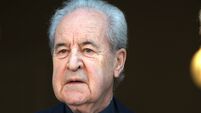
Paul Simon pictured in 1986. Picture: Bertrand Guay/UPI/AFP

“Don’t serve him”, barmen used to say and point at me. If the earth could have swallowed me, I’d have taken it. To be singled out in front of your mates was hell. Being 17 but looking 14 was no joke if your friends wanted a few pints.
Things were different then. There was no such thing as an ID, fake or otherwise. It was all down to the barman. He had discretion, he had power; so, your mate — who was 16 but had been shaving since he was five — was grand. He could drink until he fell over. But not you.
Into this mortifying universe came ‘vodka and lime’. A friend with facial hair would buy it for you, and the barman would — kindly — choose to believe it was a mineral. This allowed you to stay, but not just that: It identified you — to those who knew — as a music fan of some taste.
“Drinking my vodka and lime” was a line from Paul Simon’s
“Look around, leaves are brown, and the sky is a hazy shade of winter”, you might add after three of them. “Hang onto your hopes, my friend” was always a good way to end the night. Girls thought you knew things.
And you did. You knew was a seminal album. If The Beatles gave us modern pop, Dylan the modern singer-songwriter era, The Beach Boys a kind of bruised genius, and the Velvet Underground indie music, then Paul Simon gave us the kind of intellectual music now espoused by The National and their ilk.
But it was even better than that. Not dissing The National, but there is no version of reality in which they top the charts with a song that everybody knows. Paul Simon did, and did so time after time, capturing moments in the “most optimist decade ever” with a coolly observant writer’s eye.
If he had only written in the Mike Nichols’ 1967 film he’d probably still be remembered anyway. It was perfect. The entire 1960s — the coming of age, the sex, the wide-eyed wonder — all captured in one film poster, one screenshot, one song. Mrs Robinson’s frail humanity in the eye of the ’60s storm.
Looking back at this, it's hard to credit how music that was ‘the soundtrack to the ’60s counterculture’ could also be so highbrow.
These are not ‘kiss me quick’ songs. And if the 1960s ones were good, the 1970s ones — — were simply sublime.
But it’s for me. An album up there with , , or any of those seminal recordings that seem to only get better with age.
A concept album that explores life’s journey from childhood to old age.
It has a lot to recommend it. It was Art Garfunkel who recorded the voices of old people at the United Home for Aged Hebrews in New Rochelle. Their voices add an incredible poignancy. You sense their lost agency among tracks that are dripping with youth, vision, and hopes for the future.
But it’s Simon’s songs — — that bring it all to such vivid life.
Prior to making its director, Mike Nichols, had become obsessed with them, listening to their music before and after filming.
Eventually, he asked the record company boss Clive Davis if they’d write songs for the film. They wrote two he wasn’t wild about, a third, which he pressed them to finish, became .
was released only 10 months after As the record company paid all recording costs — a folk duo could surely not be expensive — they decided to bring in viola and brass. Like Brian Wilson and Paul and John, they too became obsessed with “the studio as an instrument”.
is It doesn’t have gear changes that made The Beatles' track so revolutionary, but its lyric captures that same “I read the news today, oh boy” wistfulness.
The idea of going “to look for America” captures that dream like no other writer has before or since.
You’d suspect that this tour and Dublin gig — he is 84 — really are the last. He deserves to be remembered among Wilson, Dylan, McCartney and Lennon. Rhymin’ Simon, stone cold genius.