Book review: Erudite, witty, and illuminating read from one of Ireland’s great thinkers

In his introduction to this collection, Liam Hannaway notes that 'Talking Heads' is a 'bracing read, as one would expect from a poet who is always pushing boundaries'
Book review: Erudite, witty, and illuminating read from one of Ireland’s great thinkers

Paul Muldoon was born in Armagh in 1951. He has published over 30 collections and was formerly poetry editor of ‘The New Yorker’.

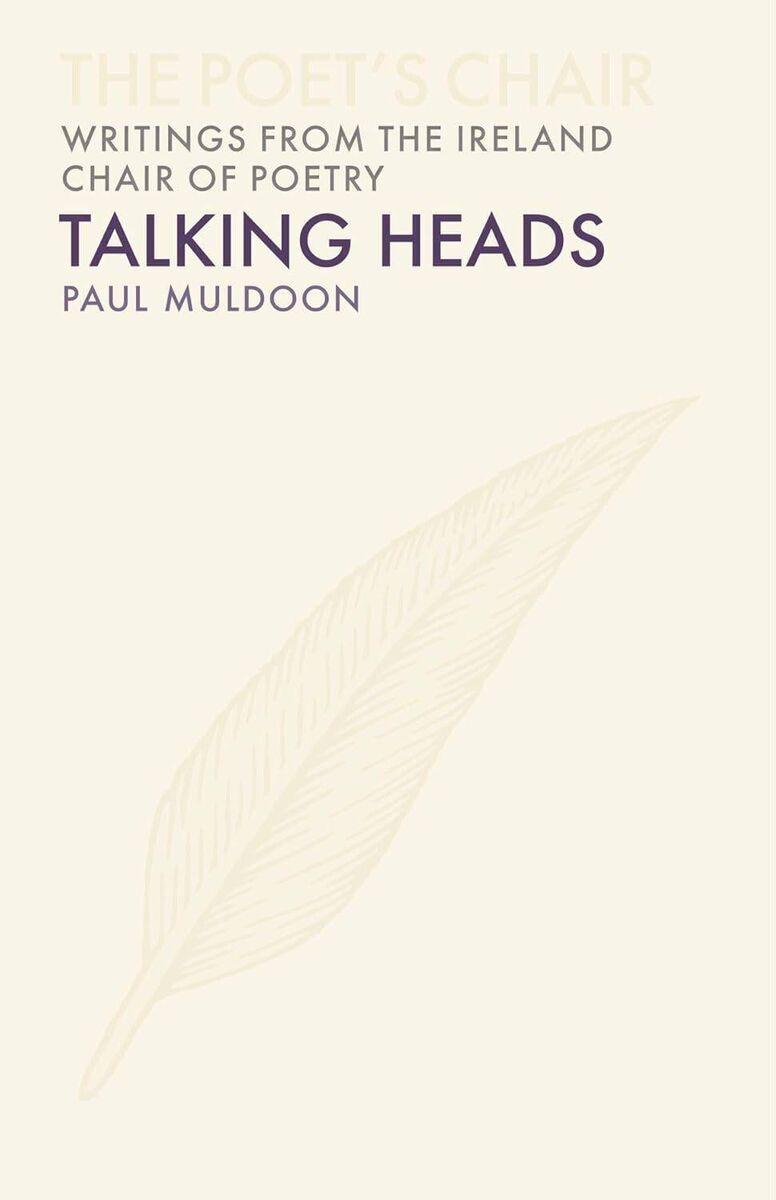
  • Talking Heads 
  • Paul Muldoon 
  • UCD Press, €16.00

Talking Heads comprises the transcripts of three fascinating lectures by one of Ireland’s most lauded poets, Paul Muldoon.

These lectures were given by Muldoon at Queen’s University Belfast, Trinity College Dublin, and University College Dublin in his role as Ireland Chair of Poetry, a position established in 1998 following the awarding of the Nobel Prize in Literature to Seamus Heaney.
As with his poetry, Muldoon undoubtedly makes demands of his readers, general and scholarly. His writing is erudite, witty, and illuminating, as well as surprising, allusive, and digressive. 

As readers of these lectures will almost immediately realise, Muldoon’s extraordinary ability to mine the cultural, historical, and linguistic links between medieval and modern texts, and between popular and high culture, is most probably unmatched in contemporary Irish letters.

In his introduction to the collection, Liam Hannaway notes that Talking Heads is a “bracing read, as one would expect from a poet who is always pushing boundaries”. 

This includes pushing the boundaries of the lecture form itself; reading Muldoon’s published lectures is like following a series of mesmerising, twisting smoke rings rising from a rapidly puffed pipe.

The first lecture here, the eponymously titled Talking Heads, begins with an allusion to the 1980s New Wave band of the same name before immediately segueing into a discussion about Muldoon’s time as a radio producer with RTÉ at the time of loyalist killings in 1974. 

This is follow quickly by a discussion of French philosopher Julia Kristeva’s 2011 book, The Severed Head, in which she ruminates on the Celt’s practice of taking enemy skulls.

These rapid shifts between temporalities, geographies, and cultures is key to Muldoon’s method. As with all the essays in the collection, there are no introductory remarks to guide the reader.

One must jettison notions of linearity and instead pay close attention to the accretions of core imagery, in this case heads, and in particular, silenced heads: Censored paramilitaries, dead victims of loyalist violence, decapitations from medieval Ireland to Hollywood films, tally sticks to prevent the speaking of Irish in the 19th century, Beckett’s disembodied voices, Oliver Plunkett’s martyred, exhibited head. 

Throughout, Muldoon weaves in close readings of poetry by, among others, John Montague (the first Ireland Chair of Poetry), William Carlos Williams, Gary Synder, and AR Ammons.

Textual and linguistic connections are central to Talking Heads.

Make Like a Bird, delivered in Trinity in 2024, for example, explores the semiotics of birds in Irish writing, though not exclusively, for Muldoon’s thought draws from the global wellspring of literature. 

This cultural capaciousness releases Irish writing from any narrow confines and situates it within the largest possible contexts. 

The lecture, and we are greatly simplifying here, takes us on an epic journey of avian references from the medieval Ulster Cycle to The Dead by James Joyce, taking in along the way the Classics (including classical scholarship in Trinity), the teaching of Latin in Irish hedge schools, and medieval English romance. 

Throughout, Muldoon retains both characteristic humour and serious engagement with the Irish poetic tradition in both languages, including Eiléan Ní Chuilleanáin, another predecessor in the Ireland Chair of Poetry role.

What does it all amount to and is it worth the effort? Muldoon may provide the answers. 

Referring to criticism that AR Ammons’ poetry had a tendency to jump “unexpectedly from one image or idea to another”, Muldoon suggests “this disjointedness may be its strength”, since as David Kirby said, poetry “is less subject than fiction to a demand for clarity”. 

Elsewhere, Muldoon quotes TS Eliot in reference to Michael Longley: poetry compounds the “continuous parallel between contemporaneity and antiquity”.

x

BOOKS & MORE

Check out our Books Hub where you will find the latest news, reviews, features, opinions and analysis on all things books from the Irish Examiner's team of specialist writers, columnists and contributors.


More in this section

Scene & Heard

Newsletter

Music, film art, culture, books and more from Munster and beyond.......curated weekly by the Irish Examiner Arts Editor.

Cookie Policy Privacy Policy Brand Safety FAQ Help Contact Us Terms and Conditions

© Examiner Echo Group Limited