Cork International Film Festival 'is constantly innovating' says director Fiona Clark
Ee mark 69 years of the Cork International Film Festival. As organisers look to a milestone anniversary next year, Noel Baker meets director Fiona Clark
Cork International Film Festival 'is constantly innovating' says director Fiona Clark

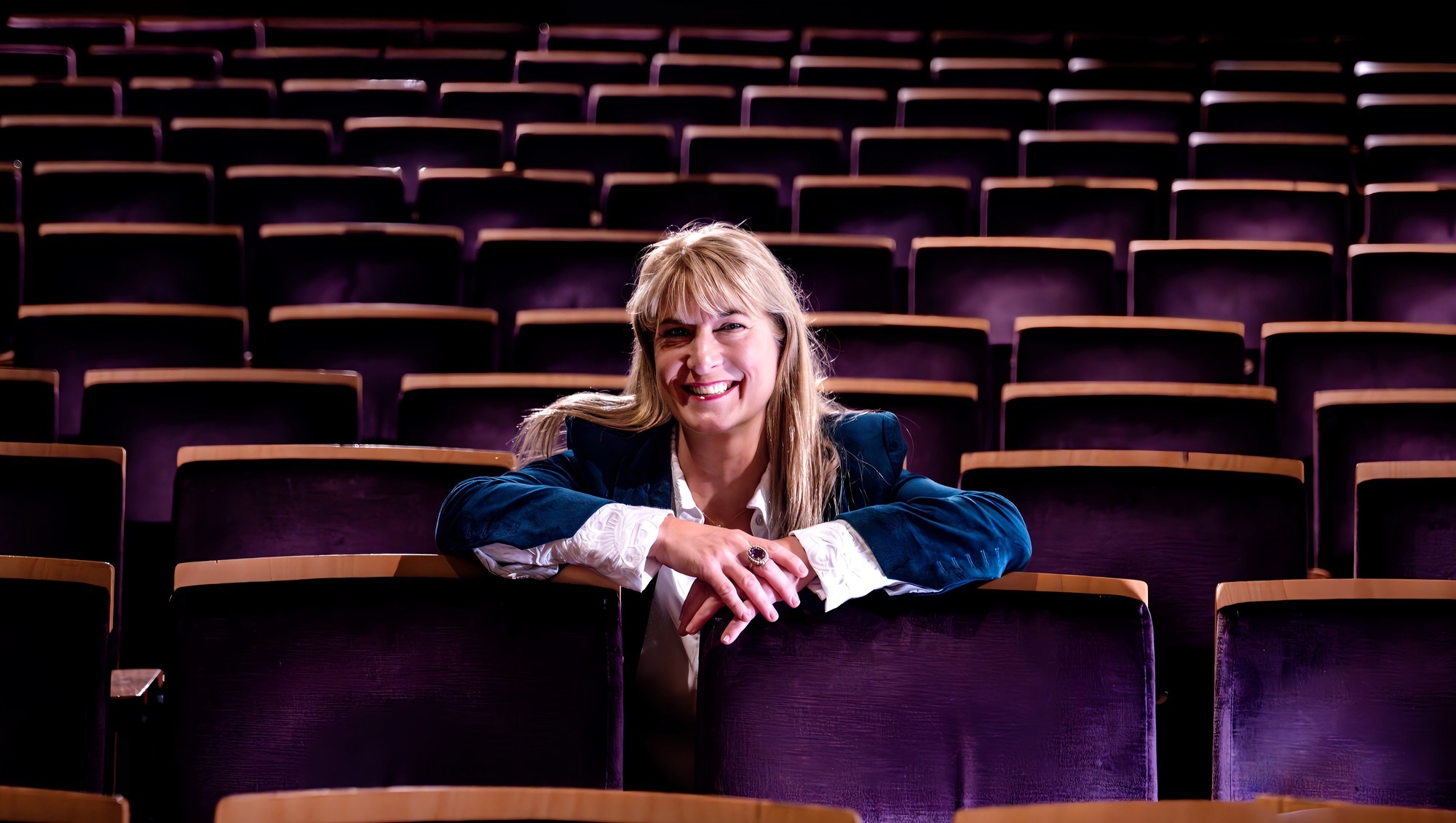
Cork Film Festival director Fiona Clarke in Cork Opera House. Picture: Chani Anderson

You know, it might work if you try it in a Cork accent. Give it a go. “Here’s looking at you, kid!”


The Cork International Film Festival (CIFF) is already gearing up for its 70th birthday in 2025, an ever-lengthening thread in Irish cultural life, or to use an old Orson Welles line, a ribbon of dreams. Already, festival director Fiona Clark is gearing up for the celebrations, and as ever, with an eye to the future while commemorating the past.

“This year we are trying to build that sense of movement towards next year,” she says, referring to the history and legacy of film in Cork, which will feature in 2024 with a focus on the “Irish Lumieres” — the Horgan brothers from Youghal, Philip, James and Thomas. Their short animation of more than a century ago, of the Clock Tower in Youghal spinning and dancing, was in its own way a leap forward for the art form here, something the CIFF has always been keen to continue.

The first Cork International Film Festival ran under the banner of Tóstal Corcai, a festival held across the country, with the film festival founded by Dermot Breen, secretary of the Cork Tóstal Council and manager of the Palace Cinema, now known as The Everyman Theatre. 

The CIFF emerged in the austerity of the post-war years and at a time when the Catholic Church had a dominant position in Irish life, following a period when films — including the aforementioned Casablanca — were not screened in Ireland during the war years over fears of propaganda reaching the Irish populace. 

The festival emerged before Cork even had an airport, as one of the big European festivals, alongside Cannes and Berlin and Venice — “very forward thinking,” as Clark points out.

Actress Jean Seberg is accompanied by festival director Dermot Breen and his wife Vida and Donal Crosbie of the Irish Examiner in 1961.

Breen’s imprint on the festival was to last to his death in 1978 and beyond, as was that of his wife, Vida. According to Ciara Chambers, head of the Department of Film and Screen Media at University College Cork, it was Vida who recorded and maintained so much of what was ultimately to enter the Festival’s digital archive.

“It kind of built up a historical picture of the festival that now exists that wouldn’t necessarily have otherwise,” Chambers says, lending Vida Breen a handle which wouldn’t look out of place on a film poster — an accidental archivist.

Dermot was front and centre at one of the controversies which erupted in the early years, when in 1969 the Bishop of Cork, Most Rev Dr Cornelius Lucey, had written to the CIFF asking that they withdraw its opening night screening of the film I Can’t, I Can’t, a movie filmed in Co Wicklow and focussing on a woman’s refusal to consummate her marriage over fears of sex and pregnancy. 

While the Bishop hadn’t seen the film, he feared its content was not for public consumption. Breen cooly but politely dismissed those concerns in an RTÉ interview and the film was screened.

Other controversies emerged over the years, including another instance of the Church decrying a movie, this time Martin Scorcese’s The Last Temptation of Christ in 1988. The screening sold out. Also over the years, various stars made their way to Leeside, including Robert Shaw, Jean Seberg, Jane Seymour, but it’s worth remembering that the actor currently in possession of the Best Actor Oscar is from down the road — Cillian Murphy, someone who no doubt attended many screenings at the festival over the years.

 Fiona Clark. Picture: Chani Anderson
Fiona Clark. Picture: Chani Anderson

It’s a form of symmetry but also a reminder of the festival’s eye for the new and the yet-to-be-discovered. It is a point Fiona Clark is keen to emphasise.

“We are celebrating our heritage but this is also a festival that has constantly innovated and is constantly innovating,” she says. 

“The festival has been key in helping in shaping and documenting changes in the city and you can see it is deeply woven into the city of Cork and also in the history of film in Ireland. In terms of the 2025/70th activity, we’ll be focussing on the theme of ‘Projection’ in all its forms and meanings, animating the city, small and large, old and new, perhaps incorporating a projected red carpet, symbolising film, Cork, and a sustainable future.

“We also hope to launch a new education and outreach legacy project, Aeráid — meaning climate — a pioneering film and education intervention programme that leverages creativity and film to address the urgent issue of climate change.

“On the final day of this year’s festival we’ll be announcing a couple of other projects, a major award, plus an archive project and public call-out.”

Details of a new programme of seminars and mentoring sessions on the screen industries for transition year students have already been announced by Fís Éireann/Screen Ireland, Atticus Education, and University College Cork for spring 2025, and both Ciara Chambers and Fiona Clark believe that even though film is a relatively young art form, it needs greater emphasis in schools.

“We need to focus more on the moving image in education,” Chambers says, “because we live in a screen-saturated reality.”

For Clark, the questing spirit of the festival will always mean an opportunity for young filmmakers, producers, and directors to showcase their work and, just as importantly, to discuss it with those who view it.

“I am really proud to be a custodian of that,” she says. 

It is not my festival, it’s our festival, it’s Cork’s, it’s Ireland’s.

However, she is clear that continuing and meaningful support, not limited simply to those who buy their tickets, is vital. “Be proud of this festival, don’t take it for granted,” she says. “We have to look at investment in infrastructure across the creative industries in Cork and we need the infrastructure to support that and build that.

“This is a growing city and we all want to live in or be connected to a city which is vibrant, whether it’s music or film or restaurants, a city that is inclusive, a city of sanctuary. Long term capital investment is really important and I am on a mission to push that agenda now and next year provides an opportunity to do that.”

And then there’s the magic. The dimming of the lights, the rolling of the opening credits, the enveloping glow of the first scenes. For Clark, this “collective experience” cannot be beaten. It has been the life blood of the festival since its inception and will surely propel it deep into its eighth decade and beyond.

“Our mantra is ‘discover film, reimagine the world’,” Clark says. “And we really mean that, on every level.”

x

More in this section

Scene & Heard

Newsletter

Music, film art, culture, books and more from Munster and beyond.......curated weekly by the Irish Examiner Arts Editor.

Cookie Policy Privacy Policy Brand Safety FAQ Help Contact Us Terms and Conditions

© Examiner Echo Group Limited