Film review: The Brutalist is an audacious masterpiece
Film review: The Brutalist is an audacious masterpiece

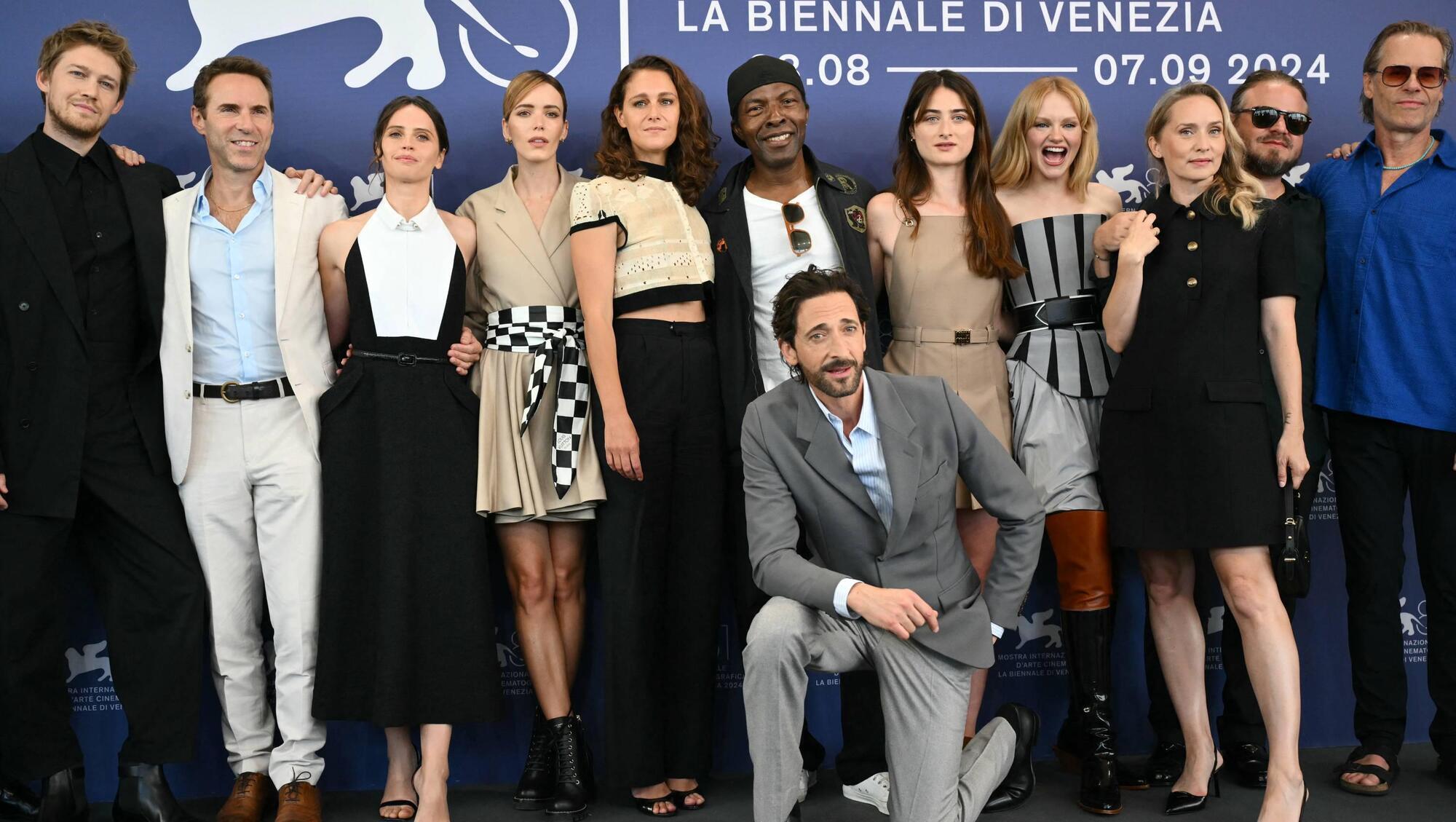
US actor Adrien Brody, centre, poses with actor Joseph Alwyn, actress Raffey Cassidy, director Brady Corbet, Mona Fastvold, actor Isaach De Bankole, actress Felicity Jones, actress Emma Laird, actress Stacy Martin, actor Alessandro Nivola and actor Guy Pearce during the photocall of 'The Brutalist' at the Venice Film Festival. Pi ture: Getty Images)

The Brutalist

★★★★★

The Brutalist is a film that explores the darkest recesses of the human psyche, not least the darkest recesses of the American Dream. 

In short, it is a masterpiece and will likely have a ripple effect across the modern cinematic landscape — at least critically and artistically. 

How this film will be sold to the public is another question given its density, niche subject matter and behemoth length of three hours and 35 minutes, with a courteous 15-minute interval at the halfway stage.

Written and directed by actor-turn-director Brady Corbet — and using Ayn Rand’s The Fountainhead as a touchstone — The Brutalist is many things, but principally it deals with the troubled life of architectural maven and Holocaust survivor László Tóth (played by Adrien Brody) after he flees his motherland of Hungary for the promise and opportunity of post-war America. 

One day that opportunity comes knocking in the form of wealthy and mysterious client Harrison Lee Van Buren, played by Guy Pearce. With a shot at success,Tóth’s life changes forever, for better or for worse. But this doesn’t begin to scratch the surface.

Tóth's triumphs of minimalist design have most in awe, but with success and responsibility comes adversity. Things are never easy for him, Corbet won’t allow it. The filmmaker is apparently insistent on hammering home the point that the immigrant experience is rarely a smooth one, even for those with exceptional talent and promise. Inevitably, wealth and power intervene to spoil the broth, moral corruption creeps in and poisons the waters of creativity.

Adrien Brody poses at the photo call for  'The Brutalist'.

As a character Tóth is so intricately and enigmatically constructed that I was surprised to discover after the fact that he was purely a creation from the mind of Corbet. 

The director covers the bases when it comes to his protagonist, touching on all creative, psychological, and personal aspects of the tortured Hungarian polymath. No stone is left unturned.

It is Adrian Brody’s best work to date, proving that early Oscar success for The Pianist (a heavy double-feature with The Brutalist, no doubt) was not premature, and certainly no fluke. He is a treasure and still, somehow, underrated. 

The connection for Brody, though, is deeper than what is on the page. His mother was a Hungarian immigrant who fled the country for a better life stateside. This truth is felt in every facet of his layered and exacting performance

 The cast is rounded out with an impressive dramatic roster including Felicity Jones as László's sick wife, Alessandro Nivola, Raffey Cassidy, Isaach de Bankolé and Joe Alwyn who plays Van Buren’s slimy privileged son Harry.

For the true cineaste there are some refreshing details to unearth, two being its VistaVision (the first live-action film fully produced in this format since Vengeance is Mine in 1979) and 70mm formats — both extremely rare in today’s filmmaking climate — which work synergistically with Lol Crawley’s camerawork to create nothing short of a visual wonder. 

You could count on one hand the filmmakers of today who are willing to sacrifice time and comfort for the sake of older filmmaking techniques. Now you can add Corbet to the list

 Comfort does not exist in his dictionary, hence why it took him seven years to deliver this tour de force. He simply loves cinema.

Every detail of the mise-en-scène is painstakingly created and obsessed over as to give the period illusion, and more importantly, entrench the audience in the world of Tóth. It is thorough and extensive in its examination of architectural integrity, immigrant strife, addiction, passion and creativity. There is always the fear with a three and a half hour filmic excursion that the writer and/or director is biting off more than they can chew or worse, overloading the film with thematic heft.

Thankfully it never struggles or buckles under the weight of its own substance. It plays out like a great American novel, gargantuan in grasp and scope, dense, detailed and at times a little unruly. For any patient cinematic romantic, this is a dream. There’s nothing cookie cutter about it. No corners cut. No expense spared both financially and emotionally. We could be witnessing one of the defining films (and voices) of our generation. Cinema is well and truly alive.

More in this section

Scene & Heard

Newsletter

Music, film art, culture, books and more from Munster and beyond.......curated weekly by the Irish Examiner Arts Editor.

Cookie Policy Privacy Policy Brand Safety FAQ Help Contact Us Terms and Conditions

© Examiner Echo Group Limited