Book review: Fisk’s sobering view of the Middle East bites with truth
'Night of Power' lays bare, with a cynical tone, the events that have transpired in the Middle East and how the West’s lengthy oppression of the Muslim world influenced the instability and atrocities there
Book review: Fisk’s sobering view of the Middle East bites with truth

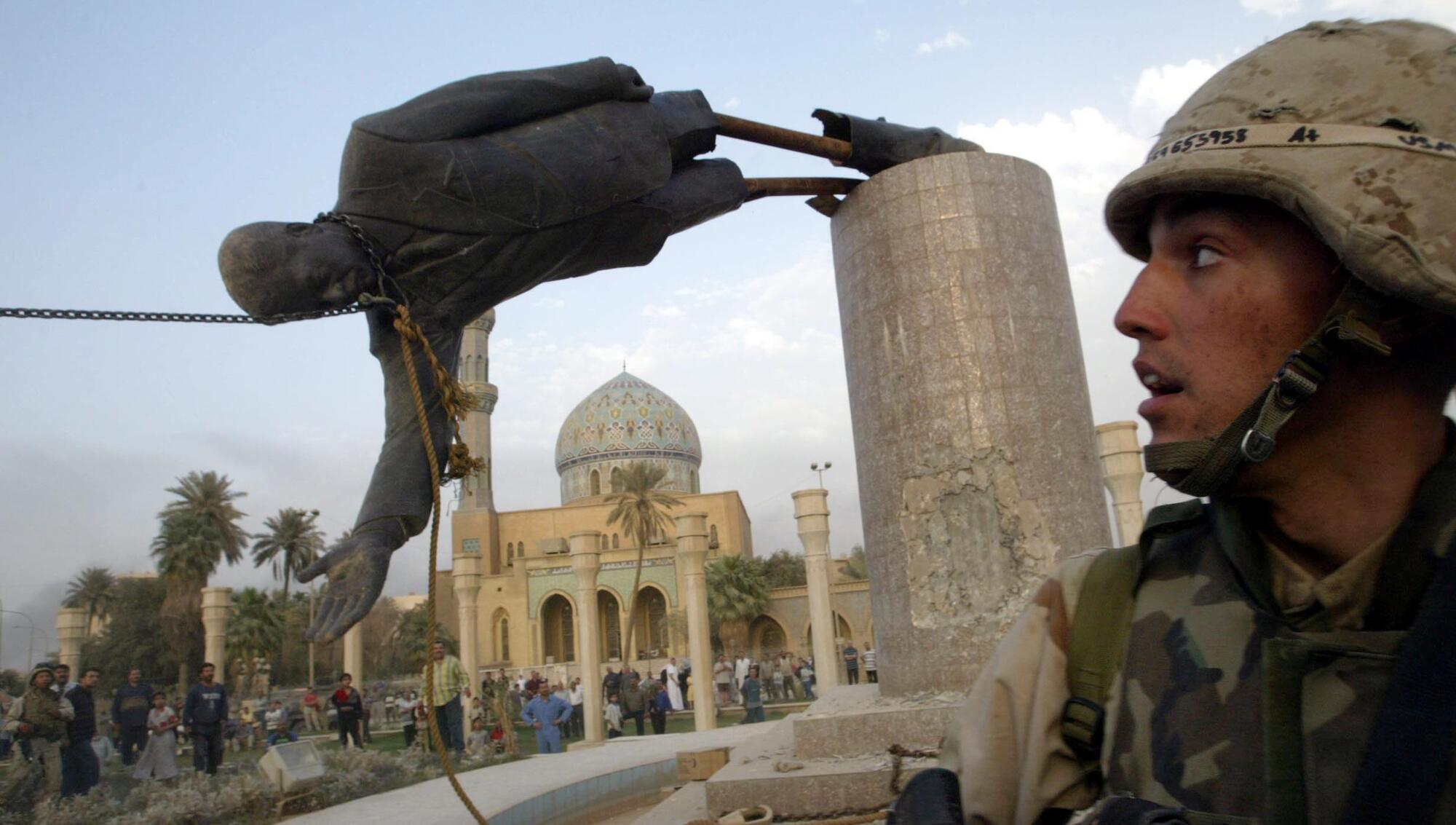
A US soldier watches as a statue of Iraq's President Saddam Hussein falls in central Baghdad in April 2003. File picture: Goran Tomasevic /Reuters

  • Night of Power: The Betrayal of the Middle East 
  • Robert Fisk 
  • 4th Estate, €30


Robert Fisk, one of the foremost journalist provocateurs of his time, filled the 539 pages of this shuddering indictment of western imperialism, inhumanity and hypocrisy with the righteous outrage of an Old Testament prophet.

He distilled rather than filtered massacre after massacre, crowded, stinking morgue after crowded stinking morgue, predictable betrayal after predictable betrayal gathered over many decades reporting from that forlorn and grossly exploited region.

The consequences are gaping, unfixable breaches below the water line for the reputations of so many of the imagined great and good of our world. 

The unblinking lies, the barefaced corruption around allegations about non-existent weapons of mass destruction from Tony Blair, then-British prime minister; former American president George W Bush and his vice president Dick Cheney; the empty, body-bag-filling ultimatums of Barack Obama too. Others are also laid bare.

Fisk, who became an Irish citizen after Brexit, died almost four years ago on October 30, 2020. 

This book, a partner of The Great War for Civilisation, a benchmark work of reporting/history of the decades leading to the September 11 attacks on America in 2001, does not deal with the Hamas atrocities of October 7 or Israel’s unending genocide in Gaza. 

His opprobrium would be sharp as he had — an almost life-long empathy with the Arabs and those ever-fewer Israelis who sought, or seek, sustainable solutions to that great catastrophe (one predicted all too accurately by Winston Churchill, as Fisk records, at the very earliest stages of Israel’s colonisation of Palestine).

Veteran British journalist Robert Fisk was one of the best-known Middle East correspondents who spent his entire career reporting from the troubled region and won accolades for challenging mainstream narratives. File picture: Bassem Mroue/AP

In the opening passages of Night of Power Fisk winnows reality from stated intention, deed from shameless propaganda. 

He describes how, more than two decades ago, American uber-hawk Dick Cheney was rebuffed when he tried to convince the Arab world to support Anglo/American plans to invade Iraq. 

There was, and is, huge disappointment with American policies in the Middle East: “They cannot isolate any issue from the bias which is detected in US policy on the Palestinians. In every Arab capital he visited, Cheney was told to turn his attention to the bloody Palestinian-Israeli war and to forget ‘the axis of evil’ until Bush brought his Israeli allies into line.”

Despite these serial public rejections, Cheney’s press handlers repeatedly claimed — lied, if you align with Fisk’s reportage — Arab leaders privately gave their support for an American strike on Iraq. 

Gulf Arab officials insisted that what Arab leaders said in public was what they said in private. They warned that an invasion of Iraq would be a disaster — exacerbated if Saddam was overthrown as Iraq would then split along sectarian lines with dire consequences for the region.

Hindsight is a wonderful thing but imagine the resentment, the bitterness germinated by America’s dismissive imperialism before that disaster? 

Imagine what Arabs who understood all too well the reality of their world then and now think of the West? 

How many of those murdered on October 7, how many of those near 40,000 Palestinians trapped and murdered in Gaza’s turkey-shoot might be alive if that advice had been taken, if diplomacy had trumped militarism?

As America veers again towards an insecure strongman, Fisk’s comprehensive indictment could be a sobering antidote to lock-and-load possibilities. 

However, the more things change — Cheney’s early-century manipulations are almost a template for so many episodes in the imbalanced relationship between Western powers and the Arab world. 

The West has repeatedly and instinctively imagined itself the benefactor rather than the intruder with disastrous consequences.

Fisk describes how the millions of Western and American troops who passed through Iraq brought a “plague” to that country — the “infection” of al-Qaeda.

“They smothered Iraq with injustice and fed the cult of the suicide bomber. They brought the disease of civil war. They injected Iraq with corruption on a far grander scale than that which had existed under Saddam.

“They stamped the seal of torture on Abu Ghraib just as they had refined it in Afghanistan. They sectarianised a country that for all its Saddamite cruelty and veniality had hitherto held its Sunnis and Shiites together.”

This undoubtedly would be a minority view in America, certainly in MAGA America, underlining the mindset that facilitated so many of the atrocities described by Fisk.

If Night of Power was no more than an indictment of the West and particularly America, it would be all too easy to imagine valid criticism — maybe in the voice of the flexible and ambitious JD Vance. 

However, Fisk excoriates corrupt and murderous Arab leaders as well. 

He unblinkingly describes the atrocities inflicted on the people of Egypt by their homegrown despot Hosni Mubarak; the crimes of Libyan dictator Muammar Gaddafi are recorded as are the multiple barbarities of Syria’s Bashar Al-Assad and Obama’s failure to contain him.

Fisk records too the carnage inflicted by one extremist Islamic grouping after the other — each determined to venerate their god by destroying those who follow another or even a different version of their own god. 

It is heartbreaking to have to acknowledge that many if not most of these terrorist entities were midwifed by America — or Russia — to undermine one regime or another once seen as unamicable to the West.

Fisk is also critical of the role played by the West’s media in the Arab Spring uprisings. He points out, in a hard lesson for all would-be revolutionaries, that social media posts may be enlivening and reassuring but they are no match for a well-armed, ill-disposed and aggressive junta. 

He argues that Western cheerleaders are culpable for the carnage that ensued the Arab spring when earnest social media rallying cries ran into automatic rifle fire. Like most of his considered and passionate arguments it is difficult to dismiss this counter-intuitive balancing of the books.

This book is nearly 600 pages of reportage intermingled with some powerful editorialising — but then how could it be anything else? Fisk bore unwavering witness to our world, even if this book would have been far easier to read had there not been concentration-cracking footnotes on almost every second page.

In the last stages of Fisk’s life, like many other conscientious journalists working in this post truth era, he looked back with frustration and regret.

“I have witnessed such bloodbaths and massacres, seen so many mass graves, described so many tortures and executions, written so many times of the West’s oppression of the Muslim world — nothing I wrote seemed to have any effect.”

What a sad epithet for an individual — and a terrible indictment for our world where a fading superpower once celebrated as the shining city on a hill, is culpable in genocide against displaced, largely powerless Arabs. 

Fisk is now silent, but the root cause of his passionate anger persists. We can only hope that other Robert Fisks emerge to shine their light into the darkest corners of humanity’s fallibility. A disturbing and distressing book but tragically undeniable too.

x

BOOKS & MORE

Check out our Books Hub where you will find the latest news, reviews, features, opinions and analysis on all things books from the Irish Examiner's team of specialist writers, columnists and contributors.


More in this section

Scene & Heard

Newsletter

Music, film art, culture, books and more from Munster and beyond.......curated weekly by the Irish Examiner Arts Editor.

Cookie Policy Privacy Policy Brand Safety FAQ Help Contact Us Terms and Conditions

© Examiner Echo Group Limited