Famed account of Gaelic poets showed riches of a starving people
Daniel Corkery’s ‘The Hidden Ireland’, published 100 years ago, will be celebrated at a conference in his native city next week
Famed account of Gaelic poets showed riches of a starving people

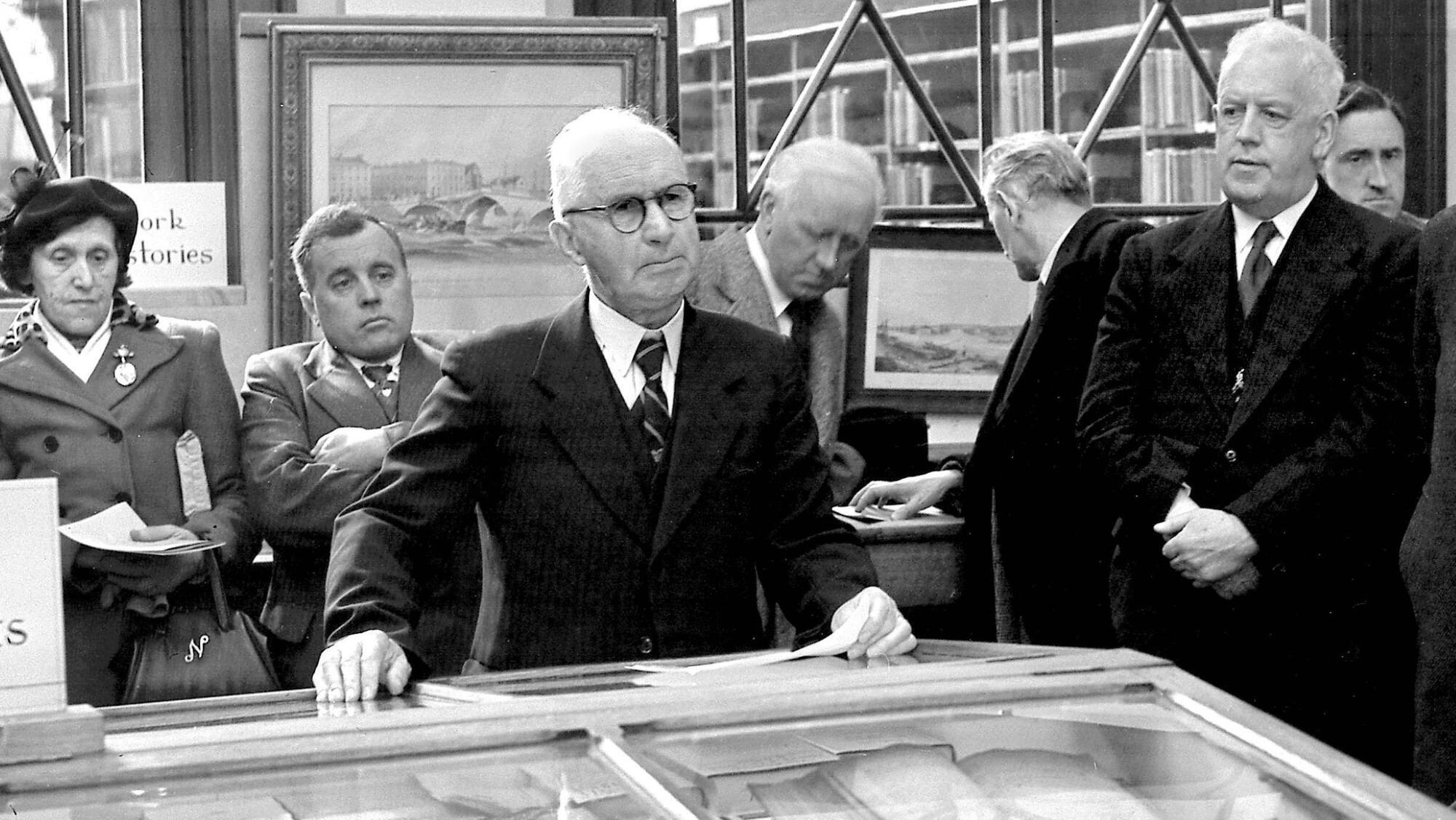
 Daniel Corkery. Picture: Irish Examiner Archive

Next week, scholars and admirers gather in Cork for a conference to celebrate the 100th anniversary of the publication of The Hidden Ireland, Daniel Corkery’s famed account of Munster Gaelic poets of the 18th century.

How did a book on what could sound like an esoteric backwater of Irish literary studies achieve such prominence when it was published? Why, a hundred years later, is it still considered worthy of attention?

To begin answering those questions, let’s start with Daniel Corkery himself. Who was he?

A landmark study by Dr Patrick Maume (who will speak at next week’s conference) begins:

Daniel Corkery was born on February 14, 1878, in a thatched house (since demolished) at the foot of Gardiner’s Hill on what was the northern fringe of Cork city. 

He was one of five children born to William Corkery, whose family had been carpenters in Cork for five generations, and his wife (nee Mary Barron) daughter of a Waterford sea-captain lost at sea. 

Daniel was born with a bone deformity which left his left leg shorter than his right; all his life he walked with a stick.

After her husband’s early death, Mary moved the family to Barrack Street where she kept a shop, and after that to The Lough. 

Corkery’s was an urban childhood with no connections to the countryside and the language. 

When he was 12, he saw a sign in Gaelic script. He thought it was Chinese.

A bookish boy, Corkery grew up to be a teacher, in a career that took him from St Francis’s School on North Main Street to a professorship at UCC, and a writer whose output included plays, short stories, a novel set in Cork, The Threshold of Quiet, as well as literary and cultural criticism —most notably, The Hidden Ireland

Frank O’Connor was a pupil of his whom he later mentored as a writer, along with Seán Ó Faoláin. He was a close friend of Terence MacSwiney and later Seán Ó Riordáin.

Corkery was to fall out badly with O’Connor and Ó Faoláin about the direction of Irish literature and culture, with the younger men objecting to what they saw as their mentor’s excessive nativism. 

Still, after he died on New Year’s Eve, 1964, Ó Riordáin would record in his diary that Cork’s intellectuals had lived in his shadow as Dunchaoin lives in the shadow of Sliabh an Iolair.

Corkery had an ambivalent relationship with the city of his birth. As The Hidden Ireland reveals, he came to see it as a much lesser site of culture than, say, the little hamlet of Whitechurch, six miles outside.

There, in the 18th century, a humble Court of Poetry, under Diarmuid Mac Cárrthaigh, clung to existence, part of “a network of song laid over the land”, especially Munster.

According to Corkery, to see the Irish-language poetry of the 18th century against the dark world it emerged from is to be “astonished, if not dazzled”. 

And here, once more, he holds nothing back in attempting to convey the greatness of these poems, as he saw it: An aisling by Aodhagán Ó Rathaille is compared to “some perfect movement of a Mozart sonata”, and the poet himself to Dante. 

The south-west corner of Munster was “the Attica of Irish Ireland and Sliabh Luachra its Hymettus”.

Corkery believed that this literature provided a gateway to a world into which the beleaguered O’Connells of Derrynane or the O’Connors of Castlerea could retire, along with the McDermotts of County Sligo or the O’Callaghans of North Cork, all their followers and dependants, and the cabin dwellers also. 

His eulogising of the talents of Eoghan Ruadh Ó Súilleabháin provides a fine example of Corkery’s eloquence and of the raptures older Gaelic poetry appeared to induce in him:

“In not even one song, one verse, does he go astray in the whirlwind he has raised about him, or forget his destination.”

No other lines were ever more spontaneous, free-running, unburdened, triumphant, carrying their message to the very gate intended, laying it there on the threshold of our consciousness, clean and beautiful.

Corkery scouted out Gaelic exceptionalism in all its guises: the bardic schools, Brehon law, unique poetic forms (including the aisling), and the Courts of Poetry. 

The latter, impromptu gatherings of all of the poets in a particular area, maintained “among the common people the idea of the humanities”. 

Corkery could claim that by evolving and maintaining these courts “the literary tradition of the Gaels did its utmost to ensure that its legatees should, at least on occasions, assume their higher selves, their fuller humanity, should put off the mere delver of the earth, should raise themselves, should extend themselves” — and here Corkery imports some lines translated from a poem by sometime farm-labourer and one-time Royal Navy seaman, Eoghan Ruadh Ó Súilleabháin — “to the contemplations of the adventurous ways of Death, or to the vision of the burning towers of Ilium”.

Corkery could certainly adopt positions that some might perceive as idiosyncratic: in The Hidden Ireland, for instance, he repeatedly argues that the Renaissance had been a disaster for European art and culture, thus agreeing with the stance taken in De Profundis by Oscar Wilde (whom he praises in a footnote).

Later scholarship has shown some of Corkery’s assumptions to be faulty or premature or in need of qualification.

Yet, even if it were entirely made up, the story he is telling, and the manner in which he tells it, would still be spellbinding.

Part of the allure of The Hidden Ireland is the romance inherent in championing the greatness of a scorned, beaten-down people, impoverished and near-invisible to the wider world. 

In this respect, one might say Corkery’s book provides a kind of counterpoint to the view contained in a speech WB Yeats made in the Seanad in 1925, when the poet-Senator called the Anglo-Irish tribe from which he had sprung “one of the great stocks of Europe”.

“We are the people of Burke,” Yeats proclaimed, “we are the people of Grattan; we are the people of Swift, the people of Emmet, the people of Parnell. We have created the most of the modern literature of this country. We have created the best of its political intelligence.” 

It was an easy thing, of course, for Yeats to valorise his “stock” with a roll call of great names from history. For Corkery, this was a far more difficult feat, but he pulls it off. 

One puts down The Hidden Ireland convinced that Ó Rathaille and Ó Súilleabháin and the rest were themselves, to use Yeats’s famous phrase, “no petty people”. Daniel O’Connell, of course, erupted out of this stock to seize the reins of Irish life for a time at least.

Corkery would want the last word to go to one of the poets. Here then is the opening stanza of an aisling by Aodhagán Ó Rathaille:

Gile na gile do chonnarc ar slighe i n-uaigneas;

Criostal an chriostail a guirm-ruisc rinn-uainne;

Binneas an bhinnis a friotal nár chríon-ghruamdha;

Deirge is finne do fionnadh n-a gríos-ghruadhnaibh.

For a translation, turn to chapter seven of The Hidden Ireland.

Daniel Corkery: The Hidden Ireland — A Hundred Years On is a conference being held next Saturday in the Imperial Hotel, Cork. See eventbrite.ie for details.

BOOKS & MORE

Check out our Books Hub where you will find the latest news, reviews, features, opinions and analysis on all things books from the Irish Examiner's team of specialist writers, columnists and contributors.

More in this section

Scene & Heard

Newsletter

Music, film art, culture, books and more from Munster and beyond.......curated weekly by the Irish Examiner Arts Editor.

Cookie Policy Privacy Policy Brand Safety FAQ Help Contact Us Terms and Conditions

© Examiner Echo Group Limited