Martin Beanz Warde: 'In Nairobi, I wasn’t a Traveller – I was a white man with smart clothes'
On his new RTÉ series, The End of the World with Beanz, the presenter travels to various corners to meet people doing their bit for the environment 
Martin Beanz Warde: 'In Nairobi, I wasn’t a Traveller – I was a white man with smart clothes'

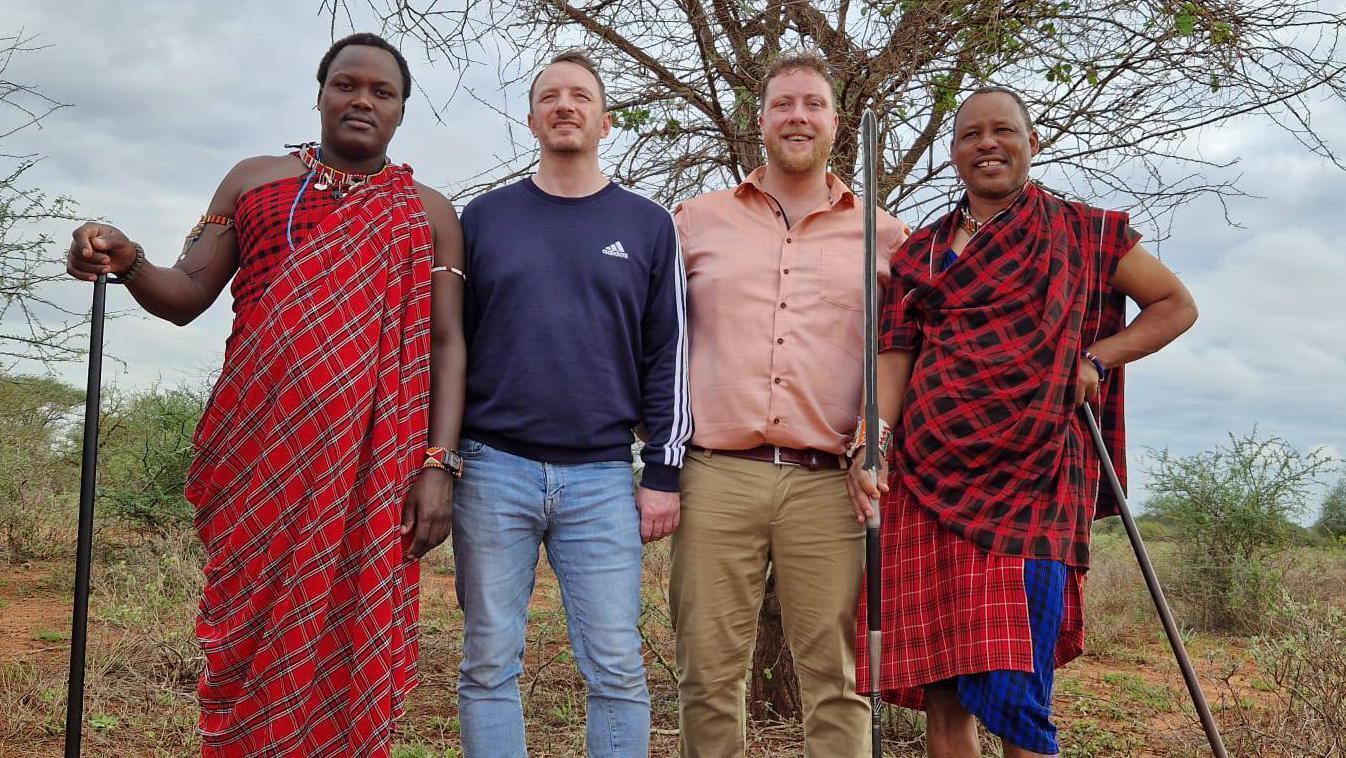
Martin 'Beanz' Warde with Gearóid Farrelly and two members of the Maasai tribe in Kenya, for RTÉ series 'The End of The World'. 

Martin ‘Beanz’ Warde drives a diesel car. He doesn’t always recycle correctly. He goes overboard buying clothes “and stuff”. Which is why, he says, he’s no one to preach about climate action.

“I have a bag of bags — I go to the shop and I buy another ‘bag for life’, and it will be a bag for life because I never use it. I’ve a fortune of bags sitting in the boot of my car.”


Fronting new six-part series The End of the World with Beanz, Warde jumps head-first into the sustainability and climate action challenges facing us today. His aim is to demystify these massive themes for himself, bringing us along with him. He’s well placed to be Everyman, representing the “vast majority of people who get on with life and don’t really think too much” about climate.

“Climate action isn’t anything I was overly well versed in, but meeting people with stories different to mine really interests me. And I love Irish nature and the environment,” the writer and comedian says.

Teaming up weekly with a different co-host — and spending time in locations near and far, with people making extreme life choices for the planet’s sake — Warde is “your average Joe, your average Martin, going on this journey of learning and having a bit of craic along the way”.

CLIMATE & SUSTAINABILITY HUB

Inevitably, his own ideas and emotions get shaken up. In the Ohio woods, returning to basics and learning how to survive from someone who has trained elite SAS squads, he realises he’s not built for this. “We never know could we survive if we lost our electric grid, our water resources,” he muses.

However, he learned how to shoot a shotgun and  how to use a crossbow. “I learned how to build a fire from scratch. It’s a crying shame that I come from a Traveller community and didn’t know that — I’m going to lose my Traveller membership! We had to rely on a cat to catch our dinner … I don’t think I’d survive very long.” 

On the 4,000 acre zad in France, where “a community of people are squatting”, he learns about communal living and sees the beauty of bartering. “They’ve no money system. It’s all about swapping skills — what’s beautiful is the community spirit behind it.” 

It sets him thinking — what if “we had 100 builders across Ireland, 100 electricians, and they all chipped in to work on other people’s buildings, and those people returned the favour?” 

Meeting an Amish man living in rural Maine — excommunicated from his community for suggesting an electric vehicle to lower the carbon footprint — Warde is struck by his hybrid life. “He lives as Amish, but has an electric vehicle — strange juxtaposition of a very traditional [way of life] and very futuristic technology.” 

Martin is joined by Roz Purcell and Roc Sandford on the Scottish island of Gometra, where Sandford is living off the grid.

After an epic journey by land and sea, Warde meets Roc Sandford on the remote Scottish island of Gometra. He is seriously impressed by his off-grid life. “He’s living self-sufficiently, has his own poly-tunnel. He doesn’t use gas or burn fire, he uses alcohol as a burner to cook his food.” 

Closer to home, his heart breaks  seeing the effects of coastal erosion in Portrane, North Dublin, where he meets a woman whose home is a holiday house owned by her family for decades. “She showed me photographs from 10, 20 years ago, how the water is now nearly up to her garden. Her parents loved the house and wanted their ashes buried in the garden. The time will come when she won’t be able to visit their grave.

“Her neighbour — there’s 10 feet between his garden and the sea — has a mortgage, he can’t get house insurance, and won’t be able to sell his house on. As an island nation, coastal erosion is scary. I’m afraid for these people I’ve never met: Families, couples…” 

Half-way around the world, he has an eye-opening climate awareness moment when he connects his own actions to the impact on others’ lives. It happens at Dandora dump in Kenya, where he has followed the trail of Ireland’s textile waste. He joins the dots between our buying “cheap t-shirts that don’t last long”, to bales of discarded clothes sent to Nairobi where second-hand clothes retailers buy on the blind.

“They open the bales without knowing what’s in them. They choose what they can re-sell. Unfortunately, a large percentage is useless — can’t even be sold in a second-hand market in an impoverished area. They’re thrown into a landfill site that just keeps piling up.”

 At Dandora, sited in a residential area, he learns about children’s respiratory difficulties due to chemicals in the dump. “In the first bit of filming, I’m wearing my smart blazer. I’m a first-time presenter, I feel I need something new and snappy. I want to look great, great for Instagram.

“Then I meet these people, and I don’t give a sh*te if I’m seen in the same top again. I’m not going to give into my own ego and narcissism. It’s absolutely liberating to break that mindset that you have to be always seen as dapper and looking great.”

Martin and Emma Doran travel to France and meet some of the squatters on the 4,000 acre zad. 

Seeing children barefoot on that dump, “running up to the jeep looking for sweets, grown men looking for Coca-Cola”, Warde realises: “I’ve nothing to cry about, nor do [most] Irish people, apart from those going through hard times. I’ve huge privilege. Growing up as a Traveller, there’s that victimhood mentality and there is discrimination. But in Nairobi, I wasn’t a Traveller — I was a white man with smart clothes and a film crew. That really brought it home.” 

Which leads to a question about Warde’s thoughts on current Traveller areas of concern. He is firm, there are enough people working for activism. “I’ve gone through periods where I focused solely on the wrongs done to my community. I didn’t spend enough time looking at how hard other people have it —working class people surrounded by crime and addiction, friends with severe mental health issues.

“Now I want to focus more on people as people, rather than any segment of people, rather than divvying it up. [Now it’s] what might my neighbour be going through?” A fitting question for a man who has seen that climate makes neighbours of us all, no matter the miles between us.

  • The End of the World with Beanz, Tuesday, March 12, 7pm, RTÉ One.

The End of the World with Beanz – some highlights:

  • Episode 1: His co-host is Emma Doran. He meets two sisters running Cavan’s first plastic-free store,  and attempts foraging for lunch with mixed results.
  • Episode 2: With comedian Gearóid Farrelly, he meets a local hip-hop group and a recycling fashionista in Kenya. Nearer home, primary schoolchildren give a lesson on giving your jeans a new lease of life.
  • Episode 3: His co-host is Neil Delamere. He meets teenagers who wake at night anxious about impending climate disaster. “It shouldn’t have come to this. This isn’t how we make change,” Warde says. “We need to… stop using loaded language like ‘we’re at the 11th hour’. Instead focus on small changes we can make, like not asking for a new pair of jeans every month.” 
  • Episode 4: His co-host on the remote-island-Scottish-trip is Roz Purcell. In Navan, he learns about sustainable funeral options.
  • Episode 5: Along with fellow comedian Bernard O’Shea, he meets a hybrid Amish man. Back in Ireland, he visits an inner-city Dublin beekeeping project.
  • Episode 6: Warde and Julie Jay have a staycation — while working on an organic farm. He learns about fending for himself in the wild with some Kilkenny-based survivalists.
x

CLIMATE & SUSTAINABILITY HUB

More in this section

Scene & Heard

Newsletter

Music, film art, culture, books and more from Munster and beyond.......curated weekly by the Irish Examiner Arts Editor.

Cookie Policy Privacy Policy Brand Safety FAQ Help Contact Us Terms and Conditions

© Examiner Echo Group Limited