'Most of them are harsh places to live': Ardal O'Hanlon on his Irish islands show
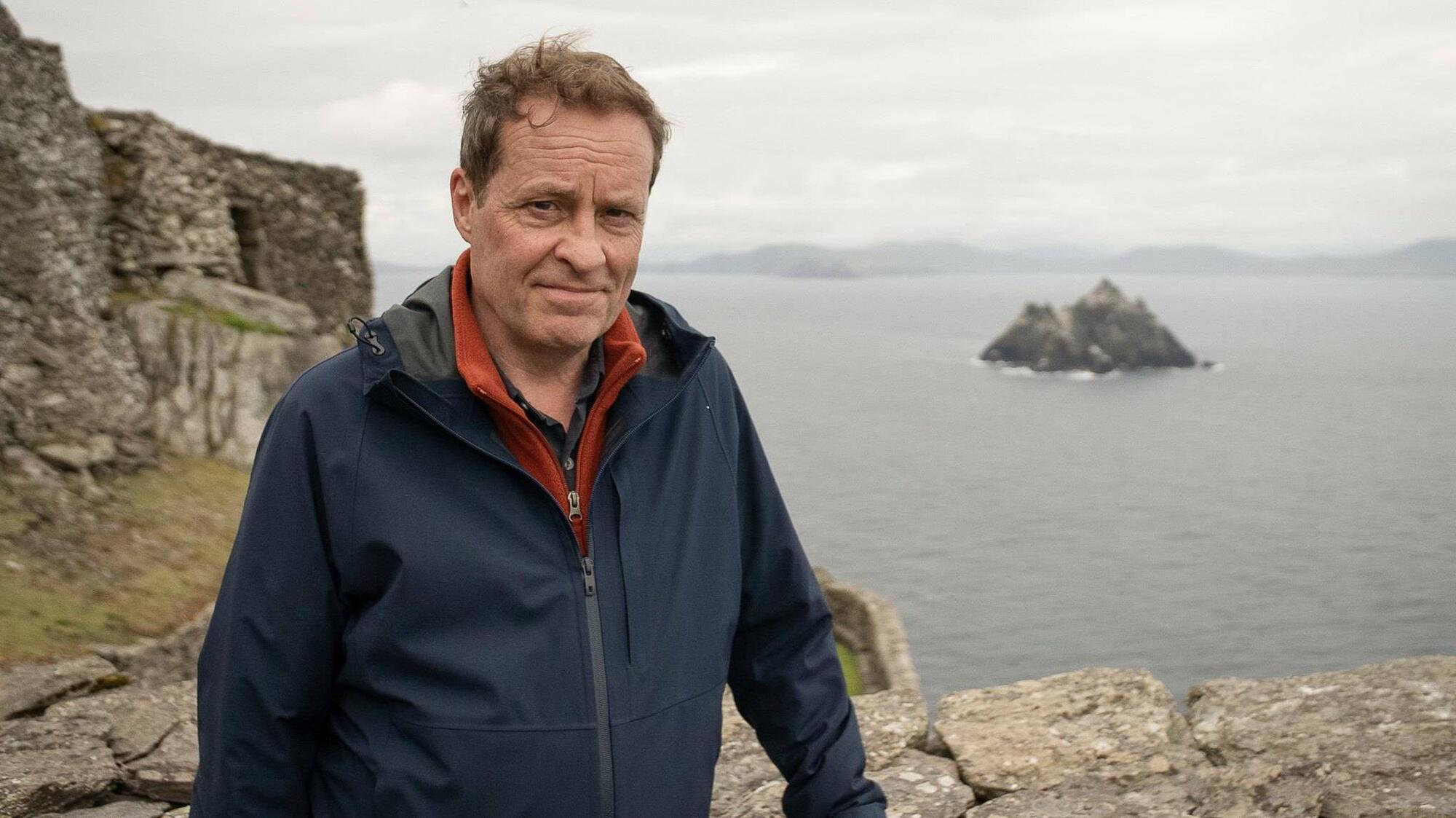
Ardal O'Hanlon on the Skellings for Inis na nIontas on TG4.
Skellig Michael was at the peak of a mountain range south of the Equator 360 million years ago. All these years later, it’s still as remote and beautiful, albeit it’s now surrounded by sea water, seven miles off the coast of Co Kerry. Around the sixth century, a group of monks established a monastic settlement on the crop of rock, carving distinctive beehive-shaped huts for shelter around their church.
Getting to visit the island — which has garnered worldwide attention since used as a location for a Star Wars film — was a highlight for Ardal O’Hanlon, presenter of Inis na nIontas, a three-part documentary on the islands off the coast of Ireland.
“It was everything I hoped it would be,” says O’Hanlon. “It’s hard to put into words. It was finally achieving a life-long ambition, something I wanted to do for decades. It sounds grandiose, but walking in the footsteps of those monks makes you see things in a different way. It doesn’t change your life in an instant, but it makes you ask yourself the deeper questions.
“What’s it all about? What brought them here? How did they actually live? How did they build this monastery in this impossible place in impossible conditions? And why? Because you’re there — and it’s silent and there’s no one else around and it’s so eerie and it’s such an unusual shape. Everything about it is strange.”
The documentary series is O’Hanlon’s first in the Irish language. His mother Teresa is a native Irish speaker. Helming the programme gave O’Hanlon a spur to brush up on his command of a tongue he could understand and read in, but admittedly had difficulty in thinking in Irish.
“I couldn’t quip more to the point,” says O’Hanlon. “There’s an English language version of this documentary, which will be distributed elsewhere in the world. For me, that was far easier because particularly during the interviews you can build up a great rapport with the people you’re speaking to in your first language, and you can easily throw in quips and sideways observations, which I couldn’t do in Irish.”
O’Hanlon’s journey began on Rathlin Island, off Co Antrim. From there, he moved anti-clockwise until concluding at Fastnet Rock, dubbed “Ireland’s teardrop” as it was the last view of the country emigrants taking the boat to North America got to see.
Inevitably, the series showcases breathtaking scenery. It also captures fascinating wildlife diversity. These include the Irish mountain hare on Rathlin, a native animal — unlike the rabbit — not found anywhere else on earth; thriving seal colonies on the Blasket Islands and Garnish Island; as well as the gigantic fin whale, as long as two buses put back-to-back, off Sherkin Island.
The white-tailed sea eagle has also nested on Garnish Island near Glengarriff in recent years. It’s a magnificent bird, with talons longer than those of a lion and a wingspan of more than 2 metres. It feeds itself by catching fish in the waters off Bantry Bay.

The appropriately named ornithologist Steve Wing — who has catalogued 324 bird species, two-thirds of the species in Ireland — was drawn from England to live on Cape Clear 24 years ago. The island is a haven for birdwatchers from around Europe, who are known to descend on the island within 48 hours if a rare bird has been spotted, as they’re blown onshore from as far away as Africa and the Americas.
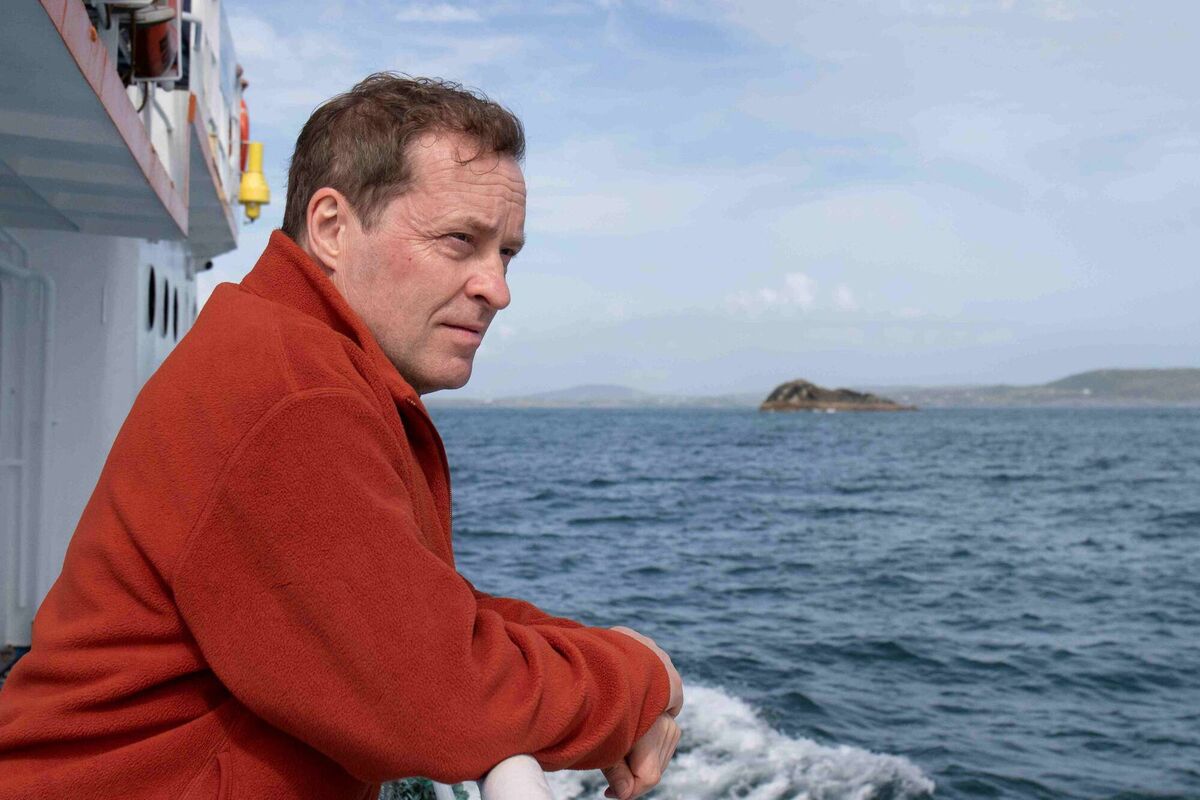
If there is a star of the series it is perhaps the sea. It’s the ingredient that makes island life — which can be inhospitable in stormy weather and a tough port, financially, to make a living — so invigorating.
“You can’t underestimate the power of the sea,” says O’Hanlon. “It’s something writers and philosophers have struggled to articulate for millennia. You have to be beside the sea to appreciate it. It’s extraordinary — the power of it, the majesty of it. When you’re somewhere like the Aran Islands, on the Atlantic Coast, you could sit there for hours in all weathers, just gazing out to sea. It’s profound.”
O’Hanlon has a choice phrase in the documentary, suggesting that “island life has a certain poetry about it”. It’s easy to see why Ireland’s great writers like John Millington Synge, and great painters like Seán Keating, have been attracted to its charms, as a repository of Irish culture, and its slower pace of life.
“I would have known Tory quite well as a kid,” says O’Hanlon. “It would have a special place in my heart. It’s all very sentimental. Don’t get me wrong. I’m guilty — and the programme is guilty — of romanticising island life. Most of them are harsh places to live. That’s why they’re so depopulated. I’ve never lived on a coastal island, only on fictional islands. I know nothing about island life for real, but there is an idea of freedom to island life.
“As places to visit for a few days, there is that idea of escapism. You feel you’re leaving the conventional world and the rat race. I know this is patronising, but you’re going back in time. One tends to idealise the islands. There’s nothing else to do. There isn’t a museum or a bookshop to go to. There aren’t many restaurants in a lot of these places. There’s no café culture to speak of. You’re alone with your thoughts.
“It’s not for everybody. Most of the people who live on islands maybe don’t have much of a choice or there’s a strong family tradition, but a lot of the other people have willingly moved to the islands for work or solitude. It’s that solitude that is rare. It’s what attracted the monks to the Skelligs in the early Middle Ages. There’s definitely something to be said for it.”
- The second episode of Inis na nIontas is on Wednesday, 9.30pm on TG4. Episode 3 featuring the Cork islands — Sherkin, Garnish and Cape Clear — will air on January 24

“What’s the Irish for ‘arghh’?” wonders Ardal O’Hanlon, as he stands on a boat off Sherkin Island. Ireland has a chequered history of piracy, particularly around Sherkin Island, which is opposite Baltimore in West Cork.
“That history of piracy around Sherkin Island is all incredible — the fact that pirates were coming as far away as Algeria to either trade or attack Cork,” says O’Hanlon. “They had a problem with Cork people!”
Ireland harboured its own pirates, too. In the fifteenth century, the O’Driscoll clan — who built the monastery on Sherkin Island — controlled the islands off Baltimore. They owed their wealth to piracy, by raiding passing ships that were on the way to trade with Waterford city.
In 1537, a Portuguese boat, the Santa Maria de Soci, full of wine heading to Waterford, was lured ashore by the O’Driscolls. While on land, and enjoying themselves at a banquet in Baltimore Castle, the Portuguese sailors were clapped in irons, and their wine seized.
The wine theft triggered an unmerciful reprisal. An army was dispatched from Waterford. Baltimore and its surrounding islands, including Cape Clear and Sherkin, were pillaged and burnt. The attack lasted for about a week. It marked an end to the feud with the O’Driscolls, which had been rumbling for a century and a half, and an end to their power.