Books are my business: assistant librarian Amy Boylan
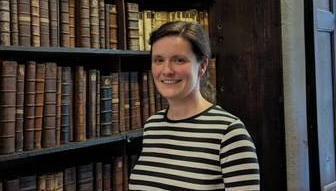
Amy Boylan is assistant librarian at Marsh’s Library having volunteered there in 2016.

Amy Boylan is assistant librarian at Marsh’s Library, located at St Patrick’s Close in Dublin. It was founded in the early 18th century by Archbishop Narcissus Marsh as the first public library in Ireland.
How did you become an assistant librarian?
It was very circular. I didn’t really know much about libraries.
I taught English for a long time, and I had been living away. I lived in Mexico for four years and I came back and I didn’t really know what to do.
I volunteered in Marsh’s in 2016 and I had such a great experience here, everyone was really encouraging.
I was giving people tours and that kind of thing, but the people here really encouraged me to look into librarianship and then I worked in the National Library.
I did a studentship there and from there, I went to Oxford to work in a library.
I came back to Marsh’s when this job opened up, I couldn’t resist going back to such a great place.
What does your role involve?
We’re a small library so I get to do a little bit of everything. We are a special collections library and one of my roles is to manage the reading room and everything associated with granting access to the collections.
I also do cataloguing as part of my job as well — stock control, collection development, all that kind of thing.
My job also involves a lot of outreach which I really enjoy — getting people to engage with the collections in lots of different ways.
I teach classes with third-level students, do tours and all of that.
We are also dipping our toes in digitisation and I’m also involved in that. There’s also a research element to it as well. So it’s varied, which is great.
Can you tell me more about what is held in the library?
In terms of our special collections, we have about 20,000 to 25,000 books. But we continue to collect reference works and books that support the collections.
All in all, we have about 40,000 books, they are all in our catalogue and people can see them there and request to view them.
We are also a museum of an 18th century library and people come from far away to see that — it’s very Instagrammable.
You can hear the intake of breath when people come in, which is good as it reminds us about why the library is so special.
We also have exhibitions, so that’s another aspect of my job, curating exhibitions.
Our first librarian, Élie Bouhéreau, was a Huguenot refugee who left France in 1685 and came to Ireland, we have his books and letters, we have an IRC fellow working on his letters at the moment.
We get academics, PhD students, postdocs, who might be interested in particular texts, or how people used their books.
We have a fair number of books that are unique and fabulous natural history collections, medical collections, books on antiquities, everything you could possibly imagine.
What do you like most about your job?
For a long time, special collections seemed closed off and very much the domain of academics and people doing serious and important things.
It’s wonderful to be able to bring the collections to the wider public.
What do you like least about it?
I suppose there’s never enough time to look at all the books.
It’s hard with old buildings and old books, you need infinite time and infinite resources to really look after them and protect them.
Three desert island books
I would pick two novels by Benjamin Labatut — When We Cease to Understand the World and The Maniac. They’re not like anything I’ve ever read before.
They’re like non-fiction novels, the stories of the great scientists, physicists, and mathematicians who shaped the 20th century. He takes really complex ideas and makes them so interesting and so tangible.
Another one is Super-Infinite: The Transformations of John Donne by Katherine Rundell.
I don’t read that much biography because I find a lot of them very dry, but this book was anything but — it pulsates with life, like John Donne’s poems, in a way that is absolutely brilliant.
The last one would be the novels of Elizabeth Taylor, I love her. My mum introduced me to her years ago, and she is very much under-appreciated, although she is having a renaissance now.
She’s so incisive, witty, and writes really well about women, loneliness and people’s internal domestic lives.
- marshlibrary.ie

Cancel anytime