Book Review: Nature, nurture, and everything inbetween in North Woods
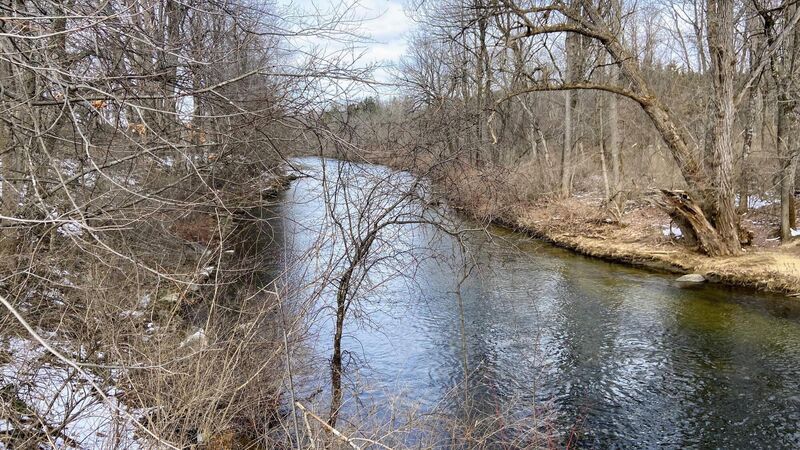
Walloomsac River in Bennington, Vermont
- North Woods
- Daniel Mason
- John Murray
- €23.79 hb €15.99 pb
If ever there was a book fit to be called American Pastoral, this is it. Daniel Mason chose instead for his title, the plain monosyllables, North Woods.
The novel takes place at a “yellow house in the north woods” and it is through these two phenomena, the habitation and the forest, that the story of modern America is told.
In the beginning, there was a simple hut, and in it lived a woman, originating from the Puritan community and later partially assimilated into Mohican society.
But, “as the centuries go on” states Mason, “these houses moult, new wing goes up, old one becomes the servants’ quarters, old servants’ quarters become the barn, old barn becomes the carriage house, and so on”.
Mason depicts the residents, many of whom show up in a random way, in a symbiotic relationship with their surroundings: woods, mountain views, icy streams, mossy rocks, birds and insects, and even a roaming catamount (puma).
In his acknowledgements Mason talks about being hosted “in the forests of northwestern Massachusetts and southern Vermont, on Mohican ancestral homeland, in the watersheds of the Hoosic, Deerfield, Housatonic, and Walloomsac rivers” hosted by “the ash and beech, the striped maple, the sugar maple, the northern red oak, the hemlock, the clubmoss, the spring warblers, the flying squirrels, the porcupines, the boletes, the dryad’s saddle, the ostrich fern, the catamount, the wild apples”.
In other words North Wood, tells of the love affair between Mason and the countryside in which he has walked and camped.
He diminishes the importance of the individual proprietors, seeing them only as temporary intruders on the land and rewards or punishes his characters according to the ways in which they nurture or damage the environment.
The guardians who plant and husband, producing marketable Merino wool or delicious apples prosper but those who indulge in hunting and tree-felling undergo unhappy outcomes.
There is a lyrical description of the burial and exhumation of three men on the hill above. Their grave was hurriedly dug and the rain came, saturating the ground and causing the hillside to slump and to extrude the skull of “the man who offered the apple to the woman”.
Later wolf cubs drag the skeleton around, exposing the ribcage to the sunshine and allowing a pip, ingested in his last meal by ‘the man who offered the apple to the woman’, to germinate and grow, first to a sapling and thence to a tree.
Mason prefers these times when the natural world is fully in control and people are absent.
Later again an orchard planted from this original fruit is destroyed and replaced with chestnuts.
But like their predecessors, these trees are vulnerable and are struck down by a naturally evolved blight, blown by a wind from the western Appalachians.
An elm, planted outside the front door to provide light, is infested by a beetle whose larvae begin the tunnelling which will kill it and all its kin.
Mason shows that whilst humans may be the most destructive beings on the planet there are other aspects of nature by which she, red in tooth and claw, creates her own extinction events.
A small beetle can precipitate the annihilation of every stately elm in the world. The hope is that after global heating has eradicated everything, an apple pip (or other kernel) will survive and begin the cycle of life again.
Meanwhile, the people who come to and go from the “yellow house in the north woods” are indicative of the infinite variety of the species and, of the particular genus that is the American.