Book Interview: Franco’s virulent antisemitism leaves a dark and lasting legacy, says Paul Preston
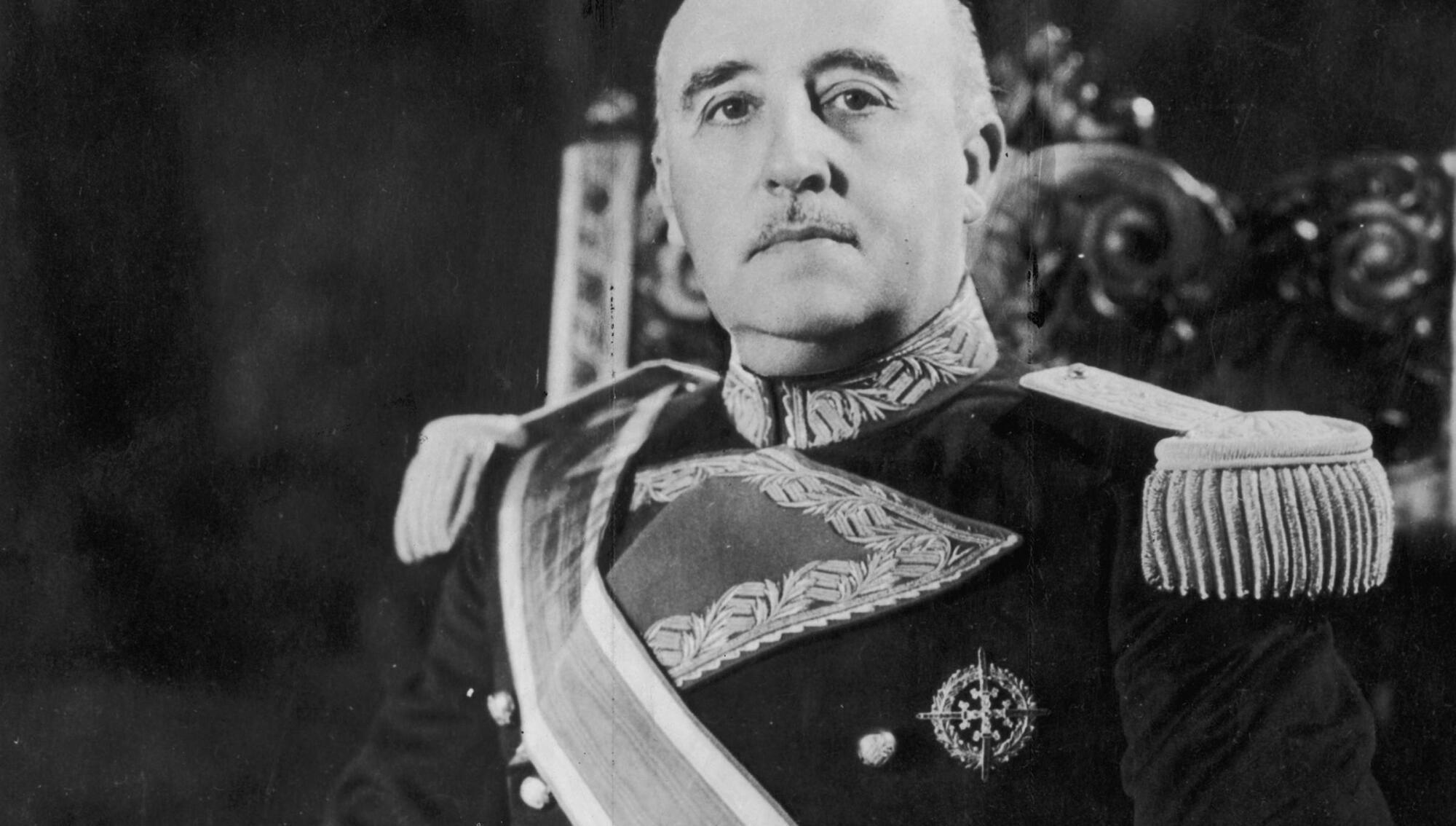
A portrait of Spanish dictator Francisco Franco (1892 - 1975) sitting on a throne in full military regalia. (Photo by Hulton Archive/Getty Images)
- Architects of Terror: Paranoia, Conspiracy and Anti-Semitism in Franco’s Spain
- Paul Preston
- Publisher: William Collins
In the spring of 1937, a book was published in the zone controlled by the military rebels commanded by General Francisco Franco.
Concerned with the progress of the Spanish Civil War to date, it was entitled War in Spain against Bolshevik Judaism.
Curiously, though, there was no mention of Jews or Bolsheviks on any of its pages.
Why, then, was Franco framing the Spanish Civil War as a conflict against Jews and Bolsheviks?
This is the main question Paul Preston examines in Architects of Terror: Paranoia, Conspiracy and Anti-Semitism in Franco’s Spain.
The book, published earlier this year in Ireland and Britain, hit bookshelves in the US in late summer.
It explores how, during the years of the Second Republic, from 1931 to 1936, throughout the Spanish Civil War, and for many decades after it ended, a myth continued to be fostered in Spain that Jews and freemasons were attempting to destroy Spanish Christian civilisation, while also plotting to take over the world.
The British historian points out that antisemitism has been a common theme in Spanish history for centuries.
And especially since 1492, when the Jews got expelled from Spain during the early years of the Spanish Inquisition.
It was only after the foundation of the Second Republic in April 1931, however, that antisemitism began to play a key role in day-to-day politics in Spanish public life, says Preston.
“The extreme right was determined to destroy [the Second Republic] and its reformist agenda [and] to justify its efforts, the cover was used that this was a life-or-death struggle to defend Spain’s traditional values against an attack by a coordinated force of leftists and freemasons masterminded by the Jews,” Preston, a Professor of International History at the London School of Economics, explains from his home in London.
The historian, whose previous books include The Spanish Civil War, Franco, Juan Carlos, and The Spanish Holocaust begins with a brief discussion about the Spanish Civil War (1936–39).
The conflict was fought between the republicans (made up of liberals, socialists, communists, anarchists and Basque, Catalan, and Galician nationalists) and the nationalists (the rebels), who eventually won, and took the lives of 500,000 Spaniards.
In April 1939, Franco — who by then had assumed the role of Spain’s supreme leader with dictatorial powers — issued the last dispatch of the war.
“Nationalist troops have achieved their ultimate military objectives. The war has ended,” he proclaimed.
Preston, who was knighted by the late Elizabeth II in 2018 for his services to UK/Spain relations, notes that, for the rebels at least, the civil war was actually fought to overturn the educational and social reforms of the democratic Second Republic and to combat its cultural challenges to the established order. “But the bogeyman of the Jewish–masonic–Bolshevik conspiracy provided a convenient label for a huge range of leftists and liberals that [were] bundled [by the rebels] into an ‘other’ that needed to be exterminated,” the historian explains.
He describes the central idea behind the so-called Jewish-masonic–Bolshevik conspiracy theory as “absurd, stupid, and illogical”.
“What makes all of this demonstrably absurd is the fact that in 1931 there were hardly any Jews in Spain and in Spanish Morocco, about 3,000 in total.
“Those numbers doubled from the rise of the Nazis. Between 1933 and the outbreak of the Spanish Civil War, roughly another 3,000 Jews reached Spain. But we are talking about refugees, people who are struggling for their own survival, hardly individuals in a position to dominate the world.”
Still, Preston’s book spends considerable time and ink exploring the platform antisemites were given in Spanish newspapers to promote their views during the 1930s and for many decades after.
Preston claims antisemitism increased in Spain from 1932, following Spanish translations of the fiercely antisemitic fiction, The Protocols of the Elders of Zion.
First published in Russia by writer and mystic, Sergei Nilus, in 1905, the book’s intent was to portray Jews as having secret plans to rule the world by manipulating the economy, controlling the media, and fostering religious conflict.
Those views were shared by General Francisco Franco who “referred to The Protocols of the Elders of Zion as if it were a serious historical document,” Preston says.
He says the religion-based antisemitism of the Francoist right shared many traits with the extreme racism of the Third Reich.
He notes how, in June 1941, Spain’s Ministry of Foreign Affairs, under Serrano Suñer, informed Spanish consuls in Greece and the Balkans that the Spanish government did not recognise local Sephardic Jews as Spanish citizens and that they could not be afforded consular protection.
“The [Franco] regime allowed the Gestapo to seize German, Jewish, and other, refugees and take them back to the Third Reich,” Preston explains.
“The fact that many Jews survived, by getting into Spain, has been the basis of the self-congratulatory myth that Franco’s attitude towards the Jews was benevolent.”
In April 1945, Franco’s pro-fascist press announced Adolf Hitler’s death “as if he had died heroically in combat,” says Preston.
“It was insinuated that the horrors of the German extermination camps were the consequence of the chaos of defeat.”
Bizarrely, though, Franco made considerable efforts after the Second World War to “ingratiate himself with the World Jewish Congress and with Jews in Israel,” says Preston.
“But it was all lies and propaganda, and it was only until the tide of Axis success began to recede, that Franco confronted the need to lie about his antisemitism. Coupled with the fact that he needed the [financial and political] assistance of the United States after the war.”
Preston also explores how, nearly two years after the death of Hitler, Franco, using the pseudonym Jakim Boor, began to write a series of antisemitic and anti-masonic articles (50 in total) in the Falangist daily, Arriba.
The first article appeared on December 14, 1946, just two days after a plenary session of the General Assembly of the United Nations, which had excluded Spain from all its dependent bodies. Franco, using his secret pseudonym, wrote that “Judaism hates the Catholic religion” adding that “it was “a handful of Jews that were the target of German racism, that impelled [the allies] to go to war”.
“Franco’s dismissal of the Shoah as merely a handful of Jews falling foul of race laws revealed an indifference to, if not approval of, the slaughter of millions of Jews,” says Preston.
“Antisemitism was a key part of the legacy of the Franco dictatorship,” says the historian.
Despite the regime’s rigid censorship, it permitted the publication of 12 reprinted editions of The Protocols of the Elders of Zion, along with other antisemitic works in Spain throughout the Franco dictatorship, which did not end until Franco died, aged 82, in 1975.
Spain’s entry into NATO and the European Community in the mid-1980s completed the country’s transition from dictatorship to democracy.
But the legacy of a fascist dictatorship still looms large. Preston mentions a rally held in February 2021 in Madrid’s Almudena cemetery, where flags bearing Nazi symbols and placards carrying anti-Semitic slogans were on display.
Its main purpose was to commemorate the Spanish volunteers who died fighting with the Germans in Russia during the Second World War.
“There is no doubt that Francoism is still alive after the death of Franco,” the historian concludes. “Today, there is no shortage of pro-Franco books published in Spain and there still exists a National Francisco Franco Foundation. It would be very difficult to imagine an Adolf Hitler foundation in Germany.”