'We’re promoting vegetarianism': Seán Scully and son Oisín collaborate on Jack the Wolf book

Seán Scully and his son Oisín have published Jack the Wolf.
Seán Scully and his 14-year-old son Oisín are reclining on a hotel bed in Brest, France. They are just back from a walk on the Breton coast with Oisín’s mother, the artist Liliane Tomasko, and Scully is taking a breather before he delivers a public lecture on his latest exhibition, Sean Scully: Géographies, which runs at Passerelle, Centre d’art Contemporain in Brest until January 2024.
The three have recently relocated to London, where Scully grew up, from New York, where he has been based since 1975. “We didn’t want to live in America when Oisín was in high school because of the guns,” he says. “It’s nice to be back in Europe. We are very European. And Oisín’s happy in London, he loves his new school. It’s a rather refined establishment, but he goes to football a few times a week on Hampstead Heath with these kids who play as if their lives depended on it.”
Father and son have just launched their first collaborative project, a lavishly illustrated children’s book called Jack the Wolf, whose hero prefers eating chocolate to meat and is best friends with a character named Rebecca the Rabbit.
“It’s a morality tale, and a little bit of political propaganda,” says Scully. “We’re promoting vegetarianism, which is something we really believe in in our family.”
The book began taking shape some years ago. “It was a bedtime story you used to tell me when I was about five,” says Oisín. “And you just decided to write it at some point, right?” “Yeah, you were five or six,” says Scully, “and the book is appropriate for that age.”
Of all the stories the artist told his young son, Jack the Wolf was always the most effective. “Oisín liked it so much he used to fall asleep when I told it to him. So it was extremely successful. And then one day, I was waiting for him to finish classes at his first school, the Blue Rock School in New York, I was in the library and I began to write the story down. And when I got it down, the next thing was, what about pictures? And that was it, we were off and running. There are about 40 illustrations, and Oisín participated in most, though not all of them.”
Scully is known for the breadth of his palette, and it is no surprise that the settlement where Jack the Wolf pilfers chocolate every night is called Colorfull Town, “where each house was painted a unique colour, or a different colour combination, never to be repeated.”
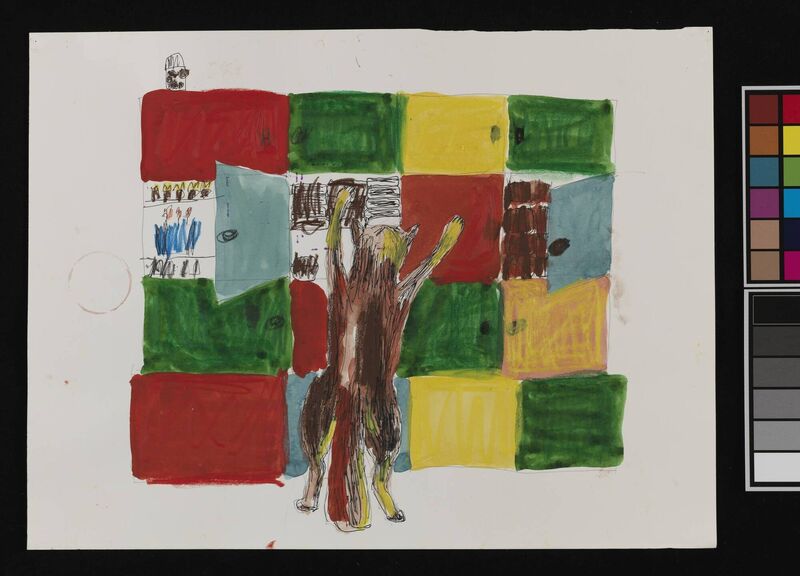
Scully is better known again for his use of the stripe, a motif that has featured in hundreds of his abstract paintings, drawings, prints and stained glass windows. Even the sculptures he has produced in recent years are essentially three-dimensional stripes. It follows that the stripe should also appear among the mostly figurative illustrations in Jack the Wolf; in one image, Jack can be seen rummaging through a suite of cupboards whose doors resemble nothing so much as the panels of a Scully painting.
“Here’s the thing about that picture,” says Scully. “It’s a true and very sweet collaboration. I painted the drawers - and Jack the Wolf, of course - but Oisín drew all the little jars and the chocolate bars and everything that’s in the drawers. See the jar on top of the cupboards, the one that breaks the picture frame… Oisín drew that too.”
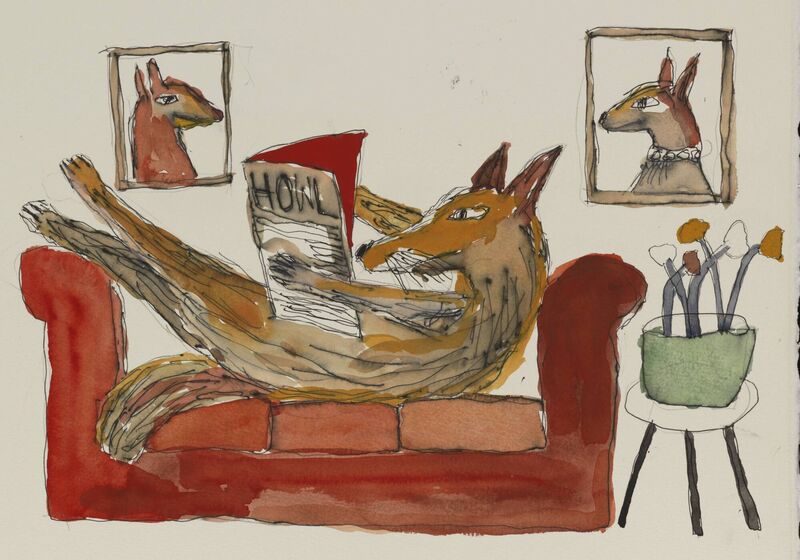
The reaction to Jack the Wolf has been overwhelmingly positive. “People seem fascinated by the idea that we did this together,” says Scully, “and it’s grown into a bit more than we intended. The illustrations are showing at the Chaim Reid gallery in New York at the moment, and I’m doing another eight paintings based on the story. And we’d like to see it made into a film.” “An animated film,” says Oisín.
“Yeah. Like The Gruffalo. I can just hear the voice of Adrian Dunbar as Jack the Wolf, and Helena Bonham Carter as Rebecca the Rabbit.”
Would the Scullys direct it themselves? “Nah, we’re not filmmakers. We’d leave that to Martin Scorcese.”
Surprisingly, given that both his parents are successful artists, Oisín does not intend to follow in their footsteps. “I don’t paint much,” he says. “And I wouldn’t say my illustrations have developed whatsoever.” He actually prefers writing.
There are no plans for a sequel to Jack the Wolf. “No, this is it,” says Scully. “In the future we’re going to be looked upon as one hit wonders.”
But neither rules out a further collaboration down the road, one where Oisín focuses on the written work and his father on the visuals.
“Oisín is a real writer,” says Scully. “He writes beautiful stories. And yeah, who knows, maybe when I’m older, and he’s being published, he might say to me, ‘What about you illustrate my books? I don’t want to pay anybody, I want somebody to do it for free. What about you, dad?’ And I’d like to do it, I think.”
Scully maintains a busy schedule, and is already hard at work on his next range of projects. “I’ve got a small show in China in November,” he says. “And there’ll be a big exhibition there next year, I believe. But next week I’ll be in New York. I’m doing a big project there, a series of sculptures on Broadway, so I’ve got a meeting for that. I can’t remember how many sculptures there’s going to be. It’s either five or seven.”
As for Oisín, his plans – for now at least – are more modest. “I’ve got to get back to my homework,” he says, rolling off the bed. “See you!”
- Jack the Wolf by Seán and Oisín Scully is published by Callaway Books. Further information: callaway.com