Dublin Theatre Festival reviews: Fascinating fare from two Brazilian shows
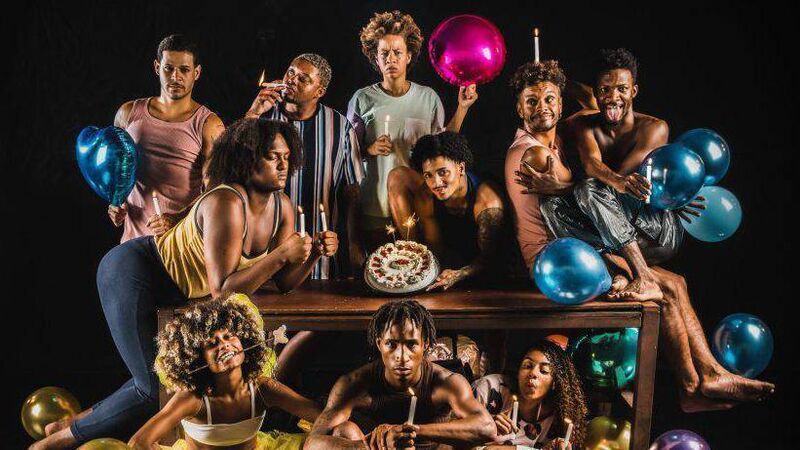
Zona Franca at Dublin Theatre Festival.
★★★★☆
There was a Brazilian flavour to the opening days of the Dublin Theatre Festival, in the shape of two shows that wore their politics rather differently. First up was a dance piece, Zona Franca, by Alice Ripoll and the company Cia Suave.
While the “zona franca”, or free space, of the show's title is billed as a response to the potentials opened up by the election of Lula da Silva, you’d be hard pressed to guess it from the show itself. Yes, we are invited to project Brazil-ness onto the loosely structured choreography, with shaking derrieres for instance, or when some actual beach football breaks out. But otherwise, it’s about bodies and rhythm, with harsh techno beats to the fore, as the dancers each interpret the urban “passinho”, or quick-step, style.
Above them hover 10 or so black balloons, the bursting of each marking a transition: from a writhing, sexualised crowd scene, say, to a moment of stillness; from the joyous and celebratory, to where the body itself seems to become a prison, something to fight, or a nightmarish form worthy of Goya at his darkest. It is by these contrasts that Ripoll conveys a coiled tension to the audience, making Zona Franca a visceral, heartstopping experience, even if its message is more muted than perhaps it would wish.
★★★☆☆
Things could not be clearer with After the Silence; well, to begin with anyway. We are invited by performer Juliana Franca to applaud Lula’s victory, as, lecture style, she gives a brief history of race and slavery in Brazil. She decries the “discredited” official narrative of a successful melting pot, sketching the absurdity of teaching the poor black and indigenous farmers of the rural interior about the lineages of Portuguese royalty and such. Four million African slaves, she tells us, were taken to Brazil, compared with 400,000 to what is now the United States. Slavery did not disappear, she says, it merely “changed shape”: immiserating subsistence farmers for the country’s entire history.

The curious thing is what happens next. Christine Jatahy, described accurately as the show’s “creator” rather than director, subverts our expectations of docu-accuracy, mixing archive footage with beautifully shot films across three screens that dominate the stage. These new clips, it turns out, form a mockumentary shot amongst villagers in the interior of Brazil’s vast Bahia state. Jatahy’s fiction is placed in parallel with lived experience and history.
So, we watch footage of Joao Pedro Teixeira, the agrarian reformer, and hear of his assassination in 1962, but are presented in the same way, as a kind of update on this, with the murder of Severo dos Santos, a fictional character from Itamar Vieira Junior’s novel Torto Arado, which Jatahy seizes upon as a generational saga of inherited violence. The novel’s spiritualism, animism, and symbolism are in stark contrast to the conference-like setup of the stage, and the documentary grammar we’re presented with. Jatahy’s upending of conventions is more something you’d expect to find in an art gallery video installation.
Taken into the theatre, it is disorienting, challenging, and perplexing. But it’s a piece that certainly keeps you keenly alert. Formally daring, balancing playfulness and conviction, After the Silence is a beguiling experience. Its very ambition undermines its coherence, however, diluting its emotional impact, even if the craft, intelligence and sophistication are obvious and laudable.