Book interview: Fascinating story of Israel’s claim on Jewish artist Bruno Schulz
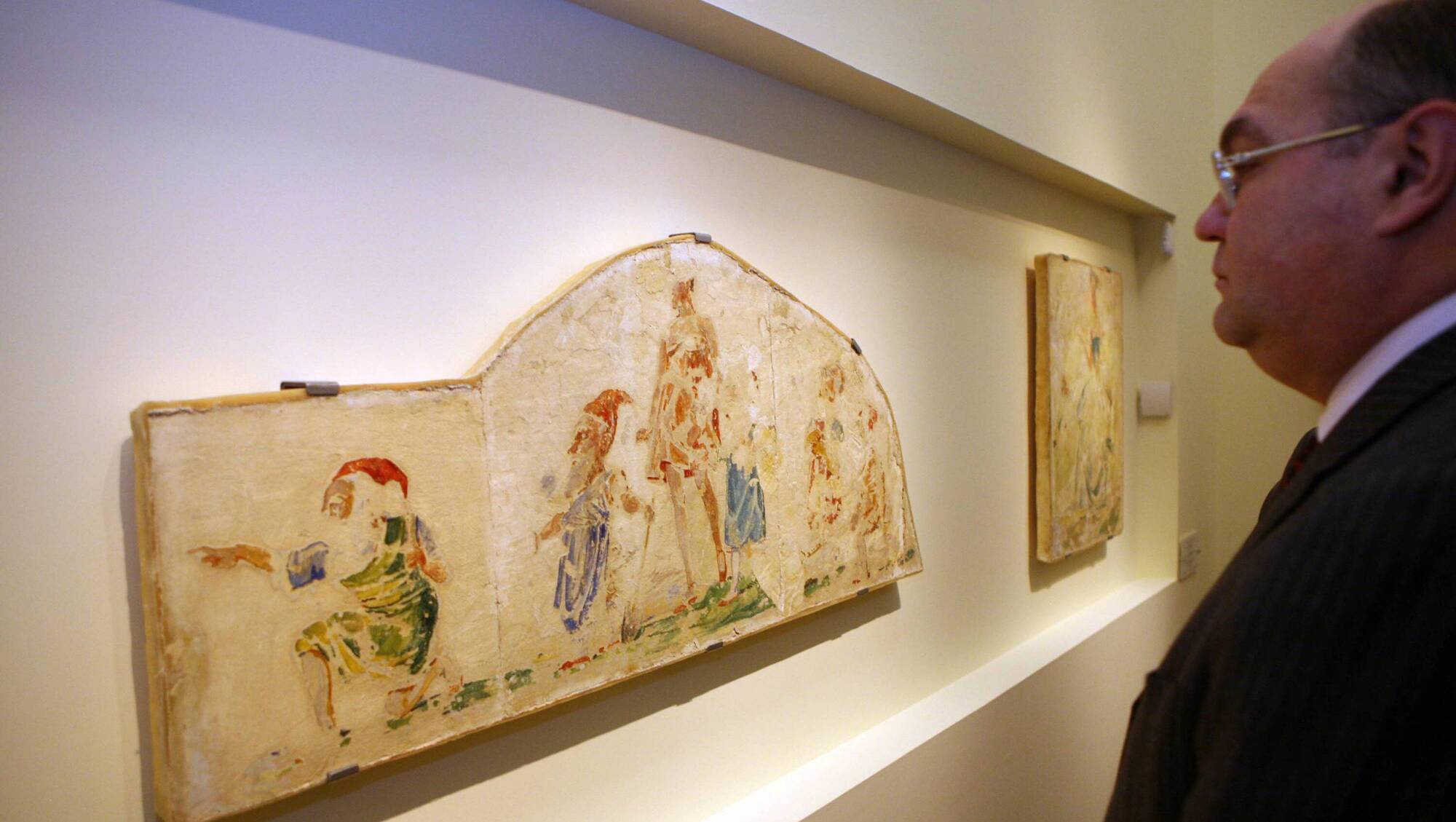
A man looks at wall paintings made by Jewish author and artist Bruno Schulz at the Yad Vashem Museum of Holocaust Art in Jerusalem in 2009. The display includes three wall paintings, from the last known work by Schulz before his murder on November 19, 1942. Picture: Getty
In Kafka’s Last Trial (2018) Israeli author, Benjamin Balint, examined a decades-long legal battle that asked a controversial question: who is the rightful cultural guardian of Franz Kafka’s original manuscripts, since Max Brod’s death in Tel Aviv, Israel, in 1968?
Brod, a German-speaking Jew and committed Zionist from Prague, fled the Nazi invasion of Czechoslovakia in 1939, emigrating to Mandatory Palestine. Kafka was born in 1883 into a German-speaking Jewish family in what was then the Bohemian capital of Prague and died from tuberculosis in 1924 at the age of 40. As Kafka’s sole literary executor, Brod edited and prepared posthumous editions of Kafka’s unpublished novels: The Trial (1925); The Castle (1927); and Amerika (1927).
Numerous parties laid claim to Kafka’s original literary manuscripts. Namely: Eva Hoffe, the daughter of Brod’s good friend, Esther Hoffe, who was clearly cited as a beneficiary of Brod’s estate in his will; The National Library of Israel; and the German Literature Archive in Marbach, Germany. In 2016 the legal question was settled by Israel’s supreme court. It ruled that Eva Hoffe must hand the entire Max Brod estate — including Kafka’s manuscripts — over to the National Library of Israel.
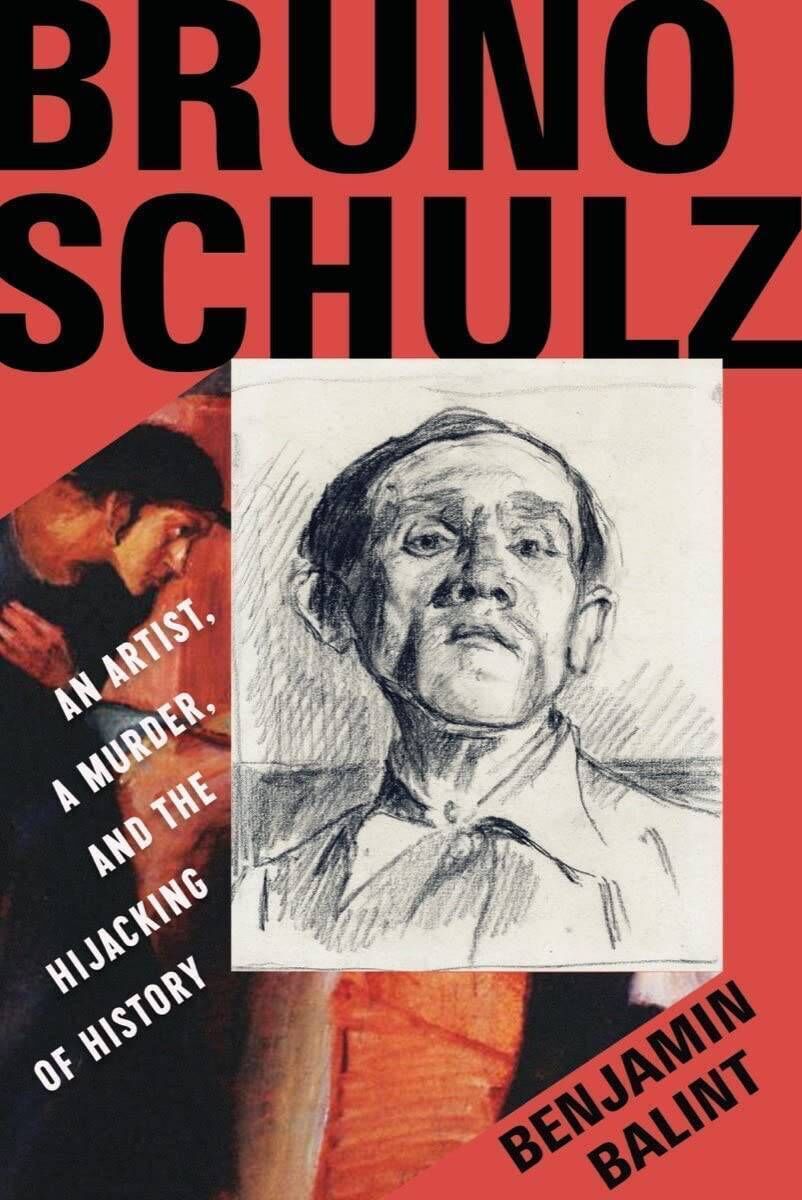
Balint, a Jerusalem author, whose other books include Running Commentary (2010) says he came up with the idea for Bruno Schulz: An Artist, a Murder, and the Hijacking of History while in Poland on a book tour for Kafka’s Last’s Trial. “I [encountered] many people in Krakow and Warsaw in 2019 who told me that Bruno Schulz is the Polish Kafka,” Balint says.
Schulz helped out on the first Polish edition of Kafka’s The Trial that appeared in the spring of 1936. Schulz’s then fiancée, Józefina Szelinska, contributed much of the work in this translation, but Schulz took most of the credit.
He was by that stage a well-known figure among the Polish literati. Schulz had already published his own debut collection of short stories, Cinnamon Shops (1934). He published a follow up collection Sanatorium Under the Sign of the Hourglass in 1937. Schulz’s fiction has since been translated into 45 languages. He might have offered the world more literature, but he was shot dead, aged 50, by a Nazi, on November 19, 1942, while walking back home toward the Drohobycz Jewish Ghetto in German-occupied Poland.

On the eve of the Second World War Drohobycz contained about 17,000 Jewish residents. Roughly 400 from that number survived the arrival of the Red Army in August 1944. Many Jews were transported to the Belzec death camp. Others were shot in a forest not far from Drohobycz. After the Second World War the city was, for the second time, incorporated into the Soviet Union. In 1991 Drohobych (note the different spelling) became a regional city in Lviv oblast, in the western part of the then newly independent Ukraine.
Balint says that “Schulz was born an Austrian, lived as a Pole, and died a Jew”. “Born a citizen of the Habsburg monarchy, Schulz would, without moving, become a subject of the West Ukrainian People’s Republic (November 1918 to July 1919), the Second Polish Republic (1919 to 1939), the USSR (September 1939 to July 1940), and, finally, the Third Reich,” the author writes.
It’s a maze of complex history where contested borders are the dominant themes. Balint’s latest book explores why this history is crucially important when thinking about the career — and posthumous legacy — of Bruno Schulz the writer, and the illustrative artist and painter. Between 1922 and 1940, Schulz displayed his art in galleries throughout Poland, including: Warsaw, Lwów (today Lviv, Ukraine), Vilna (today Vilnius, Lithuania), and Kraków. In June 1942 (six months before he was murdered) Schulz had been ordered by Felix Landau, a sadistic high-ranking Viennese SS Nazi, to paint murals for the children’s room in Villa Landau, Drohobycz. The property became a home to Landau during the Holocaust.
In Drohobych today there is no grave containing Schulz’s remains, since nobody knows where they are located. Schulz’s fresco paintings are, however, on public display in Yad Vashem, the World Holocaust Remembrance Centre in Jerusalem, Israel.
In the prologue to his current book Balint visits Yad Vashem and describes them in poetic detail. “One rough-hewn fragment depicts a seductively dressed, resplendent Snow White surrounded by red-hatted gnomes … Another tableau features a colourful carriage drawn forward on clattering wheels into an uncertain distance by two splendid horses ready to canter away,” the author writes.
He refers to the clandestine cultural repatriation project that moved the murals from Ukraine to Israel as ‘Operation Schulz’. It began May 19, 2001, when three Israeli agents (one of whom was, allegedly, an ex-KGB employee) entered Villa Landau in Drohobych and removed from the walls of the property five fragments of murals, which were then brought across the border from Ukraine into Poland, and subsequently loaded onto a jet bound for Israel.
Balint says the Israeli Secret Intelligence Service, the Mossad, “used bribes in this smuggling operation” which amounted to €840,000. He also claims Israel’s [then] ambassador to Poland, the late Shevah Weiss, used his diplomatic immunity to help bring the Schulz murals across the border, from Ukraine into Poland, in May 2001.
The Schulz murals were first discovered on February 9, 2001, by a pair of documentary filmmakers from Hamburg, Germany. Balint’s book, however, explores the idea that the removal of the murals “was followed by a cover-up operation”. ‘Operation Schulz’ defied Ukrainian, Polish, and numerous international laws too.

The removal of the paintings violated both the Convention on the Means of Prohibiting and Preventing the Illicit Import, Export and Transfer of Ownership of Cultural Property, ratified by 140 countries, including Poland and Ukraine, as well as accepted standards for the treatment of artistic heritage set forth by the International Council of Museums, a Unesco organisation founded after the Second World War.
Balint notes that in the summer of 2001 Ukraine lodged official complaints, with the Israeli government and with the International Council of Museums. On September 11, 2001, Avner Shalev, chairman of Yad Vashem, replied in a letter to the council of museums secretary general, Manus Brinkman, stating that “Yad Vashem has the moral right to the remnants of those fragments sketched by Bruno Schulz”.
Balint believes there are parallels between ‘Operation Schulz’ and the case of the Mossad, kidnapping Adolf Eichmann in Argentina in 1960. At the time there was no international criminal court. Eichmann was the chief bureaucrat in the Nazi genocidal project to implement the Final Solution, which culminated in the extermination of six million Jews in Europe during the Second World War. The Eichmann trial in Jerusalem during 1961-62 saw him convicted and hanged for his crimes. The trial was grounded on the same legal principles that came out of the first Nuremberg trials that began in November 1945. However, the actual charges put to Eichmann during that case were not just crimes against humanity, but “crimes against the Jewish people”.
“This brings up an interesting question,” says Balint. “How legitimate is it, and under what circumstances, can a moral right [especially a moral right asserted by a nation] supersede international laws?” Israel and Ukraine eventually reached a legal agreement in 2008 pertaining to the Schulz paintings: the disputed artworks would remain in Yad Vashem ‘on loan’ from Ukraine for 20 years, after which the loan could be renewed every five years. In 2009, Yad Vashem put Bruno Schulz’s murals on public display for the first time.
However, is Israel — to borrow a phrase from Balint’s book — engaging in “post-Holocaust cultural colonisation”? Also, should the Poles feel disgruntled? They believe an invaluable cultural artifact from one of their most well-loved writers has been stolen from them.
“Very much so,” says Balint. “And that is what makes this story so complex.” He concludes with an open-ended question: does Israel have a right to claim writers like Kafka and Schulz, just because they were Jewish? He says neither were Zionists, and they both died before the State of Israel was established in 1948.
- Bruno Schulz: An Artist, a Murder, and the Hijacking of History by Benjamin Balint
- Norton, €27.99


Cancel anytime