Book Review: Anne Enright's tale of unconventional Dublin women spans a generation

Anne Enright. Photograph Moya Nolan
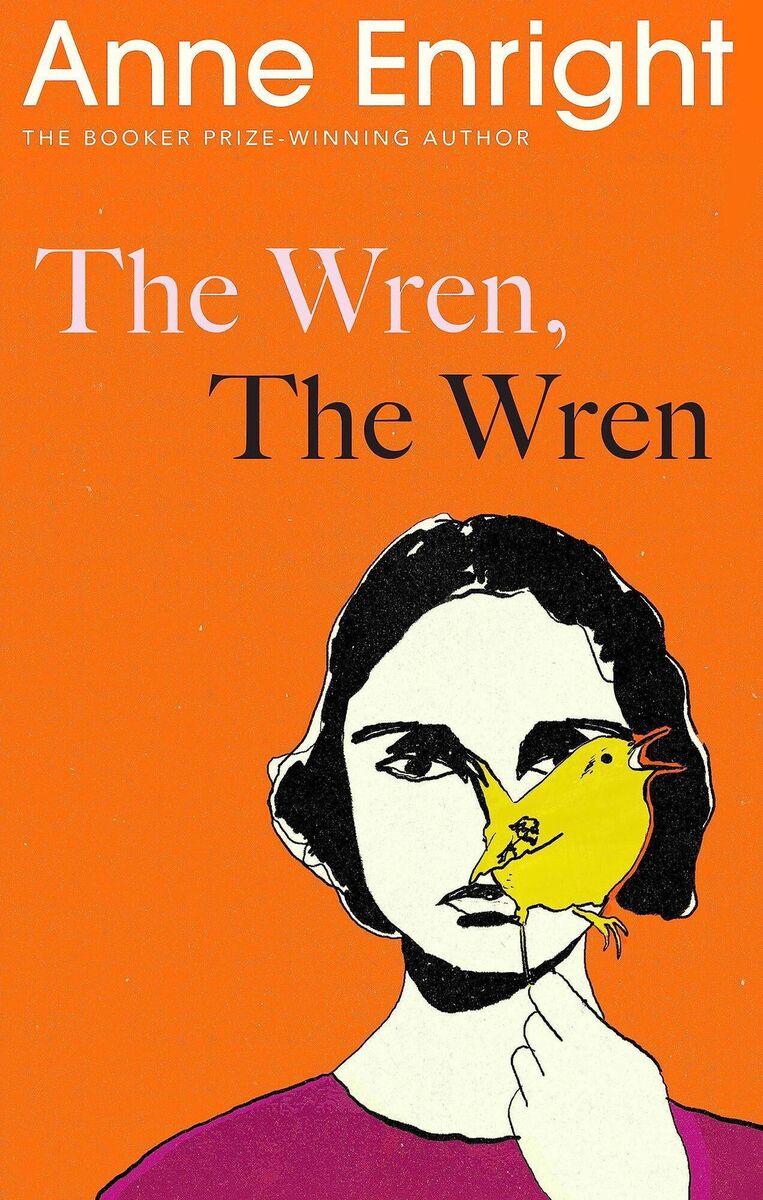
- The Wren, The Wren
- Anne Enright
- Jonathan Cape, €15.99
Anne Enright is one of the best writers of her generation, and this, her seventh novel, does not disappoint.
It is a family saga featuring a mother and daughter, with only glimpses of their respective father and grandfather, the Irish poet Phil McDaragh — a man praised in public for his love poetry, but selfish, even cruel at home.
Both women are independent, unconventional, and consequently outsiders in middle-class suburban Dublin.
Carmel, Phil’s younger daughter, and her daughter Nell tell the story alternately, during the five years from age 22 that it takes Nell to realise what she wants from life.
Nell is a year out of college, self-aware, adventurous, and hungry for experience: ‘I was poking my snout and whiskers into the fresh adult air and I knew how to be… My body was not on mute. I knew how to enjoy sex, eat, get drunk and recover, touch myself, touch someone else…’ Romantic she is not.
Felim, the enigmatic and sometimes coercive man she falls for, suggests a serious relationship by saying, after sex, ‘That was a lot of fun. Let’s hang out, yeah?’.
Her mother Carmel is still suffering the after-effects of her father abandoning the family when her mother, Terry, was diagnosed with breast cancer. Carmel was 12 when he left, and her father’s favourite, the one who seemed to have inherited his poetic temperament.
Terry is an innocent, easily seduced by the sweet-talking poet. Carmel’s dutiful elder sister Imelda acts as nurse to her ailing mother, while working on her PhD thesis.
The monotony of life in their Dun Laoghaire home — ‘a four-bedroomed early Victorian, not too far from the sea’ — is vividly evoked.
But when Terry dies and Carmel realises that Imelda has cheated her out of a fair share of their inheritance, they fight hand-to-hand in a vicious brawl.
Both Carmel and Nell travel after college. Their contrasting reactions to the nudes in the Uffizi highlight their generational differences.
Carmel looking “furtively” at the underneath of a statue is shocked to see ‘a cock and balls’ hanging down, while Nell, who has more fun than Carmel, casually makes a head-count of all the nudes in the famed gallery.
Nell is conceived during a brief fling with Edgardo, a foreign student at the language school that Carmel runs in Dublin. He goes home, and Carmel becomes a single parent.
Perhaps the absence of a father in her life partly explains her daughter Nell’s obsession with her grandfather, the poet.
There is some enjoyable satire on the Irish literary scene, though Phil is entirely fictional.
His poems, quoted as chapter headings, read very well, thanks to the help of two living poets who are thanked in the Acknowledgments.
Phil is even given a section of narrative in which he writes a memoir of his rural childhood, a brilliant pastiche of the genre.
Anne Enright’s sharp intelligence ensures that this novel is far more than just a family saga: it is a meditation on love in its many manifestations — romantic, sexual, or familial — and an exploration of the possibilities for women who choose to live outside the dominant conventions.
I especially enjoyed the many sharp observations embedded in Enright’s prose — for example, Carmel’s discovery as a new mother that ‘…birth was not the end of pregnancy… it was just pregnancy externalized’.
The bird motif is carried throughout the narrative, mutating from the Christmas wren, beloved of Phil, to a cheeky bullfinch that catches Nell’s eye one sunny Sunday, and convinces her of his immortality.
She realises that despite mankind’s mindless destruction of the world, there will always be a bird perched on top of the landfill, singing.