Theatre review: Impressive six-hour staging of O’Casey classics
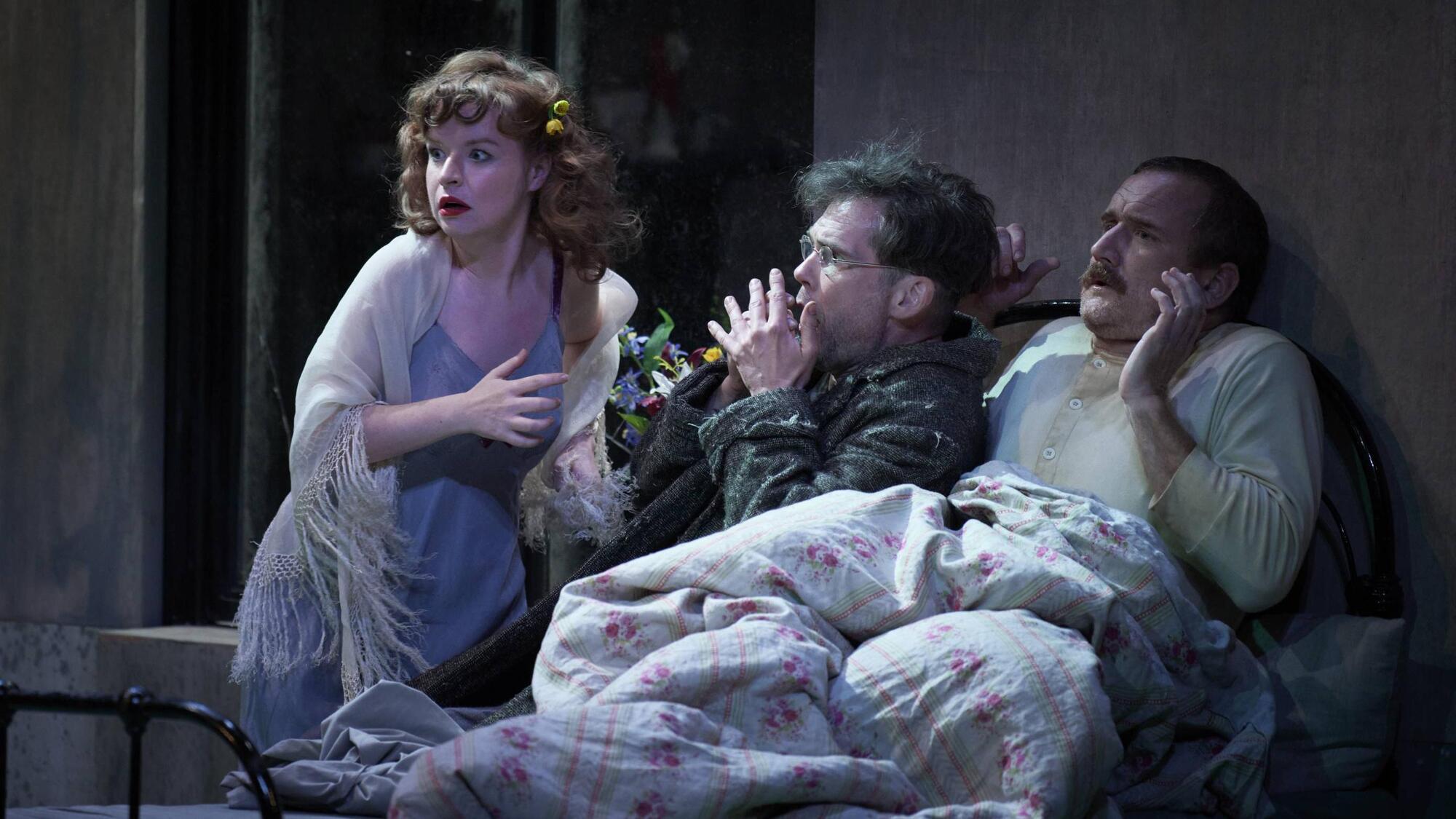
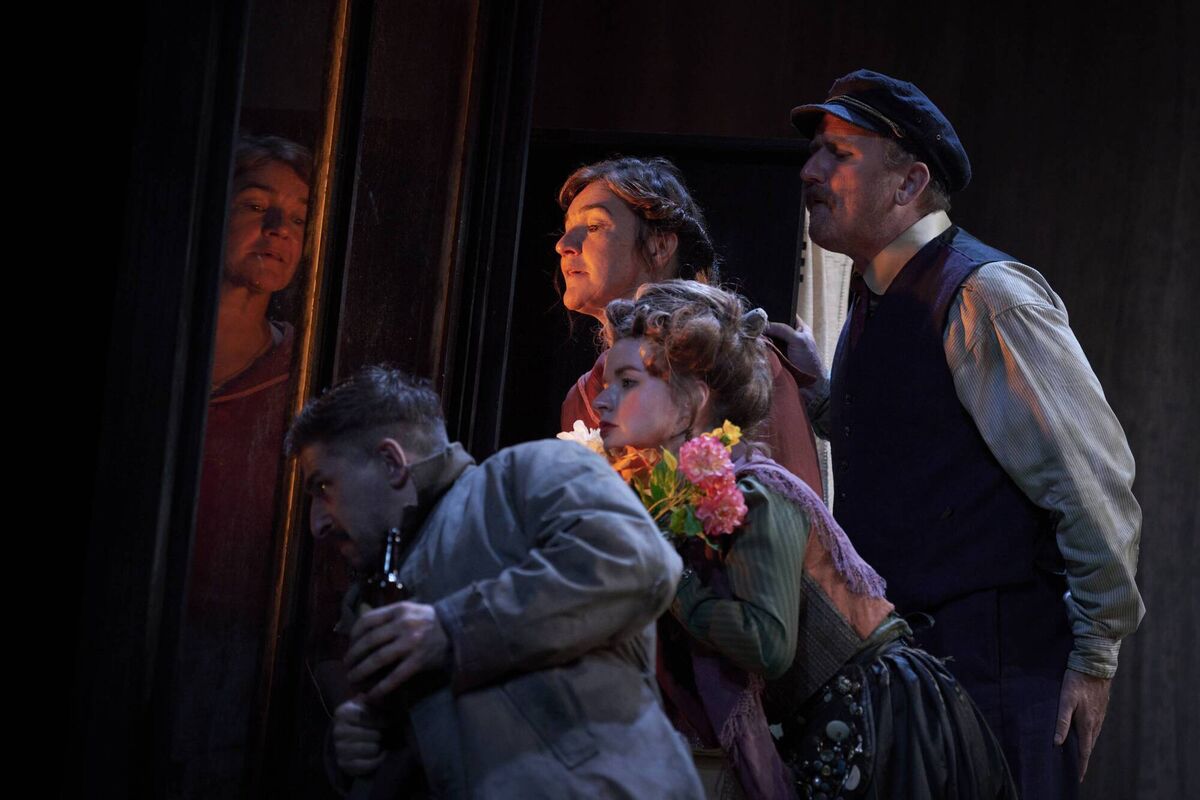
Caitríona Ennis, Marty Rea and Rory Nolan in The Shadow of a Gunman, as part of DruidO'Casey, in Galway. Picture: Ros Kavanagh
- DruidO’Casey
- Town Hall Theatre, Galway
- ★★★★☆
Back in 1991 at the Abbey Theatre, Garry Hynes shook The Plough and the Stars from its slumbering status as a cosy heritage piece. Her stark, expressionistic production divided opinion, but it had a clear intent. Now, with Druid, she’s taking on Sean O’Casey’s full Dublin Trilogy, staging the plays in succession across one day in a way that makes clear O’Casey’s central concern: what happens to ordinary people when history comes knocking?
Hynes takes this cue from the very beginning: the first thing we see is a slouch-hatted, uniformed Garrett Lombard literally knocking on the wall of O’Casey’s intimate tenement world. Rather than staging the plays in the order they appeared (The Shadow of a Gunman first, then Juno and the Paycock, finally The Plough and the Stars), Hynes places them chronologically: The Plough is up first, set around the Easter Rising. There’s a headiness to that moment, an openness, among the men at least, to the rhetoric of nationalism. Shadow comes next: set in the War of Independence, the appeal of revolutionary political violence has truly worn off for bedsit bluffers like Seumas Shields and Donal Davoren. Finally comes Juno, during the Civil War. Here O’Casey’s view is more domestic still: women picking up the pieces amid the carnage.
O’Casey’s dramatic toolbag is stuffed with the conventions of his time: comic double acts, musichall knockabout, maudlin heroines, tragic twists, malapropisms, and melodrama. His genius finds its fullest expression in The Plough and the Stars, where his alchemy turns this base metal into the gold of a national epic. Indeed, it’s so much the masterpiece that it threatens to make the other two plays here seem, in contrast, like partial expressions of what The Plough would fully synthesise.
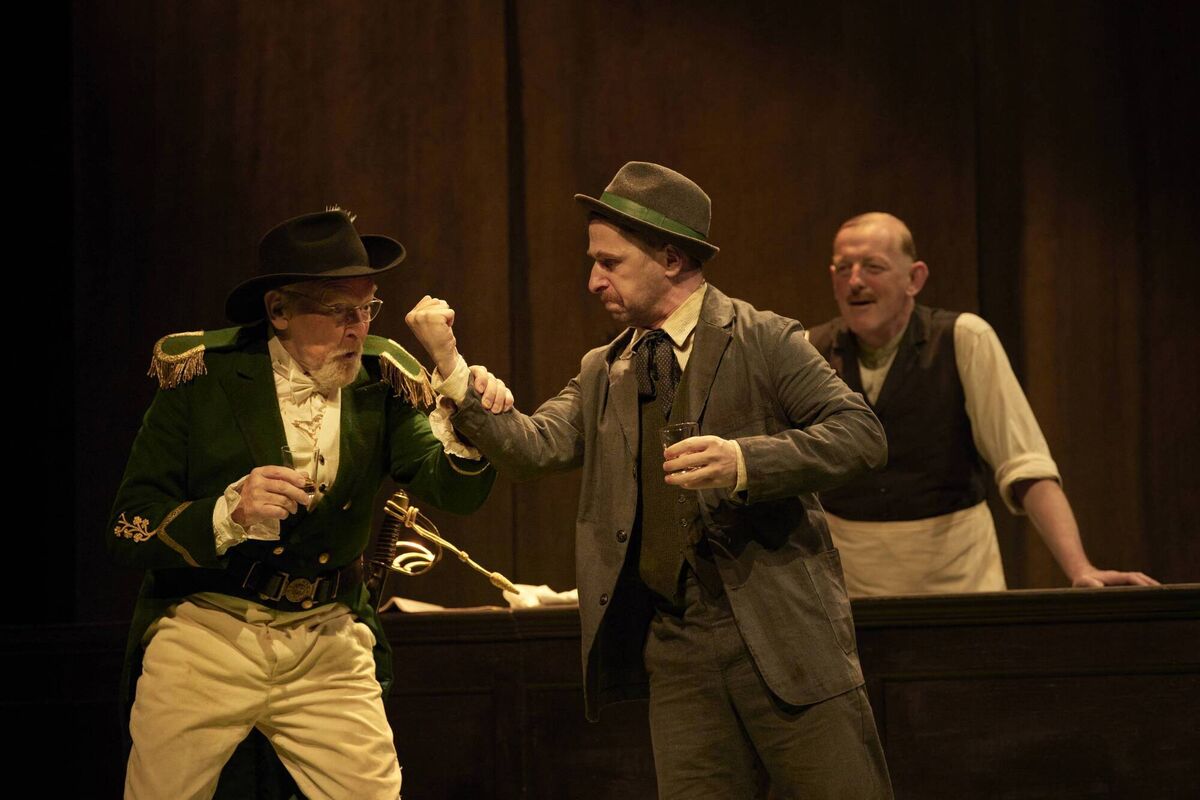
Hynes more than does justice to the mature O’Casey, delivering a Plough that leaves room for all the fun to be had with Fluther (a brilliant turn by Aaron Monaghan), the Covey (Marty Rea), and Uncle Peter (Bosco Hogan), while shifting elegantly into an expressionistic mode, as when the Speaker’s repulsive blood-lust nationalism is shrilly broadcast into the pub in Act 2. Now, the interior shades into blood red, the dialogue, elsewhere so full of poetic colour, devolves into dehumanising chant. Sophie Lenglinger, meanwhile, brings presence to the difficult part of Nora Clitheroe, and Hilda Fay’s Bessie Burgess grows to operatic proportion in her death throes.
After this magnificent staging, Shadow feels like a sitcom. Conor Linehan’s score takes a shift into the 1920s, delineating the setting for this work. Even at his weakest, however, O’Casey gives enough for a good actor to thrive. There’s genius and there’s genius in it, as Mrs Gogan might say. Seeing a chameleon-like Marty Rea give us a wimpy drip of a Donal Davoren after his surprisingly robust Covey is a treat. As is Rory Nolan’s Seumus Shields, something of a warm-up towards his full-blooded Captain Boyle in Juno. Caitriona Ennis as Minnie steals the show with a sparky turn.
The Plough’s shadow reaches Juno and the Paycock too. Its scenario, of struggling families, noble women, and feckless men, feels like something of a retread. But Hynes varies the tone: Captain Boyle and Joxer are pathetic and funny, of course, but one senses little patience for them here. We are almost as exasperated as Hilda Fay’s Juno. They are, simply, inexcusable.
Hynes carries out a great stripping away, cutting through O’Casey’s comedy, just as, their inheritance up in smoke, the Boyles’ possessions are carted off. In an inspired coup de theatre, the curtain lifts for the final scenes on a bare, black space. The set’s wall panels are pushed aside, and turned backwards, the stage otherwise empty, save for one doorway. We started with Jack and Nora Clitheroe’s flat, neatly furnished, a place of pride and self-respect. We end here, in a vision of bleak uncertainty: a door into the dark awaits Juno and her pregnant, jilted daughter Mary (Zara Devlin).
The last words, inevitably and undeservingly, fall to Joxer and Captain Boyle. Their double act, mercilessly exposed, is now a Beckettian absurdity. Empty words and bravado can’t hide the brute fact: it’s an uncaring, indifferent universe, unless we care for ourselves.
In the end, even the doorway, with a bang, falls flat. But nothing else does in DruidO’Casey, a significant achievement by Hynes and her superb ensemble, and one that wears its six-hours-plus duration lightly.
- Until July 30 at Town Hall. Lyric Theatre, Belfast, August 5-19; Abbey Theatre, Dublin, August 26-September 16