Book Interview: Eimear Ryan talks about what it is to be a woman in the GAA

All-Ireland senior medallist Eimear Ryan. Picture: Miki Barlok
- The Glass Ceiling
- Eimear Ryan
- Sandycove, €18
Around the time of her Holy Communion, Eimear Ryan received a gift of a framed print of Seamus Redmond’s famous poem, ‘The Hurler’s Prayer’, which she immediately added to her bedtime prayer rotation.
Ryan loved the rhyming couplets and accumulating rhythm of the poem so deeply that nightly repetition made recall of the words instant, bright and colourful.
Understanding and grasping the full meaning of those words though, and how they were constructed to portray the hurler, gradually became a bigger challenge for Ryan. As a child, she used to stumble over a handful of lines, one in the middle where the speaker of the poem wishes for his on-field actions to be ‘manly’.
The last two lines, where the focus abruptly shifts towards the afterlife, were even harder to reconcile in the mind of a young child who simply loved to play the game. ‘May the great referee when he calls my name / say ‘You hurled like a man, you played the game.’
Ryan knew how to hurl but the poem made her feel that manliness was the ultimate quality of a hurler.
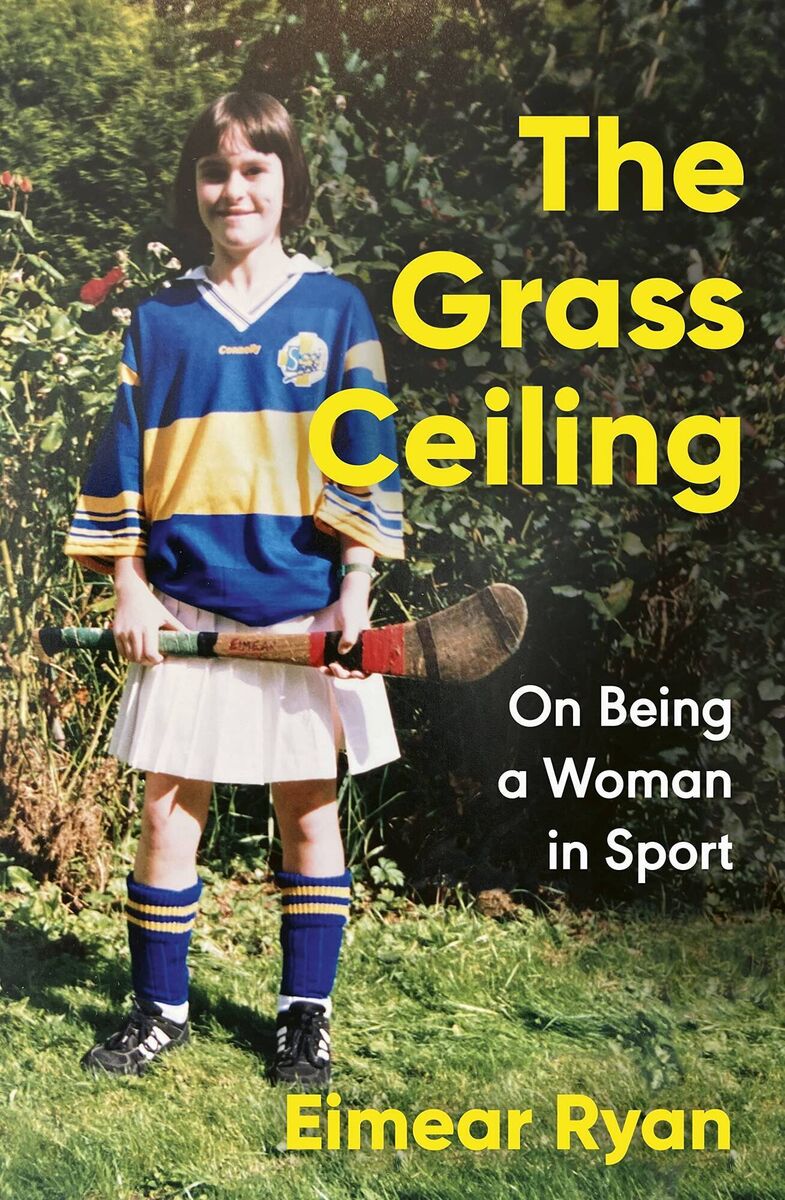
“I wasn’t even sure what that meant,” writes Ryan in her brilliant new book, The Grass Ceiling.
“What did I know of hurling like a man? What was the great referee going to say to me at the pearly gates? ‘Sorry, you hurled like a girl; I can’t let you in’?”
From a young age, Ryan struggled with what she felt was a sense of unfairness about her standing in the game or, more, how that standing as a camogie player was often diluted and downgraded, and ultimately perceived by a wider GAA audience.
The book is a vividly descriptive portrait of those struggles, as much in Ryan’s own head as on the field, to somehow try to crack that ceiling, never mind even coming close to breaking it. The evocative detail of those experiences lies in that constant thirst and desire to challenge those ingrained attitudes, and somehow make sense of any outcome.
Ryan dearly loved camogie but the failure of the game to fully reciprocate her passion was something that forced her into questioning many other aspects of her life, most of which were intrinsically connected to how a camogie player lived that life, or was almost expected to live it.
Ryan’s bold and deep search into so many of those internalised questions provides a fascinating collage of emotional detail. Writing a personal book is always a challenge but it was also a cathartic experience for Ryan.
“Someone asked me if it was therapeutic,” she says. “It wasn’t like this instant relief I felt when putting down words. But I suppose when you go back to difficult and painful memories and maybe things you avoid thinking about, you do have to work through those feelings, sort them out and come to terms with them.
“I wanted to broaden the base and get away from the clichés and the established narratives that are there. I feel like in a weird way that for something that means so much to us, there is quite a narrow emotional range in the GAA.
“There are certain things you can express, and certain things you can’t. I would love to be part of that broadening of the conversation. Even for men to pick up this book and realise that they share a lot in common with me, that we have that shared GAA childhood and those common club experiences, and those occur regardless of gender. Those experiences are universal.”
Some of them though, are extremely revealing, providing a unique insight into a mindset that was — and still is — at the heart of an established set of attitudes across society towards women and girls in sport.
Ryan brilliantly paints that picture of a young girl playing an underage hurling match with young boys, of how the sight of a ponytail sticking out of a helmet would be greeted by a laugh or a snigger, an uncomfortable bravado latently on display for the girl’s discomfort.
Once the game started, the girl suddenly, momentarily, had the power. Initially the boy would stand off the girl — something which is still obvious to this day, particularly in primary schools hurling and Gaelic football matches — as the boy tried to process the challenge. The girl must be good if she’s playing with the boys, but how good?

Once the boy recognised Ryan’s ability, he would become lost and absorbed in just playing the match, which is what the game is supposed to be all about in the first place.
“I loved playing with the lads,” says Ryan. “But there was always that bit of negotiation beforehand.”
Ryan did play at a very high level, winning an All-Ireland senior medal with Tipperary in 2004. The final took place the day before her 18th birthday. She was studying for her Leaving Cert. It looked like her inter-county career was about to take off. But it never hit the level Ryan desperately wanted it to.
Permanent status as a substitute, Ryan writes, brings out the same symptoms as unrequited love: “Jealousy, paranoia, and yearning.” The dugout was a place of desolation.
The loneliness of the unused panel member is heightened by the fact that it’s so hard to express. For so many players though, male and female, who find, and who have found themselves in that position, Ryan paints a clear picture of that toil and psychological struggle.
“So many sports books are written by players at the very top and they have such a different mindset,” says Ryan. “They don’t have much self-doubt whereas I’m the complete opposite. I’m quite an anxious person. I’m always questioning myself.
“The book was strange in how I had to look back and reassess my career and I just came to the conclusion that I didn’t fulfil my potential, which is kind of a heart-breaking realisation. I am full of regrets about my career but I think that will resonate with a lot of people out there.”
Time, experience and perspective has given Ryan the tools now to add more balm to the scars that those experiences left.
“I was lucky to be part of a successful setup,” she says. “In retrospect I am so glad I had that experience. I just probably wasn’t old enough to appreciate it at the time.
“If I was 24 or 25 and in the same position and not a starter on the team, I think I would have appreciated it a bit more. But because I was so young and so ambitious, I could only see that I wasn’t at the very top level that year.
“Going back to those moments now, there was a lot of stuff from that I either buried or hadn’t thought about. It’s also an ungenerous thing to be part of a successful set up and feel conflicted. Parsing through all of that and admitting to myself that this is how I felt, that was definitely a process.”
Ryan is a talented author. She was writing for seven or eight years before ever writing about the GAA, which was at the suggestion of Kevin Barry and Olivia Smith of Winter Papers who specifically requested an essay about women in the GAA in 2016.
Ryan had only previously written about that subject in secondary school and, while she is now a respected columnist with the Irish Examiner, she had consciously avoided personal writing about that subject for so long.
“Once you start writing about the GAA, absolutely everything is on the table,” says Ryan. “It’s your childhood, your family, your identity. Absolutely everything. You can’t help but drag all that in. I think I was afraid of the subject in a lot of ways.
“That first essay was very, very difficult to write. I was very stressed writing it. But once it came out, it got the warmest reception of anything else I’d ever written. I think that happens when you write something very personal. The more specific you are, people will identify with it.”
The flipside to that challenge is that people included in the story can always have a different interpretation of how the story is told. Their view doesn’t always necessarily sit in tandem, or agreement, with that of the author.
“One of the most nerve-wracking parts of the process for me was when I was finishing up the draft of the book last October, isolating the passages that mentioned other people, and then sending them to those people to get their sign-off,” says Ryan.
“It’s a weird thing to be written about, to be a character on someone else’s page, and I was really afraid of what family, friends, former team-mates would make of it. They were all really generous. There were a couple of fact checks here and there but the general response was, ‘This is really honest, fair play to you’.”
That honesty is a rich tribute to Ryan and the many important messages that echo loudly across the pages of The Grass Ceiling.