Adrian Duncan: An art story inspired by Bungalow Bliss
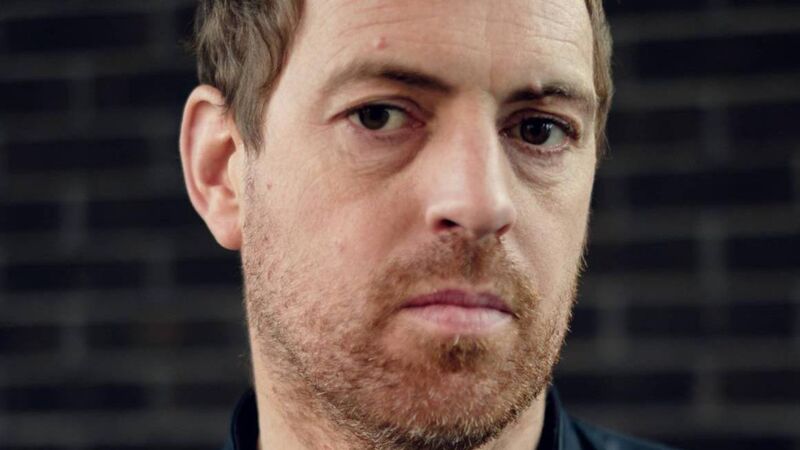
Author Adrian Duncan. Picture: Finn Richards
Few books have been as divisive as Bungalow Bliss, the catalogue of affordable house designs self-published by Jack Fitzsimons in 1971. Depending on who you listen to, it brought home ownership within the reach of the modestly incomed, or gave rise to a blight of squat unsightly dwellings all over the countryside. Over the past 50 years, Bungalow Bliss has sold over a quarter of a million copies, which seems testament enough to Fitzsimons’ foresight.
Given the extent of the current housing crisis, it seems timely that the artist and author Adrian Duncan has put the Bungalow Bliss phenomenon at the heart of his solo exhibition, Little Republics: Preparations and Elements, at the Irish Architectural Archive in Merrion Square in Dublin.
Duncan was inspired by his personal experience of growing up in a bungalow in Co Longford. “Like a lot of people in the early 1970s, my parents wanted a home of their own,” he says. “But there were not that many options. You had to emigrate or inherit or get on the housing list. Bungalow Bliss showed there was a fourth option. Jack gave the building costs beside each design, so people could make a decision based on their budget.
“Also, people had the skills to build these houses. People have different skills today, but in the late 1960s and early '70s, there were lots of bricklayers and carpenters around. The whole social fabric of the country – education, the economy - was changing. The car was affordable, you could drive around the landscape. From an environmental viewpoint, the bungalows aren’t great - they’re dispersed, with very long distances between them – but they were a brilliant way for people to build a home in Ireland. In that regard, they were fantastic.”
Duncan worked in the building trade himself for many years, having qualified as a structural engineer in 1999. “I quit in 2008,” he says. “A lot of engineers stopped working around that time, when we went into recession, but I was gone anyway. Around 2007, I’d started putting a portfolio together to apply to art college. I was accepted for a degree in Fine Art at IADT, and I started attending creative writing classes at the Irish Writers Centre around the same time."
At college he studied such subjects as life drawing and sculpture. "I was blown away by both the art-making and the writing. I was completely addicted. But after two years, I ran out of money. I wanted to stay in education, as I was enjoying it so much, but the only option was to go up a level. So I applied for a Masters in Art in the Contemporary World at NCAD. I didn’t need to have finished my degree in Fine Art; the only requirements were that I had any kind of previous degree and an interest in art.”
On graduating in 2011, Duncan moved to Berlin and found work teaching while he honed his skills as an artist and author. His first novel, Love Notes from a German Building Site, won the John McGahern Book Prize in 2019. He has since published two other novels – A Sabbatical in Leipzig, and The Geometer Lobachevsky – as well as a collection of short stories, Midfield Dynamo. He denies being prolific.
“It’s just that they’ve all been published in the past four years,” he says. “But it’s four books in twelve years, once you factor in how long it took to write them. Love Notes took five years alone.”
Duncan has also made films. Lowland, which he directed with Feargal Ward, won the Best Director Award for an Irish Short at Cork International Film Festival in November. His latest, Prosinecki, has just had its premiere in Rotterdam, and he is already at work on its successor. “It will be about a sculpture here in Germany, but it’s still a bit ropey, I don’t really know what it is yet.”
In 2021, Duncan won a Project Award from the Arts Council. It allowed him to produce the book Little Republics: The Story of Bungalow Bliss, which was published by Lilliput in October, and prepare work for his exhibition at the Irish Architectural Archive, where he has placed elements of the bungalow – what he calls ‘sculptural interventions’ – throughout the ground floor. “One is a large fabric and timberwork structure I made with Olga Tiernan, a textile fabric designer from Connemara who lives in Dublin and teaches at NCAD. That’s in the front foyer.
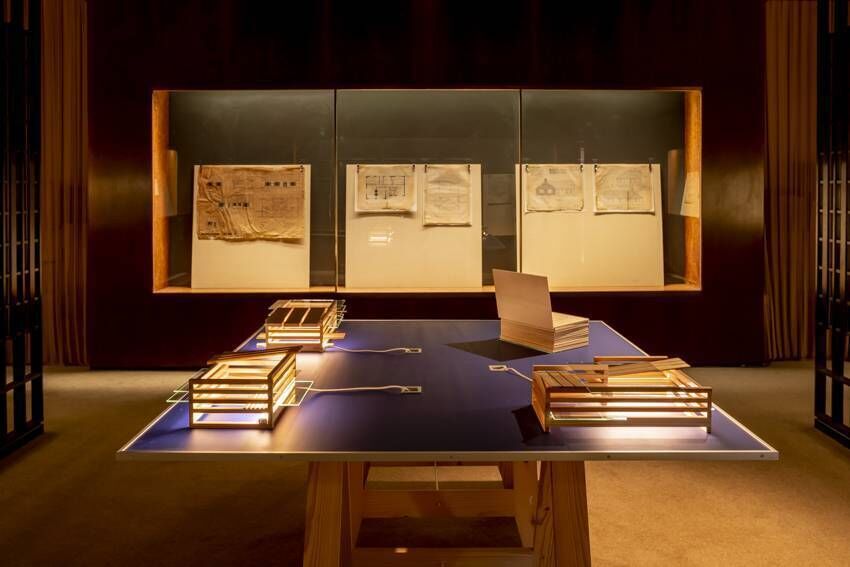
“In the Heinz gallery, the walnut and ebony and glass space, we’ve brought parts of the archive out. We’ve displayed four different bungalow designs, and a row of books that are all lit up so the colours bounce off the covers. We’ve also made lightboxes, and displayed them on what I call tracing tables. My dad was an engineer and did drafting for bungalows. He made a tracing table with a light beneath, so you could trace details of a design onto different sheets of paper.
“I wanted to remake that, reproducing designs on tables, but what I’ve done is etch elements of the design onto the glass.”
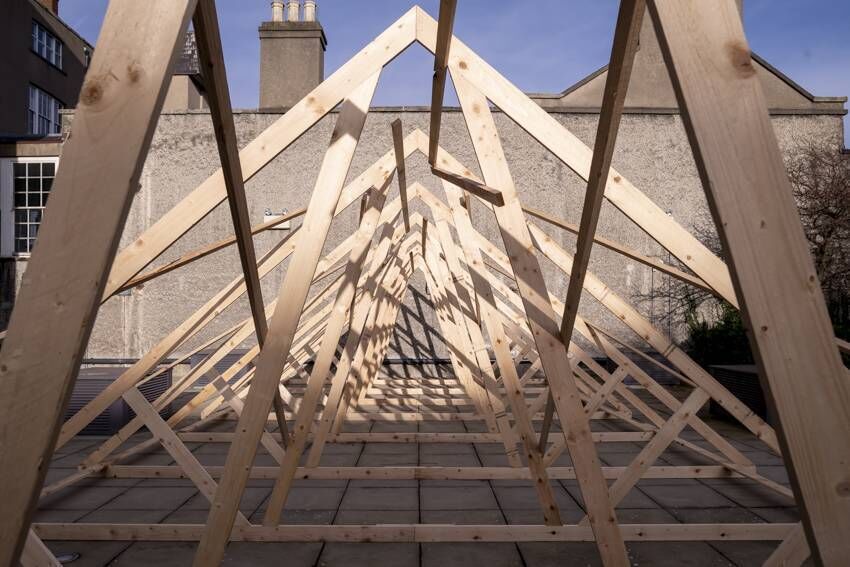
The largest element in the show is a structure Duncan has placed at the rear of the building. “I’ve always wanted to make a bungalow roof,” he says. “I’ve always been conscious that when you cover it over, the structure disappears. There’s something lovely about that. The only time you see the structure is when you go up into the attic, which is a weird little space anyway. So I’ve made what’s pretty much a full scale bungalow roof from prefabricated trusses.”
Duncan finds Berlin conducive to his creative activities, and intends staying on there for now. “I still feel very connected to Ireland,” he says. “But the only time I’ve ever felt homesick was during the Covid lockdown, when I couldn’t get back at all.”
His various activities keep him afloat financially, “but if I didn’t have all these streams, I couldn’t live off any one of them. I’ve never regretted quitting engineering, but the big difference is that an engineer stops work on Friday and doesn’t have to think about it again until Monday morning, whereas with the art it’s like a switch is left on – I never stop thinking about it.”
- Little Republics: Preparations and Elements is curated by Michele Horrigan and Seán Lynch of Askeaton Contemporary Arts. It runs at the Irish Architectural Archive at Merrion Square, Dublin until 3rd March.
- adrianduncan.eu
- iarc.ie