Book review: Writers past meet their present-day peers in a revisitation of The Bell
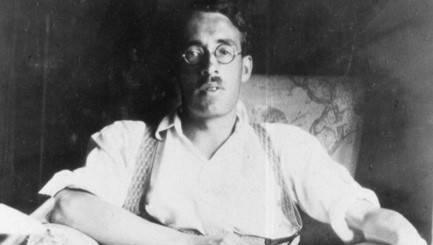
Frank O'Connor - an original contributor to The Bell, whose work is reublished and responded to in 'The Writer's Torch'
- The Writer’s Torch: Reading Stories from The Bell
- Ed. Phyllis Boumans, Elke D’hoker and Declan Meade (The Stinging Fly)

“About what is important, it seems that no one can tell one anything. There really is nothing, till one knows it oneself.”
So says Maria, a restless young woman in Elizabeth Bowen’s ‘Sunday Afternoon’, one of 18 short stories that first appeared in the Irish literary magazine, The Bell (1940-1954) and are now gathered into this intriguing new anthology, The Writer’s Torch.
Maria isn’t at this point in the story directing her critique at literature. But she might be, just as she could be when she sums up the past: “things are done over and over again with more trouble than they were worth.”
Short stories, of course, contain some of literature’s most determined efforts to tell us about what is ‘important’ in concentrated form. Many of them reach into the past precisely in an attempt to rescue how things were done, to examine the trouble they caused, the worth they stood for. Maria, one feels, might have tossed The Writer’s Torch aside in disgust. Which would have been her loss.
At the very least, and from the very beginning, there are feats of descriptiveness to admire and savour. Peadar O’Donnell provides a taut, vivid account of a ship in trouble at sea. Michael MacLaverty lands us in a dilapidated Belfast classroom with rainwater coming through the roof and a teacher making moonshine under the guise of a science demonstration. Elizabeth Bowen is our guide on the lawn of an Anglo-Irish villa in Dublin: “The late May Sunday blazed but was not warm: something less than a wind, a breath of coldness, fretted the edge of things.” This is beautiful writing, which doesn’t let up when the focus shifts to the elderly people sitting out in this weather: “they continued to master the coldness, or to deny it, as though with each it were some secret malaise”.
We end up with a quietly stunning evocation of an “eternalised Sunday afternoon”.
The Writer’s Torch also comes with a twist. Each story is matched to a ‘response’ from a contemporary writer. These responses come in different shapes and sizes: literary criticism, personal memoir, new stories, homages.
Philomena Mullen uses her academic background in sociology, and her personal experience as a mixed-race child in Ireland, to delve into the nuances of Mary Beckett’s story ‘Theresa’, about a young woman who has the child of a Black American soldier stationed in 1940s Belfast.
‘Why Blame the Seagulls?’, Peadar O’Donnell’s shipwreck story, brings forth Danny Denton’s measured but moving meditation on life in a new family home close to the house he grew up in (which had its own associations with tragedy at sea).
Martina Evans expertly ponders Olivia Manning Robertson’s tale of an injured child from the slums being brought to hospital, a story drawn from Robertson’s experiences as a Playground Leader for Dublin Corporation.
Nicole Flattery trades hallucinatory tales with John Hewitt.

Phillip Ó’Ceallaigh revisits his previously low opinion of Frank O’Connor in the light of the latter’s story ‘Uprooted’ in which two urbanised brothers, a priest and a Dublin teacher, return to their childhood home, re-entering a natural world of land, sea and light, and an ancient society running on old rules and customs, where faith-saturated language oscillates continuously between caginess and wild emotion.
‘Uprooted’ is one of the original stories that sticks hardest in the mind, as is Seán Ó’Faoláin’s ‘The Man Who Invented Sin’, a curious, spirited, enigmatic story of a golden summer the narrator spends in the company of two young nuns and two young monks “in the days when we used to pour out into the mountains to learn Irish”. (Ó’Faoláin was the first editor of The Bell.)
Mary Lavin’s ‘A Story with a Pattern’, meanwhile, is a brilliant exercise in multi-layered literary self-examination and self-doubt that still pulses with bravura storytelling and characterisation.
Naturally, when taken together, the 18 stories from pages of The Bell open a pretty wide window on mid-20th-century Ireland. We meet a hard-pressed but capable people, sometimes small-minded, warm but suspicious, who know what to do in life and in death. A society low perhaps in its stock of outright dissenters, but rich in unadulterated mavericks. A country which, though far less subject than others to industrialisation, could nevertheless produce its own razor-sharp dichotomies of urban and rural. This was “the most stable and most conservative country in Western Europe”, as the narrator of ‘Fable’, Margaret Barrington’s miniature jewel of a story, puts it to an Englishwoman newly and not yet comfortably settled in
rural Ireland.
But there is enough as well to keep us mindful of not getting too carried away with Irish exceptionalism. Local colour is applied to universal patterns of love, jealousy, insecurity, regret, and so on. Val Mulkerns’ story, ‘Girls’, concerning fraying friendships among three young women hosting a cocktail party in Dublin, might easily have taken place in New York or London.
The church is, inevitably, a recurring, unavoidable presence. But, surprisingly, it emerges as a benign force overall. Other than a humpbacked beggar who passes her in the street, the only person who shows kindness (and consistently so) to Janey Mary,
James Plunkett’s starving, downtrodden tenement child, is Father Benedict, aided by his Augustinian confreres. O’Faoláin’s young monks and nuns, meanwhile, emit a bewildering air of Merry Ireland, which time dims without ever quite quenching.

In Liam O’Flaherty’s oddly lurching story ‘The Lament’, a parish priest tries gently to forestall the protagonist’s painful descent into an all-consuming religious zealotry.
Bryan MacMahon, meanwhile, conjures an old Irish priest in America who, ever anxious to prevent “the shredding of his community”, orchestrates the rapprochement of the emigrants in his care with a half-Chinese jewellery shop owner whose mother came from Kerry, allowing her to speak in a voice the rest had not heard before. By the end, he seems to have become her new friend and religious mentor.
Most striking of all in this regard is Mary Beckett’s aforementioned story, where it is the priest who is the protector of Theresa and others like her, warning from the pulpit that he will he will publicly disgrace any person saying a word against mothers rearing their children alone. The nuns at the orphanage from where Theresa retrieves her baby are full of praise, warmth and encouragement.
Elsewhere, in the margins, there are “rosy-faced nuns” chalking on blackboards, a parish priest building a handball alley for the boys of the town. And the Church is a reliable well of metaphors and similes: one character sets a table “with deliberate, automatic fingers, like a nun preparing the altar”.
It is not a uniform picture, of course. A severe and sanctimonious curate, straight from central casting, barges his way in to the O’Faoláin story, threatening dire consequences, but he is given the run-around (by, among others, his own parish priest). The priest returning to his homeland in ‘Uprooted’ is lonely and frustrated. A priest who pops up to denounce Hollywood is handled genially enough in Benedict Kiely’s typically beguiling ‘The Enchanted Palace’.
The Writer’s Torch is a bit of a treasure trove. It contains many other good things and freewheeling curiosities that I haven’t been able to mention.
I recommend you go and find them for yourself.