Barbara Walker at the Glucksman, UCC: Addressing racism through art
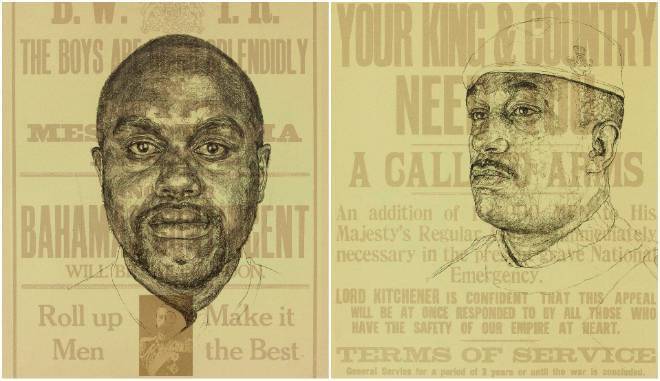
Images from the Glucksman exhibition featuring Barbara Walker.
The British artist Barbara Walker has the distinction of using the humblest of materials to investigate issues of race and privilege. Awarded an MBE in 2019 for services to British Art, she often works in pencil or conte crayon, drawing on paper or directly onto the gallery walls.
As demonstrated in The Big Secret III - one of her contributions to A Line Around an Idea, the current group exhibition of drawings at the Glucksman Gallery in Cork - it is not unusual for Walker’s artworks to feature a blank space where there might be a human figure. Such absences reflect what she perceives as the erasure of black participants from official accounts of the two world wars and other historical events.
“My early work was rooted in social documentary,” she says. “Now I look at social issues through a conceptual lens.”
Walker’s works in A Line Around an Idea include drawings of black individuals on recruitment posters. They come from a series called Shock and Awe, which reflects on the contribution of black servicemen and women to the British Army over the past hundred years.
“The project was born of a discussion I had with someone about how British soldiers, as depicted in the media, appeared to be predominantly white. I didn’t hear the voices of black soldiers fighting for the British armed forces, and I wanted to capture that.”
Walker’s own family came to Britain from Jamaica, as did at least two-thirds of the 16,000+ black soldiers who fought for Britain in the First World War.
“Initially, I was looking at the experience of contemporary soldiers, and particularly those fighting in the Afghanistan and Iraqi wars. But then, to better understand the contemporary situation, I decided to go back and explore the experience of black soldiers in the First World War, in particular the experience of British West Indians – colonial soldiers that fought for king and empire - as it relates to my heritage. I began with archives in the UK, but also, later, in the Caribbean and the Library of Congress in the US.”
Shock and Awe was commissioned by the Midlands Arts Centre in Walker’s home city of Birmingham, where the series was first exhibited in 2016. Walker continues to live in Birmingham, where she studied art at the University of Central England before completing a post-grad in Education at Wolverhampton University nearby. “I’ve stayed for practical reasons,” she says. “My family are nearby.”
Living in Birmingham has not always been a happy experience; a previous project, Louder Than Words, was based on her son Solomon’s experiences of the police’s controversial Stop and Search policy, under which black people are nine times more likely to be targeted than white.
“Between 2002 and 2006, when he was aged between 17 and 21 years old, Solomon was stopped and searched by the police on any number of occasions. Each time, he was asked a series of questions and searched, and then presented with a yellow A5 duplicate copy of an official form relating to the stop and search. I wanted to address what had been happening in my practice, to try and make sense of the all the yellow forms he had crumpled in his pockets.”
The works in Louder Than Words were created between 2006 and 2009, but Walker insists the policy continues. "Police officers in the UK still have powers to stop and search you if they have reasonable grounds to suspect a crime. There was a massive increase in stop and search during the coronavirus lockdowns, when the police forces were handed sweeping powers under emergency legislation. The policy remains controversial today because it continues to disproportionately affect black and minority ethnic communities.”
As an emerging artist, Walker often drew inspiration from other black artists such as Sonia Boyce and Claudette Johnson. “The Black art movement was instrumental for me,” she says. “But I am interested in and engaged with lots of practices. Paula Rego is a huge influence. There are hundreds of artists whose work I admire.”
Walker has always painted, but she currently favours drawing, along with the printmaking technique of embossing. “I work in a very traditional way,” she says. “Drawing is practical, accessible and fast compared to painting. I’m arguing a point about drawing and celebrating it; it is not secondary to painting, as some might think. There’s painting, sculpture and drawing, which always sits on the periphery or is marginalised.
"I have thought about that since focusing on the medium, making an argument that drawing can sit equally, side-by-side. It can hold its own. And that’s true of the individuals I depict too.
“Similarly, within printmaking, embossing hasn’t been fashionable for some years, it sits out on the periphery. But I’m bringing it in as a language. Embossing is a type of drawing in itself. The ghostly imprint. Again, the subject and the material, they sit side by side in my work, they’re having a conversation.”
Walker is in the United Arab Emirates at present, preparing a wall drawing as part of the Sharjah Biennial, which runs until June. She also drew directly onto the walls of the exhibition space for her Transcended installation at the Venice Biennale in 2017. Knowing the work will be erased is all part of the process, she says.
“I’m frustrated and disturbed at how particular groups and communities have been marginalised and removed from history. The act of washing the work from the wall is a political statement about how these individuals or experiences I am depicting have been wiped away from history.
“From the moment I make the very first mark, I am psychologically prepared. I am already saying goodbye.”
'A Line Around an Idea: ways of knowing through contemporary drawing practices’ runs at the Glucksman Gallery at UCC, Cork until March 12.