Book review: West Cork Railways reminiscing 
The book includes dozens of vivid photographs and tables of all the railwaymen and women who worked at the various stations
Book review: West Cork Railways reminiscing 

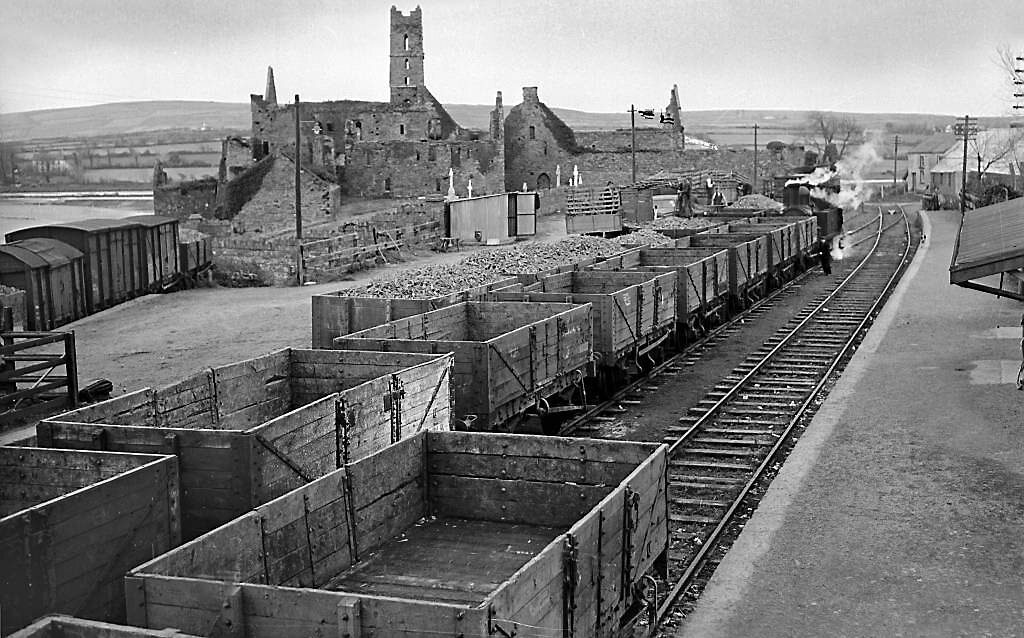
The Timoleague and Courtmacsherry line, part of the West Cork Railway, in 1952.

  • West Cork Railways: Birth, Beauty and Betrayal 
  • Chris Larkin
  • Mercier Press, €25

The highly evocative photograph of the author as a very young boy holding his father’s hand and accompanied by his mother, about to board a train, illustrates Chris Larkin’s passion for railways from a very young age. A lifetime of immersion in trains and railways has culminated in this comprehensive look at the West Cork railways.

The business community of the thriving town of Bandon got the ball rolling when soliciting parliament in London in 1845. The petition was approved and the Cork to Bandon Railway was born. Construction began when Lord Bandon turned the sod watched over by “peelers and peasants”. Engineers navigated some very difficult terrain including gullies and rivers, and the creation of a tunnel at Kilpatrick, but eventually the Ballinhassig to Bandon section opened.

Through the provision of labour the construction project helped to alleviate some of the distress of the Famine which by then was at full throttle. The first train, driven by chief engineer Charles Nixon, rattled into Bandon on June 30, 1849. Phase two of the project saw Ballinhassig connected to Albert Quay in Cork City utilising some magnificent engineering feats including a tunnel at Goggin’s Hill.

And so, on December 6, 1851, 290 passengers boarded the Cork to Bandon train for the first time. Larkin states that the far-sighted vision of civic-minded people “proved so popular that Bandon became a mecca, for horse-drawn coaches eager to offer travellers the option of travelling on to places further west, Like Skibbereen, Bantry, Glengarriff.”

This line would usher in a succession of other lines to create a network that moved people and goods to almost all corners of the county in a golden age for the railways. New routes followed: In 1863 a junction at Crossbarry brought trains to Ballymartle, Farrangalway and on to Kinsale. Bandon to Dunmanway opened in 1866 followed soon after by a line to Skibbereen.

In the meantime, the construction of a rail track from Cork to Macroom was underway. It ran from 1866 to 1879 serving Bishopstown, Ballincollig, Killumney, Kilcrea, Crookstown Road, and Dooniskey. It was reopened from 1925. Taking into account these expansions the Cork and Bandon Railway changed its name to the Cork, Bandon and South Coast Railway.

An extension of the Bandon railway reached Bantry in 1881 and Clonakilty and Schull both in 1886.

With a new state came a new way of operating and the Great Southern Railway was established in 1925 to amalgamate all the railway companies into one overall body. However, economic woes led to the shutting of several lines. Great Southern Railways in turn was amalgamated with the Dublin United Transport Company in 1945 to create a state monopoly.

Larkin takes a number of themes to shed light on the various activities associated with the railways: the sugar beet industry at Mallow where the railwaymen were nicknamed ‘the nightowls’; animal transportation; farming and tourism. And for the dedicated railway historian there are sections on railway bars and apparel (“the railway men took extreme pride in how they looked”).

There is an entertaining travelogue from the author of family trips to the Beara Peninsula when he was eight and others including a trip to one of the furthest outposts at Baltimore.

The book includes dozens of vivid photographs and tables of all the railwaymen and women who worked at the various stations. Further information is provided on signalling, carriages and locomotives. However, the book is a bit shy on text. Regular readers of The Echo and Holly Bough will have seen regular articles by railway writer Pat Walsh on some of these topics.

Larkin writes that it is to be hoped that trams and light rails make a comeback in Cork “like the closed Harcourt Street line in Dublin that reopened in a revised form as part of the Luas”. It won’t be a golden age but it would be a start.

x

More in this section

Scene & Heard

Newsletter

Music, film art, culture, books and more from Munster and beyond.......curated weekly by the Irish Examiner Arts Editor.

Cookie Policy Privacy Policy Brand Safety FAQ Help Contact Us Terms and Conditions

© Examiner Echo Group Limited