Book Review: Local viewpoints compiled by John Creedon illuminate our national Irish history
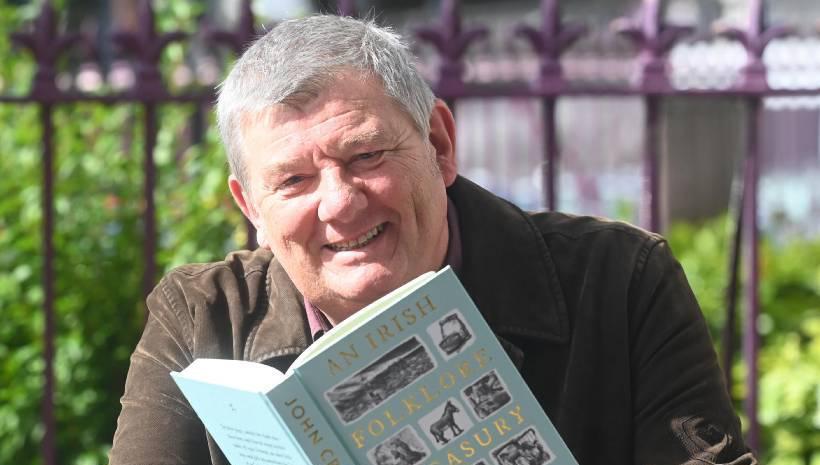
John Creedon, radio show producer and broadcaster with his book, ‘An Irish Folklore Treasury’. Picture: Larry Cummins
- An Irish Folklore Treasury
- John Creedon
- Gill Books, €24.99

Review: Niall Murray
THE successful formula with which John Creedon gleans Irish heritage gold from local communities on the small screen hinges on an ability to draw good stories out of people.
It emerges from many glimpses we get of the broadcaster’s childhood in his second book that a skill for evocative inquiry is not a recent acquisition.
The schoolchildren of late 1930s Ireland turned to their elders and neighbours as informants for the Schools’ Collection, which forms part of the wider National Folklore Collection and is the primary source for An Irish Folklore Treasury.
Its chapter introductions reveal how Creedon’s Cork city boyhood a few decades later was also spent absorbing tales of traditions and characters of old. His sources included his bus-driver father, Connie Pa, and residents and workers of inner-city streets where he grew up with the 11 siblings to whom the book is dedicated.
The anecdotes and folklore reproduced here are a tiny fraction of what fills 500,000 copybook pages, written by pupils for the Schools’ Collection.
Scans of the originals can be read online but many of us still prefer the printed word over digital copies, making Creedon’s selection a valuable taster of what lies inside the vaults of this “national memory bank”.
Readers can learn about local experiences, and memories from over 80 years ago, of major 19th century events such as the Great Famine and the Land Wars, whose narratives are best-known to most of us (if at all) at a much broader — often less interesting — national level.
But tales of superstitions and the supernatural, tradesmen and traditions, and colourful characters of Ireland’s past are most common. They stand well alongside, or sometimes within, chapters on topics such as food and crafts of yesteryear, like using moss cut from Mayo rocks to dye socks.
In one chapter prelude, Creedon recalls mid-century Cork city blacksmith and neighbour Ned Ring who “welcomed small children and huge horses in equal measure” with his face covered in “layers of soot and smoke, stuck with sweat”.
A collection like this would not be complete without a chapter on Ireland’s weather. This extends beyond 1839’s well-known Night of the Big Wind to episodes such as 1917’s “The Big Snow”.
Thomas Lyng of Inistioge, Co Kilkenny, learned from 54-year-old John Lyng (many stories came from parents and grandparents) that the hardy three-month freeze forced people “out to the fields with kishes and pickaxes to dig potatoes and turnips”. Kishes are explained as “wicker baskets” in one of the helpful mini-glossaries, explaining such disused words’ Irish-language origins (in this instance ‘ciseán’, being the Irish for basket).
The primary pupils whose neat handwriting populates the Schools’ Collection keep alive the memory of trades and practices that disappeared well before the digital age.
Even nine decades ago, the decline of local tailors was reported from Rockchapel in north Cork. One local scribe described as “very cranky” the travelling tailor who was then visiting each winter to help keep the community well-clothed.
Beautifully illustrated with Brian Gallagher’s striking artwork, readers will most likely dip in and out of this book at leisure, rather than needing to complete it in a week or even a month.
It would be fitting that the successors of the primary school teachers who oversaw the compilation of the Schools’ Collection also keep copies close at hand, to aid lessons in history, geography, nature studies, or Gaeilge.
Creedon credits many people for their help with research but his highest praise is reserved for “the worker bees: the children”. Those who sit in today’s Irish classrooms deserve to enjoy the fruits of their labour.
BLACK FRIDAY
50% off monthly and annual subscriptions.
Already a subscriber? Sign in