Book review: An ever-maturing voice heard in an exploration of nature
There is a deep affinity to Ireland and our coastal communities and geography, writes Dan MacCarthy 
Book review: An ever-maturing voice heard in an exploration of nature

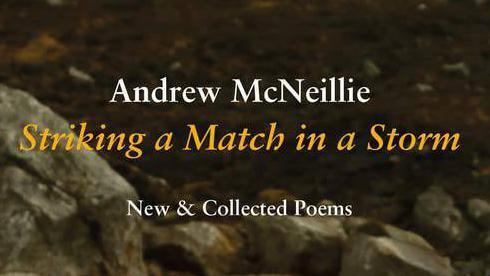
Striking a Match in a Storm by Andrew McNeillie

  • Striking a Match in a Storm
  • Andrew McNeillie
  • Carcanet, €22.30

Andrew McNeillie has a seafarer’s eye sunken into his poet’s eye, or perhaps one of each. The Welsh poet has written superbly on the Irish and British coasts in the literary journal Archipelago, and now in this multifarious collection this rapture for nature is again shown. The wind blows hard and the sea crashes through his poems, brilliant and evocative of the littoral.


This is a collection of his seven books of poetry written since 2000 and an ever-maturing voice is evident.

There is a deep affinity to Ireland and our coastal communities and geography. The poem ‘The Shipwreck at Cape Cod’ recalls the tragedy of a party of Irish emigrants where “The drowned look out through/ wide-open staring eyes, like dead-lights/ or cabin windows filled with sand”.

In ‘Lunch with Seamus’ and ‘Richard Murphy’ he recalls the lives of two of our greatest poets of recent times and in a deeply meaningful way captures what they meant to him.

Connemara was the stomping ground of Murphy and a place that has attracted many other writers including the late mathematician artist. cartographer/writer Tim Robinson. McNeillie recalls their first meeting, and now the deceased staring at him from a portrait, from another dimension.

“The last wise man gone/ another ghost in the ranks up there/ gathered with Thoreau and Melville/ to watch below/ worst fears for Earth and humankind come true”.

However, this is not a man to be overcome by sadness at the passing of close friends. ‘Goodbye’ advises “Don’t tell me absence makes the heart grow fonder/ Tell me about presence./ So summer whispers to the wind’s scythe”.

In his earlier collection, Now, Then the poet takes trees and the birds that live in or near them as his subject. In ‘Willow’ he utilises the characteristics of the tree to demonstrate human characteristics: “A supple heart is strongest of all/ for weaving withies into fish-traps”.  And “Truth stands where it is seeded. As here at the wood’s border/ your crown at evening holds against the sky the first stars I/ ever saw.”

In the same volume, ‘Grey Wagtail’ evokes at once the flight pattern of this small bird and the fleeting nature of relationships: “So I was writing when/ You flew into my head: Another favoured spot/ In your varied habitat.” 

And the pterodactyl-like heron is portrayed as a creature for which “It is impossible to exclude you from the ark of birds/ Though you stand far back in stillness of how many aeons?”. 

At the poem’s centre is the moving heron, watching and waiting, reminiscent of ‘Thirteen Ways of Looking at a Blackbird’ by Wallace Stevens.

In ‘Night Snow’ the narrator appears to wrest poetry from the seascape itself coming around hard at ‘Cape Metaphor’. Out on the ocean the rules are different and the horizon bends to the will of the mariner. “For who but a blind one can’t see/ Scotland from Cornwall?-/ every small hour of the year/ with the heart in the right direction/ And a glass to his eye”.

At his best McNeillie draws comparison with Ted Hughes where man’s place in nature is challenged. It is a nature in the Yorkshireman’s case of otters, wolves and jaguars, an engagement with the preternatural. McNeillie’s primary concerns are with the elements: wind, sun, rain, earth, and where these impact on humankind he is at his best.

In ‘Beside the Sea, Beside the Sea’ “the pier clangs and booms spills and hisses with spray/ limpet and barnacle bleach the tideswept pilings and girders” and “thin rain blows on ahead, looking for somewhere to dry out/ before the crowds descend.” 

And in ‘Sea Green’ there is a visceral sense of urgency and excitement as a sailor puts to sea: “The tide running brackish. Sea-green bass gleam down memory’s current into the jostling river-mouth”.

Striking a Match in a Storm demonstrates an outstanding nature writer at the helm of these poems.

x

More in this section

Scene & Heard

Newsletter

From music and film to books and visual art, explore the best of culture in Munster and beyond. Selected by our Arts Editor and delivered weekly.

Cookie Policy Privacy Policy Brand Safety FAQ Help Contact Us Terms and Conditions

© Examiner Echo Group Limited