Book Review: Inside Qatar shows the underbelly of wealth
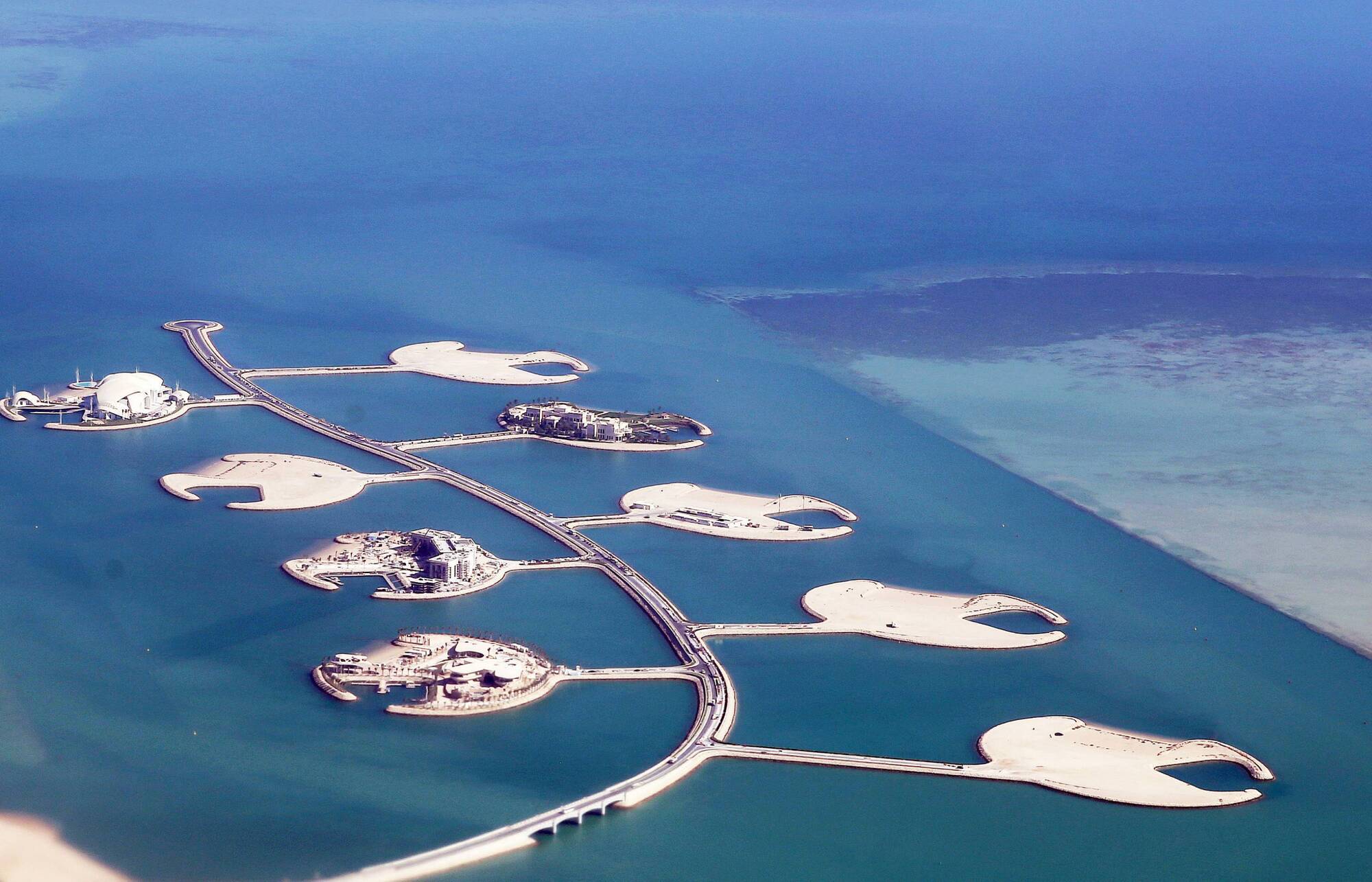
An aerial view taken on December 3, 2017, shows a partial view of the Pearl-Qatar artificial Island in the capital Doha. Picture:Yasser Al-Zayyat

If the counties of Cork and Kerry were to break away and form a nation of their own, they would create a territory around the size of the state of Qatar. Slightly larger in fact. So later this year the World Cup will be held on a peninsula in the Persian Gulf that is about as long as the stretch from Youghal to Dingle. What kind of place is it? John McManus’s account of what he learned from a year of living in Qatar is peppered with telling stats. 72% of the population is male. Qataris themselves make up only 11% of those who live there. Both of these figures reflect the enormous influx of men from India, the Philippines, Nepal and elsewhere to work in the booming construction industry.
On the numbers roll. 81% of Qataris work for the state or a state-owned company. 43% of Qatari marriages are to a relative, most often a first cousin. The high rates of marriage within families leads to an above-average instance of genetic disease.
But Inside Qatar isn’t a mere conveyor belt of statistics (however fascinating and revealing these may be). It is a genuine attempt to grapple with the mysteries of a very curious place, not least in its geography - “a patchwork of camps and compounds”, McManus, a social anthropologist, discovers. ‘Asian Town’ is a newly built complex of malls, an amphitheatre and a cricket stadium, designed, in the author’s words, to keep the inhabitants “amused and away from the rest of the population”. ‘Education City’ is a huge campus on the edge of the capital Doha that is home to outposts of eight elite western universities. ‘The Pearl’ is Qatar’s most exclusive district: a thousand acres of artificial islands built on land reclaimed from the sea, where, in the midst of five-star hotels, high-end shops and man-made beaches, there is a complex of canals modelled on Venice with its own replica of the Rialto Bridge.
The pursuit of luxury is a rule of life in Qatar. Doha is “littered with malls devoted solely to luxury brands – bright, air conditioned caverns that are empty apart from the odd Qatari and an army of shop assistants”.
But it wasn’t always like this. Elderly Qataris who now “watch their grandchildren race Ferraris down Doha’s streets” remember having no running water. McManus is ever alert to the tensions between tradition and modernity and the wavering line Qatar is attempting to walk between these forces.
When it comes to traditions, falconry is a passion among Qatari men. (Expect producers of World Cup opening credits to whip up lots of images of falcons.) By way of contrast, McManus does a good job at explaining the curious in-between status of football in the country about to host the World Cup. But neither falconry nor football is the country’s most popular sport.
That, thanks to the huge South Asian population, is cricket. There are five Asians for every local. McManus’s dive into the cricket scene in Qatar is one of the book’s big eye-openers, from the proliferation of leagues and tournaments (with names like the Nehan Premier League, the Salma Monster, and so on) to the Pakistani entrepreneur, Ali, one of the stand-out characters in the book, looking to make his fortune importing kit and equipment. On Friday mornings, most of the available open land in Doha is full of men playing cricket. The overwhelming majority of South Asians in Qatar are there alone: cricket is “the one time of the week when they can throw off the stress of work, the sadness that their families are a continent away and just hang out with friends”.
McManus explores the country’s controversial labour practices soberly and without sensationalism, and tries to understand the complexities.
McManus explores the country’s controversial labour practices soberly and without sensationalism, and tries to understand the complexities.
He probes the role played by particular features of the system, such as ‘kafala’, a form of sponsor-based employment (which places enormous, much-abused power in the hands of the sponsor), and the labyrinthine sub-contracting arrangements, while matching these with the stories of individual suffering and mistreatment.
There are more statistics to ponder too. According to Amnesty, 85 per cent of domestic workers they interviewed said that, regardless of the provisions of labour laws ratified in 2017, they still did not have a weekly day off. 86 per cent worked for more than fourteen hours per day. Yet one of the workers MacManus interviews, Maggie, reserves some of her harshest words for her family back home in Kenya who refuse to believe that, living in Qatar, she doesn’t have money to burn.
But the truth, MacManus also reminds us, is that Qatar isn’t necessarily special. The kinds of poor treatment of migrant workers that some Western journalists have reported on is, in reality, “prevalent across the Gulf region”. He assiduously demonstrates how labour reforms seem to advance at a rate of two steps forward, one large step back. Journalistic freedom too is hemmed in and precarious.
Inevitably, perhaps, a note of despair seeps in to McManus’s narrative more than once - as, for instance, when he observes that many of the volunteering programmes or community events to be found in Doha are the work of outsiders, not Qataris; or when he deduces that Qatar does not want the country’s relationship with its migrants to be “anything other than transactional”; or when he reflects on the ”racial logic” that is “visible everywhere” in the labour market; or when he realizes that on a day-to-day basis, the majority of abuse and poor treatment is “inflicted by non-Qataris on non-Qataris in a grim sort of migrant-on-migrant bear pit”. The book ends on an anecdote about a Qatari in his Land Cruiser mocking a Sri Lankan taxi driver in a way that “drips aggression and entitlement”.
Is Qatar a country with a big future, then, or has it evolved into some kind of plush, air-conditioned, tightly-controlled dystopia, where the natives are stuck in “a particularly Faustian bargain”: “prosperous but ever fearful”, “suffused with terror and agitation” that it might all be taken away from them by those flooding into the country to make all of the luxury a reality in the first place? The World Cup will be an enormous milestone, but most Qataris, an interviewee tells McManus, didn’t want it. What will happen when the football show moves on?
There is, though, one unequivocal bright spot inside Qatar. McManus’s mindset is secular and progressive, so the source is perhaps unexpected. Another one of the compounds that are scattered around Qatar is ‘Church City’ on the outskirts of Doha, containing nine places of worship, from evangelical to Greek Orthodox. It is the only place in the country where Christians can legally gather and hold services. The buildings cannot display crosses on the outside. Road signs direct drivers towards a ‘Religious Complex’, the word church having been scrubbed to avoid offending Qataris.
The Catholic Church of Our Lady of the Holy Rosary is the largest on site. MacManus lists the ways in which the priest, Fr Rally Gonzaga, a Filipino, helps people with problems at work, or who are seeking to escape an abusive sponsor, or who need food. Above all, though, the Catholic Church is “aware of the harm in always seeing everyone in terms of their nationality or ethnic group”. It is “perhaps the best example I’ve seen in Doha of people truly mixing and learning from one another. Worshipping together. Getting married and having kids. Living and learning.” At Our Lady of the Holy Rosary, MacManus finds “an antidote – if only for a few hours a week – to the hierarchy, the stratification, the racialisation of the rest of life in Qatar”.