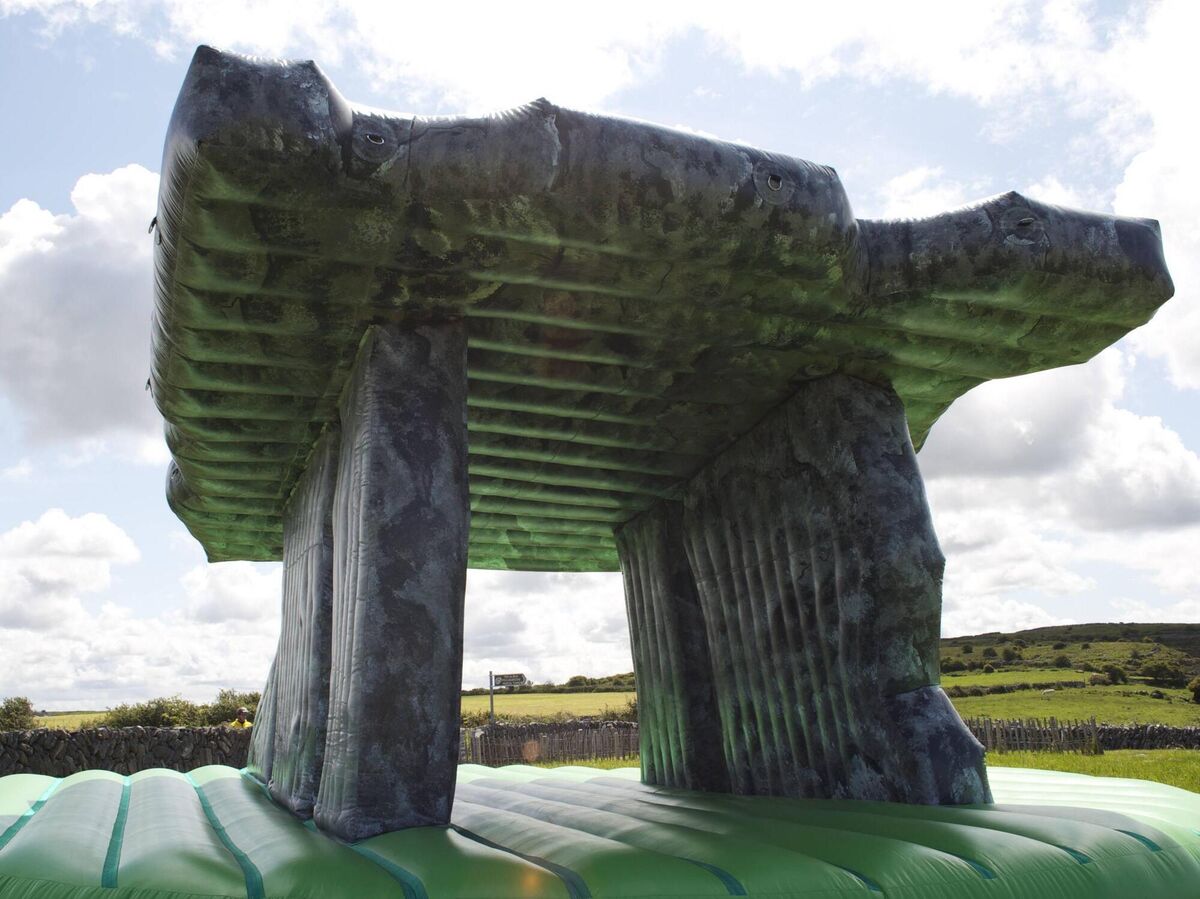
Munster in 30 Artworks, No 7: The Poulnabrone Bouncy Dolmen, by Jim Ricks
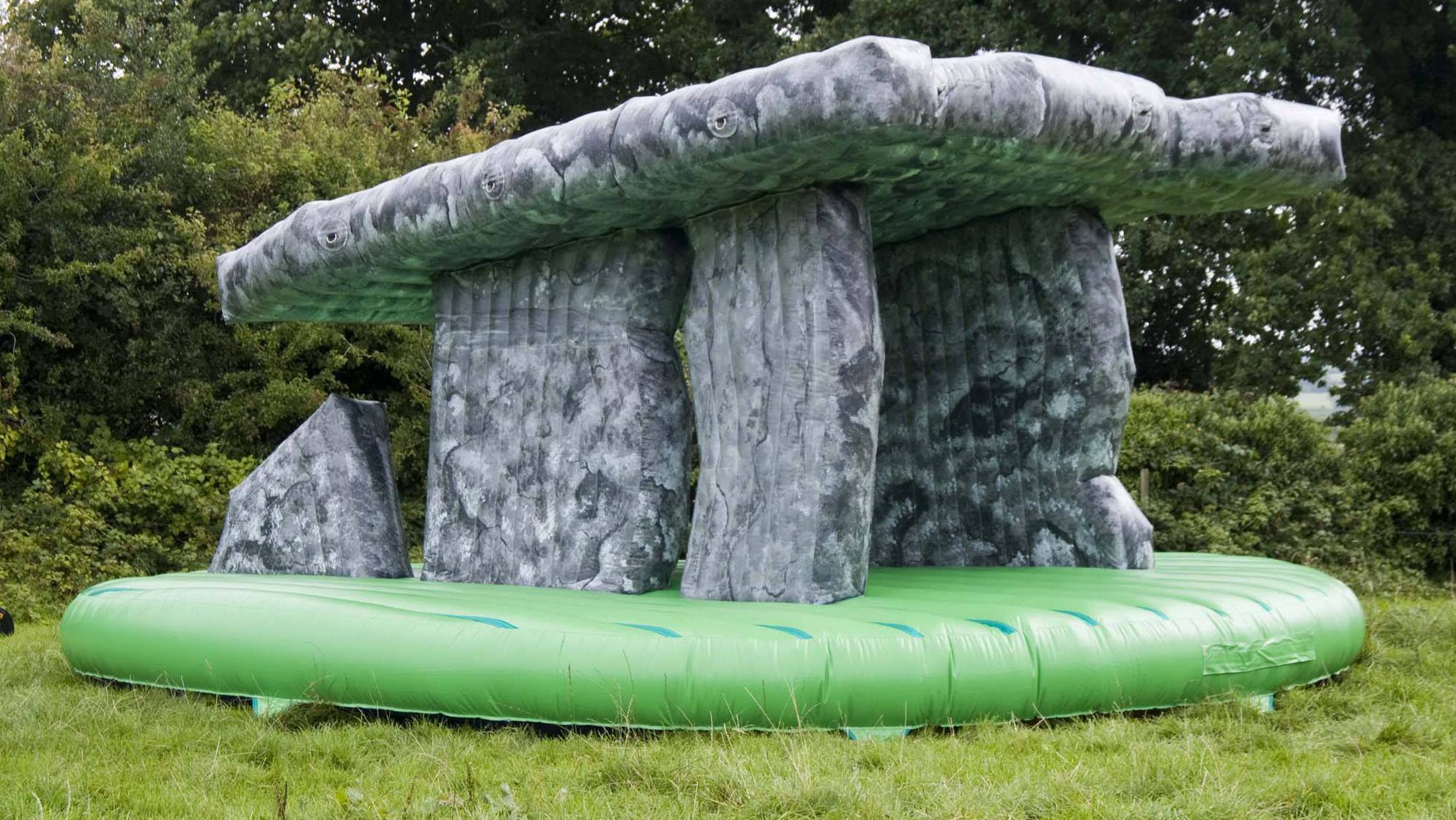
The Poulnabrone Bouncy Dolmen, by Jim Ricks. Picture: David Ruffles
Few artworks have captured the absurdity of the Celtic Tiger years as effectively as The Poulnabrone Bouncy Dolmen, by Jim Ricks. The inflatable plastic sculpture, twice the size of the 6,000-year-old portal tomb in the Burren, Co Clare, that it is modelled on, toured counties Galway and Clare for two weeks in 2011 and was shown at the Royal Hibernian Academy in Dublin the following year.
Ricks’s background is Irish-American. He graduated from the Californian College of the Arts in 2002 before moving to Ballyvaughan, Co Clare, to complete his MFA at the Burren College of Art.
“In my work, I generally respond to my environment,” says Ricks. “So it tends to relate to wherever I am at that time. When I arrived in Ballyvaughan it was 2005, the peak Celtic Tiger era. What struck me was the use of local history as branding. The Poulnabrone Dolmen, five miles from Ballyvaughan, was used on everything from coffee mugs to refrigerator magnets, and it seemed like every other B&B was called the Dolmen Lodge or the Dolmen View, even if it had no view of the actual dolmen. So this ancient monumental sculpture had become a kind of weird marketing symbol, a contemporary logo for tourism.”
The other thing that struck him was the proliferation of bouncy castles. “There was just a phenomenal amount of them. Everybody wanted one for their kids’ birthday party or their First Communion or whatever. It was this new fad at the time, but to me it was also a form of sculpture. So then I thought of combining the two, these two things that were really present in the area.

“It was very much a response to the Burren and contemporary Ireland, looking at how history is marketed. The tourist experience was looking for these cliched symbols. But where does reality fall? Where’s the truth in all this? I thought the simplest thing to do would be to mash them up. To take the old and the new and see what comes of that.”
Ricks had his idea for an inflatable dolmen for some time before Galway County Council commissioned him to make it in 2010, as part of a public art project in the Aughty region.
He wanted his sculpture to be twice the size of the Poulnabrone dolmen, but it was not possible to get near enough to measure its dimensions, as its popularity with tourists meant it has had to be roped off.
“So I photographed it, and I used the archaeological records to measure the capstone. There are drawings that look directly down on the dolmen. Actually, there’s a lot of information available about it, so I didn’t need to go out there with a tape measure anyway.”
Ricks tracked down Inflatable World, the company in Nottingham in the UK that invented the bouncy castle in the 1970s, and collaborated with them on his sculpture’s creation. “I worked with their designer on the stone effect, there was a long conversation around that. We sent samples to and fro before settling on the final plans, and then they produced it and sent it over for the launch in 2011.”
The sculpture has a base 25’ in diameter and is 13’ high, and can be inflated in thirty minutes with an electric fan running off a standard household socket. Over two weeks, Ricks toured it to a number of sites around Slieve Aughty.
“I placed it at ten or twelve different locations. I put it in front of a disused church, and no one came. But then, just up the road, I asked if I could put it up outside this beautiful house on a hill. The family were over the moon at getting to host this thing for the day. There were loads of kids, and it was super well-used.
“People got it, at one level or another. There could be a three-year-old, who just wanted to bounce on the dolmen, but then I’d end up having a conversation with their parents about the ideas behind it. They were curious about why I made it, and how I made it.
“So it proved to be an effective way to talk about contemporary art in a rural setting, where people’s experience of a public artwork might be limited to something they’d pass on the side of a motorway.”

Ricks concluded the tour by bringing his sculpture to Poulnabrone to display alongside the original dolmen. The following year, it was shown as part of the Futures 12 group exhibition at the RHA.
“Around the same time,” says Ricks, “Jeremy Deller, an artist who’s a big name in Britain, did a similar project. He got the same company in Nottingham to make an inflatable Stonehenge, a work he called Sacrilege. The same colours. The same idea. Everything. He had a much bigger budget, of course, so he got to make a much bigger sculpture, and it probably got more attention.
“Some of my friends were outraged. ‘He’s stolen your idea!” they said. But in fact Jeremy had contacted me to let me know what he was doing, and I was kind of flattered, to be honest.”
In August 2012, the artists united to show the two works together in Belfast. “We had what we called a Megalithic Bounce-off. Who won? Jeremy could fit more people on his inflatable, but mine was more popular with the kids, so it kind of balanced out.”
Ricks has spent the past few years making public art projects in Mexico, but has just moved back to Ireland, to settle in Gort, Co Galway. The Celtic Tiger is a distant memory, but soaring house prices and the post-Covid boom in tourism do recall the excesses of those times. Where is The Poulnabrone Bouncy Dolmen now, one wonders?
“As it happens,” says Ricks, “I’ve just taken the dolmen out of storage. I feel it’s the kind of thing that should be used. The only problem now is with public liability insurance; the last time I checked, you couldn’t get insurance for bouncies anymore. But if I can get that sorted, I’d be more than happy to work with the local community and show it again.”
- Further information: jimricks.info

Subscribe to access all of the Irish Examiner.
Try unlimited access from only €1.50 a week
Already a subscriber? Sign in