Munster In 30 Artworks, No 2: Peregrine Falcons Visit Moyross, by Seán Lynch
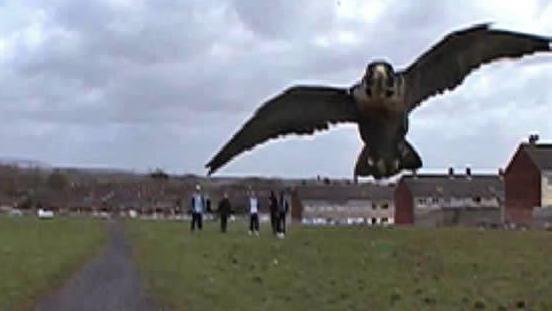
The Kerry artist strapped cameras to the back of three birds of prey to film the Limerick housing estate that was featuring in the news for all the wrong reasons 
Munster In 30 Artworks, No 2: Peregrine Falcons Visit Moyross, by Seán Lynch

A still from Peregrine Falcons Visit Moyross, by Seán Lynch.

Seán Lynch’s Peregrine Falcons Visit Moyross could be described as typical of his oeuvre in that it takes an unusual approach to an everyday subject. The three-minute film was shot from the point of view of three falcons as they swooped and dived over Moyross, a suburban council housing estate not half an hour from where the artist now lives, in Askeaton, Co Limerick.

Lynch is a native of Co Kerry who studied at the Stadelschule in Frankfurt, Germany, before completing a Master’s Degree at the University of Limerick. He represented Ireland at the Venice Biennale in 2015 with a project called Adventure: Capital, which reflected on public art at airports and the representation of Greek river gods on Irish banknotes, among other subjects.


Peregrine Falcons Visit Moyross was shot around Easter 2008. “At that time, there were around 1170 houses in Moyross,” says Lynch. “The houses were built in the 1970s and '80s, and the whole area there was based on the ideal of the Garden City, where people could have the sense of urban dynamics, while at the same time being able to access the nature around them.

 A still from Peregrine Falcons Visit Moyross, by Seán Lynch.
 A still from Peregrine Falcons Visit Moyross, by Seán Lynch.

“But very little civic infrastructure was put in place when Moyross was built. There was a church but not a lot else. By the time I started working on this project, there had been these terrible petrol bomb attacks. Houses were bombed, and a number of kids were very badly injured. Then the President of Ireland, Mary McAleese, came down and announced a regeneration vision for the area, which would involve knocking all the houses and rebuilding Moyross as more of a suburban estate with less green areas and the possibility of better spatial management. But this really upset a lot of people in the neighbourhood, particularly those who had bought their houses outright from the Council.

“I knew Moyross and I thought the people representing the situation in the media didn’t reflect on how complex a place it actually is. They’d photograph boarded up houses at the back of the estate, and these images just closed it down and made a stereotype of everybody who lived there. That kind of representation made me very uncomfortable.” 

Lynch had the idea that the area could be better represented from above. This was before drone cameras became accessible, and he decided he would get a literal bird’s eye view of the estate, engaging a bird trainer who’d worked extensively for the BBC to transport his falcons from the UK and fly them over Moyross with miniature cameras attached to their backs.

In Moyross, Lynch had to prepare for the project by meeting with the local racing pigeon enthusiasts. “There were about 20 racing pigeon coops in Moyross at the time. In around April is when they like to get the birds to start flying again, because the season is coming up for the pigeon racing, and as it happened that was when we were planning on filming too. There’d be a fair bit of paranoia about falcons in general in that community. A lot of the time if the racing pigeon doesn’t come back it can be murmured under the breath that it might have been struck off by a falcon.

“I called around to a lot of houses, and the arrangement we came to was that we would have all morning and up to about two o’clock to have the falcons in the air. Then there’d be a gap hour, and then the racing pigeons would fly after 3 o’clock.”

 In the end, Lynch’s handler flew the falcons for four days. “They’re incredible. Their eyesight is so superior, so evolved, that it has ten times better magnification than what we have. They’re the fastest creature in the world. They have holes in the bones in their wings, so the air doesn’t have to go up over the wing, or down under it, it goes through the wing. When they’re swooping for their prey, they’re going faster than a Formula 1 motor car.” 

The falcons did not menace the pigeons of Moyross at all. “But there were a lot of altercations with the crows. The handler was saying he’d never seen that before.” 

On the last day of shooting, Lynch got access to Thomond Park, the rugby stadium. “We just thought people in the neighbourhood would enjoy seeing a bird’s eye view of the stadium in the footage. But then, as the falcons were flying, they started spotting racing pigeon coops in Ballynanty, which is the neighbourhood between Thomond Park and Moyross. So they took off out of the stadium chasing the pigeons. And of course, they could get to Ballynanty in no time, whereas for us, to get the birds back, we had to drive around one-way systems and so on.” 

Seán Lynch, Kerry-born artist. 

Lynch edited the footage accumulated from the three cameras down to the three minutes that became his artwork. “We showed the video in the Watch House Cross Library, which was the nearest to Moyross at the time. And then we made up hundreds of DVDs, and distributed them all through the neighbourhood. The video was shown a good bit around Ireland as well. It was 'well-received', I suppose is the term."

As for Moyross, the drastic vision of regeneration proposed by the president never came to pass. Months after Lynch completed his project, the country went into recession, and the changes the community has undergone in the meantime have been more organic. Lynch feels this is for the better. 

“This thing of the physical infrastructure being an issue, that was never really the case anyway. It was more that Moyross wasn’t built properly as a civic project, and the amenities that other social housing projects had were never in evidence there at that time. I still know folk in the neighbourhood, I go walking around there a bit. I can see the changes, and how it’s gradually moved on in interesting ways.”

 For his next project, Lynch is investigating the evolution of telephone technology. “I’m trying to track down this touring museum that British Telecom had in the 1980s. They’d bring four vandalised telephone boxes into the schools all over England and show the kids what they shouldn’t be doing to them… that’s brilliant, isn’t it? I’m looking at mobile phone masts as well. In the town over from here, a sign went up saying they were planning to erect one. There was a protest organised. This lad arrived an hour early and tried to text his friends to say he was already there, but sure, he had no coverage. The devil’s finding new ways of existing all the time.” 

More in this section

Scene & Heard

Newsletter

Music, film art, culture, books and more from Munster and beyond.......curated weekly by the Irish Examiner Arts Editor.

Cookie Policy Privacy Policy Brand Safety FAQ Help Contact Us Terms and Conditions

© Examiner Echo Group Limited