Castle on the hill: The incredible rise of Ed Sheeran
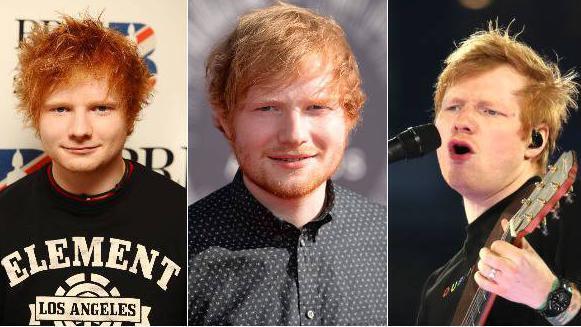
Ed Sheeran in 2012, 2014, and 2022.
With albums named after the mathematical symbols for plus, minus, divide and equals, Ed Sheeran knows better than anyone numbers do not lie. And those numbers tell us the 31-year-old native of Suffolk in the east of England is one of the biggest forces in pop.
He holds bragging right for the highest-grossing world tour in history, having generated over €800 million during the two years in which he took his ÷ album on the road. That places the megastar strummer squarely in the red zone at the top of the pop pyramid, ahead of U2 and the Rolling Stones.
He is also sultan of streaming, with the 2017 single Shape Of You clocking up a record three billion streams. For comparison, Smells Like Teen Spirit by Nirvana has just one billion streams while the most streamed Irish song ever, Hozier’s Take Me To Church, clocks in with 87 million. Even among rarefied company, Sheeran inhabits his own dizzying stratosphere of success.
And that incredible streak is set to continue with Sheeran having opened his Mathematics tour over two nights at Croke Park. He now brings the show, which features an 'in the round' stage, fireworks and a four-piece backing band (the first with which Sheeran has got on the road) to Cork’s Páirc Uí Chaoimh for dates this Thursday and Friday.
It has, by any standards, been a remarkable rise. At Croke Park on Saturday night, Sheeran told a story of how, when he first moved to London aged 17 with dreams of becoming a singer, he felt completely out of his depth. The other artists he met were older, cooler, and had, so he felt, better songs.
He, by contrast, was a gawky teenager with a shade of hair best described as Ron Weasley-red and minimal fashion sense. In an industry where image supposedly counts for a great deal, what chance did he have?
But if Sheeran felt he lacked in talent (he was obviously wrong) he more than made up for it with determination. And with a healthy chip on his shoulder.
He provided a telling insight into that mindset on his 2011 debut album, +, where he sets himself up as the opposite of well-connected insiders such as Amy Winehouse and Adele, who signed record deals the day they exited the star-making Brit School in oh-so-hip London.
“I sing, fast, I know that all my shit’s cool/I will blast/and I didn’t go to Brit School,” he raps on You Need Me, I Don’t Need You. Elsewhere in the same song, he declares “I’m bound to blow up/I’ve done about a thousand shows.” You Need Me is a gimmicky blend of rap and acoustic pop. Still, it contains a lot of truth.
Sheeran realised early on that nobody was going to pick him out of a line-up and make him a star. This was 2011: heyday of The X Factor, when fame was regarded as something that Simon Cowell-like figures bestowed from on high.
Sheeran, a scrappy outsider with no contacts in the music business, was determined to steer his own course. And that involved bypassing the major labels and taking his music to his fans. And so he released his own music – five EPs before his debut album – and played to whoever would have him.
This was famously / notoriously his “homeless’ period, where he would couch surf and when, on a trip to LA, he somehow blagged his way into living for several months with actor Jamie Foxxx. He was prepared to do whatever it took.
“I headed off with guitar under arm to escape England,” Sheeran told me shortly after the release of +. “I wasn't expecting anything. It all worked out, which is nice. I played a lot of shows over there. Little by little I made a name for myself, for being this English kid. Jamie’s manager said, ‘come and be on his radio show’. So I did. And Jamie says, ‘come stay at my house…”

It may have seemed slightly wayward way to chase success. It certainly wasn’t the route to the top as advocated by Simon Cowell. What Sheeran was actually doing was building a following outside the traditional infrastructure of record companies and publicists. As he outlined in You Need Me, the goal was a situation where labels were eager to sign him rather than the other way around. He was 'life-hacking' the industry.
“I can distribute my music independently. I can make a video for no money, put it on YouTube, tell fans about it on Twitter and Facebook. It's all good. That's the best way to be. You have longevity. If you find success from building your own foundation, you don't need the record company. Atlantic could drop me tomorrow – I've still got the fan-base that got me here. They got me into the charts before I was signed. It's a better position to be in.”
The paradox was obviously that his hustling, outsider attitude was allied to writing aimed squarely at the mainstream. Sheeran’s origin story begins when he was 11 and accompanied his cousin Laura to see Damien Rice play Whelan’s in Dublin in November 2001. The moment changed everything for him: he wanted to be like Rice, mesmerising a room with just voice and guitar.
Sheeran was never a Damien Rice knock-off, though. The Irishman’s music, if successful, has a bruised, melancholic quality antithetical to true stardom. The songs which made Sheeran a star were so much more straightforward. The A Team, released in June 2011, was a folk ballad about – to quote Wikipedia – “a sex worker addicted to crack cocaine” (crack is a class A drug – hence the name).
The A Team, if heartfelt, cannot be accused to subtlety. Any weepier and you’d need a rain-gear. The place it comes from, though, is very real – Sheeran was inspired to write it after doing a gig at a homeless shelter and speaking to a woman there named Angel. Hence the “for angels to fly chorus”.
That encounter might seem like serendipity – in fact, it was testament to Sheeran’s hard work: not many other unknown teenage artists would have been playing homeless benefits.
Fuelled by The A Team and the self-released EP Loose Change, he was suddenly going places. Still unsigned, in early 2011 he arranged a free show at the Barfly pub in Camden in London. Some 1,000 turned up. To ensure everyone saw him, Sheeran played four times and ended up singing on the street outside.
Despite looking nothing like a pop star, the music industry was now paying attention. In April 2011, he appeared on Later With Jools Holland. Having inked a deal with Atlantic Records, that September he released +. A gravity-defying rise from the obscurity of provincial England had achieved its lift-off phase.

Yet, if beloved, Sheeran had a target on his back from the start. The music press enjoyed putting the boot in, with the NME dismissing his material as “dated and tame” and the Guardian describing him as a singer-songwriter with a mercurial streak, and drawing unflattering comparisons to Damien Rice. “Sheeran sounds like the artist Rice's record company pushed him to be,” went part of its review for +, earning a swift backlash from fans.
His cousin Laura saw a different side, as she told me in 2012, “Ed is a serious pro, and such a positive guy – really up for anything and so driven,” she said. “When you're in his company you really feel like anything is possible. Knowing how hard and for how long he has worked, and continues to work, he really deserves every ounce of success he's achieved. He's earned it. We are all very proud of him.”
Sheeran’s abilities as a hit-maker are beyond dispute. And yet it’s hard not to suspect his true talent may be for pushing through and breaking down doors that were never meant to be open for him. Aside from his songwriting talent, Sheeran, after all, has few of the obvious attributes required of the modern pop star.
He is a long way from a style icon. He doesn’t do much on social media. He has jokingly described himself as looking “like one of your older brother’s mates”. And yet Sheeran has bent stardom to his will. And that ability to conjure from thin air the career he’d dreamed of since seeing Damien Rice in Whelan’s 20 years ago could go down as his greatest accomplishment.
- Ed Sheeran plays Páirc Uí Chaoimh, Cork, April 28-29; Thomond Park, Limerick, May 5-6; and Boucher Fields, Belfast, May 12-13