Cork in 50 Artworks, No 44: Red Dragon at the Lee Fields, by Jim Buckley
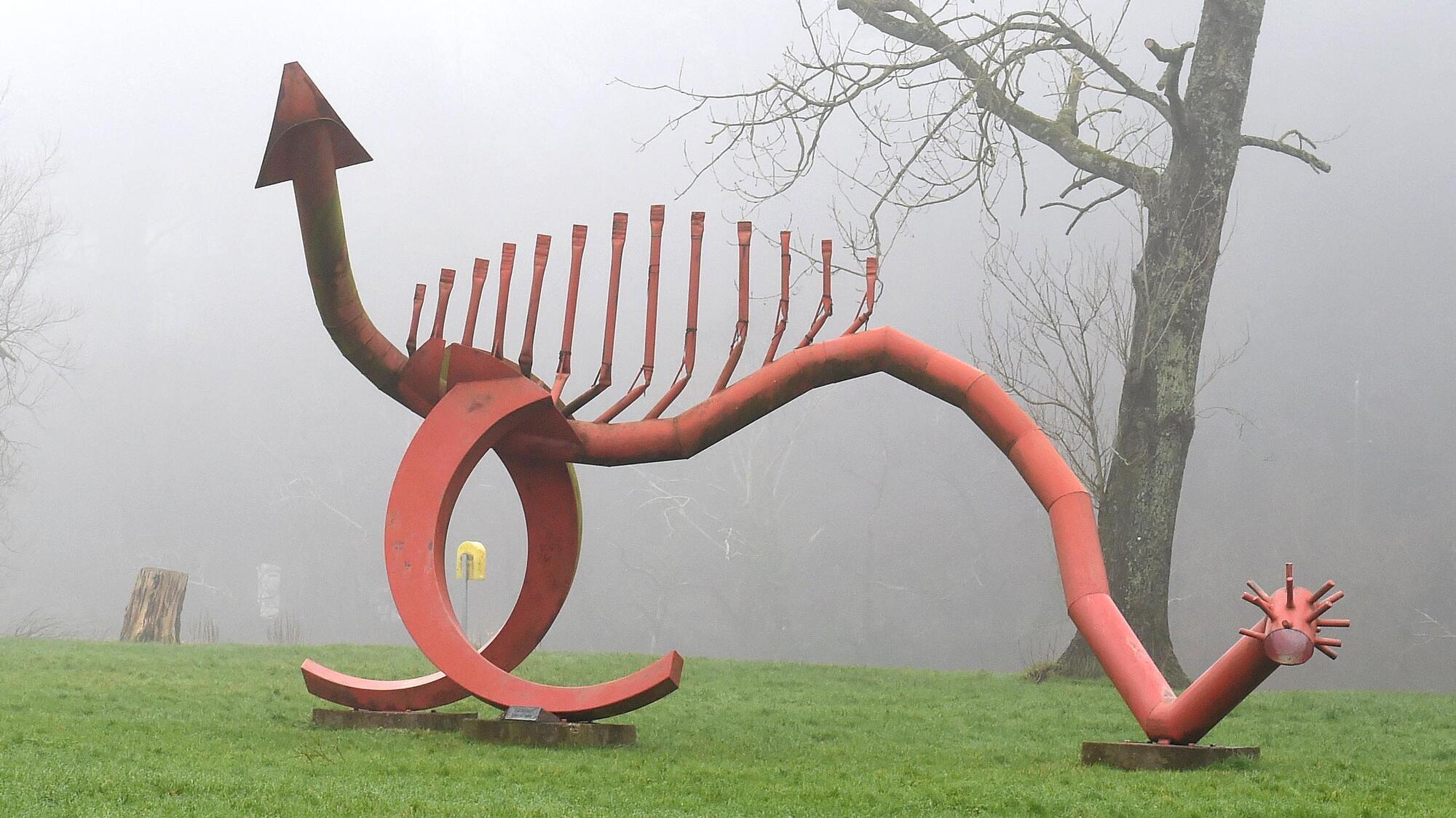
A familiar site at the riverside leisure area since the Cork 800 celebrations of 1985, the sculpture has survived numerous floods and even a makeover by fans of a local sports team 
Cork in 50 Artworks, No 44: Red Dragon at the Lee Fields, by Jim Buckley

Jim Buckley’s Red Dragon sculpture

Jim Buckley’s Red Dragon sculpture will be familiar to anyone visiting the Lee Fields on the southside of Cork. The steel structure dates to 1985, when Buckley, a graduate of the Crawford College of Art and Design, organised a Sculpture Symposium at the Anco Training Centre in Bishopstown. The event was supported by Cork 800, the committee established by Cork Corporation to commemorate the granting of the city’s charter in 1185.

Buckley invited five other artists – John Burke, Eilis O’Connell, Patrick O’Sullivan, Vivienne Roche and Hironori Katagiri – to participate. They had the use of the facilities at Anco, along with the assistance of the centre’s professional welders and trainees. All six produced work that was to be placed at different locations around the city.


“The symposium was a means of getting work made on the cheap, and having it sited,” says Buckley. “Otherwise, there was little chance of being commissioned to make anything in those days. There was no money around; you were always scrounging for materials and places to work in. My sculpture was mostly made of steel tubing I found in a scrapyard up on Dublin Hill. I was thinking about dinosaurs, but in a very abstract way, and the tubing helped me decide on the design.” 

 The budget for the entire symposium was around £20,000, with half being provided by Cement Roadstone, and the rest by Cork Corporation and the Arts Council. “There was just about enough to pay the artists a small fee, and to cover the cost of their materials. In the case of the Japanese artist Hironori Katagiri, I think we paid his flight from Scotland, where he was working at the time.”

A child climbs on the sculpture by Jim Buckley, right.

 Two of the artists, John Burke and Patrick O’Sullivan, had been Buckley’s tutors at the Crawford. “John taught me all about metal and welding. After I graduated, we did a two-man exhibition at the Lavit’s Quay Gallery. Then I went to America for a while. I attended an international sculpture conference in Los Angeles, and spent a bit of time with an old schoolfriend of mine who was American. We got work painting murals on the hoardings around building sites. 

"Then I drove cross country to New York, delivering a car for a rental company. The journey might usually take a few days, but I had the car for four days, so I got to see a few places along the way. In New York, I got work putting up posters for the very first production of the Cats musical.” 

 Buckley decided to return to Ireland when both his brothers were getting married. “I was best man at one of the weddings,” he says. “So it seemed like a good time to come home. That was in ‘82, going into ‘83.”

 There was a healthy visual arts scene in Cork at that time. Buckley had participated in the first SADE exhibition in the Crawford Art Gallery in 1982, and there were other opportunities he could have pursued in Ireland. “But I’d got to know a couple of Scottish artists in America, who invited me to spend the winter at the Scottish Sculpture Workshop in Lumsden, outside Aberdeen. I went to a conference at Yorkshire Sculpture Park along the way, and then continued up to Lumsden. Back then, you could sign on [the dole] for three months at a time. You had your money coming in, and you could get on with things. I was working on a series called Torc. They were big twisted metal pieces. Everything was designed to go in the back of whatever vehicle I had at the time, so it could all be taken apart and re-assembled.” 

 Buckley spent the summer of 1984 in Yugoslavia, in the town of Ravne, where he was one of four international artists invited to create new work as part of a sculpture symposium.

When Cork 800 was announced, he submitted a proposal for a similar event in his native city. “I had to sell the idea to the committee, obviously. But they were very supportive.”

The sculpture in its 'black and white phase' during a typical flood at the Lee Fields. Picture Maurice O'Mahony 

 Sites around Cork city were found for all six of the sculptures. Katagiri’s six-and-a-half ton work in granite stood at the junction of Patrick St and Winthrop St for many years, but has since been put in storage. O’Connell’s ‘igloo’ sculpture is on the grounds of UCC, near the Glucksman Gallery; and John Burke’s abstract work in steel is positioned on Blackrock Pier.

Buckley’s Red Dragon had only a mile to travel to its present location on the Lee Fields, but the piece is 15 feet tall and 30 feet long, and at one point the plan was to transport it by helicopter. “Publicity-wise that would have been fantastic,” he says, “but it never actually happened. We moved it on a truck instead. I’m not sure my welding would have survived the experience anyway.”

 Buckley still lives in Scotland, where he teaches sculpture at the Robert Gordon University in Aberdeen, and is very active in the local arts scene. “I’ve been on the boards of Glasgow Sculpture Studios and the Scottish Sculpture Workshop, and currently I’m chair of Peacock Visual Arts in Aberdeen.”

 He shows regularly in Cork, at venues such as the Triskel Arts Centre, and is pleased that his sculpture at the Lee Fields is still in place. “The National Sculpture Factory had a maintenance scheme, and it came under that, so it’s always been looked after pretty well."

 That said,   about twenty years ago,   supporters of a local sports club painted the dragon in black and white stripes. "I didn’t mind that much, to be honest, but still, I’m glad it’s back to its original colour. I can’t remember now what supplier I got the paint from in Cork, but I’d describe it as a Massey Harris agricultural red. I just think that suits it better.”

More in this section

Scene & Heard

Newsletter

Music, film art, culture, books and more from Munster and beyond.......curated weekly by the Irish Examiner Arts Editor.

Cookie Policy Privacy Policy Brand Safety FAQ Help Contact Us Terms and Conditions

© Examiner Echo Group Limited