Book interview: How the Sad Little Men of England keep on keeping on
Michael Duggan speaks with author Richard Beard about his analysis of private-school education and power in the UK
Book interview: How the Sad Little Men of England keep on keeping on

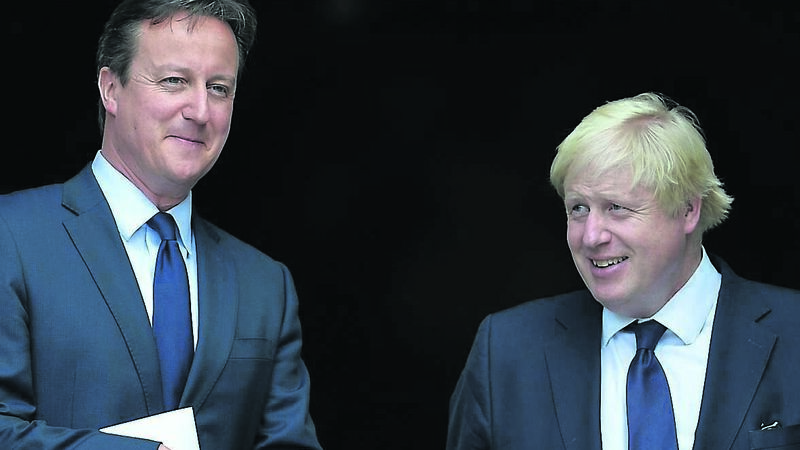
David Cameron and Boris Johnson: The former PM was saying ā€˜I’m an adult’, his successor saying ā€˜I’m just a child’, claims Beard. Picture: John Stillwell/PA

  • Sad Little Men: Private Schools and the Ruin of EnglandĀ 
  • Richard BeardĀ 
  • Vintage Publishing, hb €22.95

Boris Johnson was born in June 1964. David Cameron in October 1966. Richard Beard was born in January 1967. They all went to English boarding schools at roughly the same time. Johnson and Cameron, famously (or is it infamously?) were at Eton. Richard Beard went to Radley College near Oxford.Ā 

"I know neither of these men personally," he writes of Cameron and Johnson in his new book, Sad Little Men. "I do know that they spent the formative years of their childhood in boarding schools being looked after by adults who didn’t love them, because I did too."

Beard is a fine novelist who has also turned his hand with great distinction to memoir writing. Sad Little Men is a mix of memoir and polemic, tinged with melancholy, laced with anger, brightened by wit. Certain lines display all three qualities at once: "I was good at the stuff that mattered – lessons, emotional repression and rugby."

When we meet up via Zoom, I begin by asking Beard how he ended up in boarding school in the first place. His late father ā€œwas very keen that we didn’t lead the same life that he had had, which was going into the family business aged 17.Ā 

He was clearly a bright man, interested in mathematics and in history, all of which he kind of followed through himself as an adult, but he did feel that he missed that opportunity to have more education and had to spend his whole life living just round the corner from his father who had spent the whole of his life living around the corner from his father.Ā 

"So when I was growing up (in Swindon) I had my father, my grandfather, my great-grandfather, my uncles, all within a three-street radius, and I think he had a really strong sense that he wanted his children to move on. And an obvious way of doing that was to just move them out of the town and send them to boarding school. But there was also an element of social snobbery, I think, as well, saying ā€˜I can afford this’. It’s a sign of status.ā€

And his mother? ā€œMy Mum’s view is that she didn’t want it to happen. She wanted us to stay at home. It was my Dad’s decision, but he can’t defend that now. I think it’s probably absolutely true that they were more patriarchal times.ā€Ā 

Beard believes he - and Johnson and Cameron - attended boarding schools at a peculiar moment in their history with consequences all of its own. ā€œIn the seventies and eighties, (the boarding school system) was caught in this cusp of still being a training for empire,ā€ he says, ā€œwhere actually being pretty hardy and resilient, learning to deal with austerity was very important, and yet when we came out we were going into a very different world where that isn’t really necessary. So then the psychological effect of that becomes ā€œWell, I’ve suffered. Now I’ve done my suffering. So now I am entitled not to suffer. And, also I have already been punished, so I can lie and I can cheat and I can go into the Houses of Parliament; and I can do all of these things because I have already suffered.ā€Ā 

It’s a particular product of this period in time, which we see being played out in our political life with the people who are now in these positions of privilege.ā€Ā 

This doesn’t mean he has a positive view of contemporary boarding schools: they ā€œhave become so expensive that they are kind of an offshoot of the luxury service industry nowā€. The prettified exteriors and jaw-dropping facilities perpetuate an old sleight of hand.Ā 

ā€œThere’s a lot here of what I call ā€˜the dog food principle’, in that a lot of the beauty of these places is there to attract a buyer, rather than the person who has to consume the stuff. The labels on the dog food are not for the dog! A lot of these beautiful things are not for the children going through it, they’re for the parents.Ā 

"With these beautifully manicured rugby pitches, a lot of parents think that’s fantastic, that’s beautiful, I’ve never seen anything so beautiful. For the kids, it might be an absolute horror, if they don’t like rugby, the worst thing they’ve ever seen and they’re going to be out on those pitches five times a week.ā€Ā 

At various points in our conversation, I try to play devil’s advocate. Look at the senior ministers in Johnson’s cabinet, I say. There are women, the children of immigrants, former pupils of state comprehensives. No one could claim that he is using his power of appointment as Prime Minister to shore up his own tribe, could they?

Beard is having none of it: ā€œYou don’t have to have been to an English boarding school to have been a ā€˜sad little man’. You don’t have to be a man to be a sad little man. You don’t have to be white to be a sad little man. But if you want to get on in England you need to know how these sad little men think. You need to know the kind of effects their education has had on them, which I’ve set out in the book at great length, because, if you don’t know how these people think, you are not going to move up.Ā 

"And therefore the examples you’ve cited are all people who must have understood how this works and they have worked out how to locate their own inner sad little man, whether they’re a man or not, and whatever their ethnic background. They’ve learnt therefore how to play that system.ā€Ā 

Beard’s intimate familiarity with the boarding school effect means that he is adept at peeling the away the psychological layers of his contemporaries: ā€œWith Johnson, it is a bit like ā€˜The Purloined Letter’ (a short story by Edgar Allan Poe). If you want to hide something, you hide it in plain sight. The letter is hidden in the letter rack and nobody can find it.ā€Ā 

Johnson ā€œjust opens up this sort of public school boy - between 10 and fifteen, not a lot older, 16 maybe – and he says ā€˜Look at me! Look at my hair, look at my clothes sense, look at my sense of humour. Look, I’m just a mess and I’m chaotic and I can’t do any harm because I’m just a child.’ "So it takes away one level of deception, if you like, which I think Cameron still had. Cameron was saying, ā€˜No, look at me, I’m an adult.’

"His inner child was much more hidden, even though it’s being expressed the whole time, especially in his kind of superciliousness, really. Whereas (with Johnson) it’s a much bigger deception because it has this really rather brilliant openness to it and that is why he’s had more appeal as well because there is a daring there (…).Ā 

"Unfortunately, once you see through that then he suddenly looks incredibly vulnerable and unimpressive, and I think that’s what we are seeing recently. (…) It’s kind of double bluff. It’s saying ā€˜Look, I’m a childish oaf, but I’m not really. I’m really brilliant.’ But, actually, he’s not. He’s a childish oaf.ā€Ā 

When I spoke to Richard Beard, Boris Johnson was reeling under the first wave of revelations about parties at Downing Street under Covid restrictions.Ā 

As we wound things up, Beard’s final analysis of his contemporary took a gentler turn: ā€œI wake up in the morning and I think of him waking up in the mornings and I do feel quite sorry for him, because everything we learned in public school was to hide this vulnerable inner child and he’s waking up every morning and he’s feeling vulnerable and he can’t hide it.Ā 

"Everyone can see his vulnerable inner child now and people – I mean his political colleagues, his political opponents, just generally, this communal cultural life of the country – it feels like it’s coming for him and it’s going to be horrible. Psychologically, I think it’s really difficult and I do, sometimes, for a little while in the morning, feel a little sorry for him.ā€Ā 

x

More in this section

Scene & Heard

Newsletter

Music, film art, culture, books and more from Munster and beyond.......curated weekly by the Irish Examiner Arts Editor.

Cookie Policy Privacy Policy Brand Safety FAQ Help Contact Us Terms and Conditions

Ā© Examiner Echo Group Limited