Cork In 50 Artworks, No 42: Brian O’Doherty’s murals at Sirius Arts Centre, Cobh
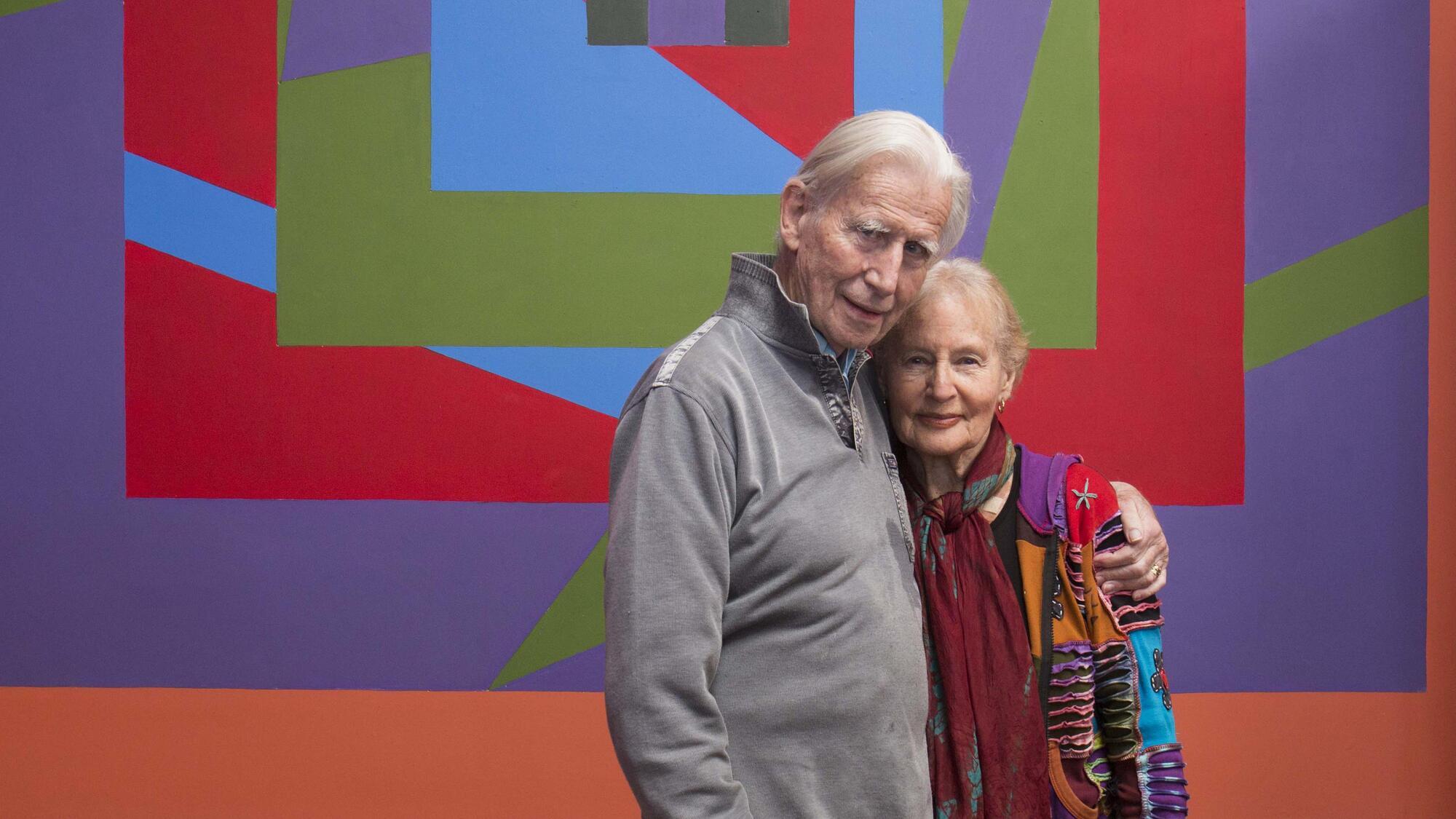
Brian O'Doherty (formerly known as Patrick Ireland), with his wife Barbara Novak at the Sirius Arts Centre in Cobh in 2018. Picture: Clare Keogh
In 2014, Miranda Driscoll was appointed director of the Sirius Arts Centre in Cobh. She had not yet taken up the position when she attended an exhibition opening at the centre and got into conversation with a local artist. “The central gallery at Sirius is filled with light,” says Driscoll. “It opens out onto a balcony overlooking the sea; and on a sunny day you could be in Croatia or somewhere. We were talking about how beautiful the space was, and he said to me, almost in a whisper, ‘I think there’s a Patrick Ireland mural behind the walls’.”
Patrick Ireland was a pseudonym used for many years by the artist Brian O’Doherty, and It turned out that he had indeed painted a series of murals in the gallery in 1995/96. “But this was nearly twenty years later,” says Driscoll, “and I thought they must have been painted over. These kinds of works are ephemeral, they tend to disappear. The murals were almost a myth.”
At that stage, O’Doherty was himself something of legend. Born in Ballaghaderreen, Co Roscommon, in 1928, he was already a qualified medical doctor when he travelled to Boston in 1956 to complete a year-long research residency at Harvard University. He had cultivated a love of the visual arts while a student at UCD. In Boston, that interest took him down a new path when he auditioned for a job as presenter of an arts programme broadcast on national television from the Museum of Fine Arts.
He excelled in the role, and a few years later, on moving to New York, he was appointed the art critic for the New York Times. Later, he made and presented documentary films for the National Endowment for the Arts, where he served as director of the Visual Arts Program. He wrote fiction and cultural criticism, and became particularly well-known for his book Inside the White Cube: The Ideology of the Gallery Space.
O’Doherty never returned to medicine, but somehow, he also found time to create and exhibit conceptual artworks, such as the ground-breaking Portrait of Marcel Duchamp, which featured an electrocardiogram of the Dada artist’s heartbeat.
In 1972, O’Doherty changed his name to Patrick Ireland to protest the killing of civilians by the British Army on Bloody Sunday. Thereafter, he signed all his artworks with the pseudonym, and was still doing so when he was invited to participate in a residency at the Sirius Arts Centre in 1995. This would involve him and his wife, the art historian Barbara Novak, staying at the basement apartment in Sirius while he created a series of wall paintings at the Crawford Art Gallery in Cork; inspired by Francesco Borromini’s architecture in 16th century Rome, they would have the title Borromini’s Corridor.
O’Doherty’s project at the Crawford was curated by its director, Peter Murray, who remembers how the artist was taken with the central gallery at Sirius as soon as he saw it. “He wasn’t here a day when he proposed to paint it with murals,” says Murray.
Part of the attraction for O’Doherty was that, when he left for America as a young man, Cobh had been his point of departure, and the balcony at Sirius overlooks the very pier from which his ship had sailed in 1957.
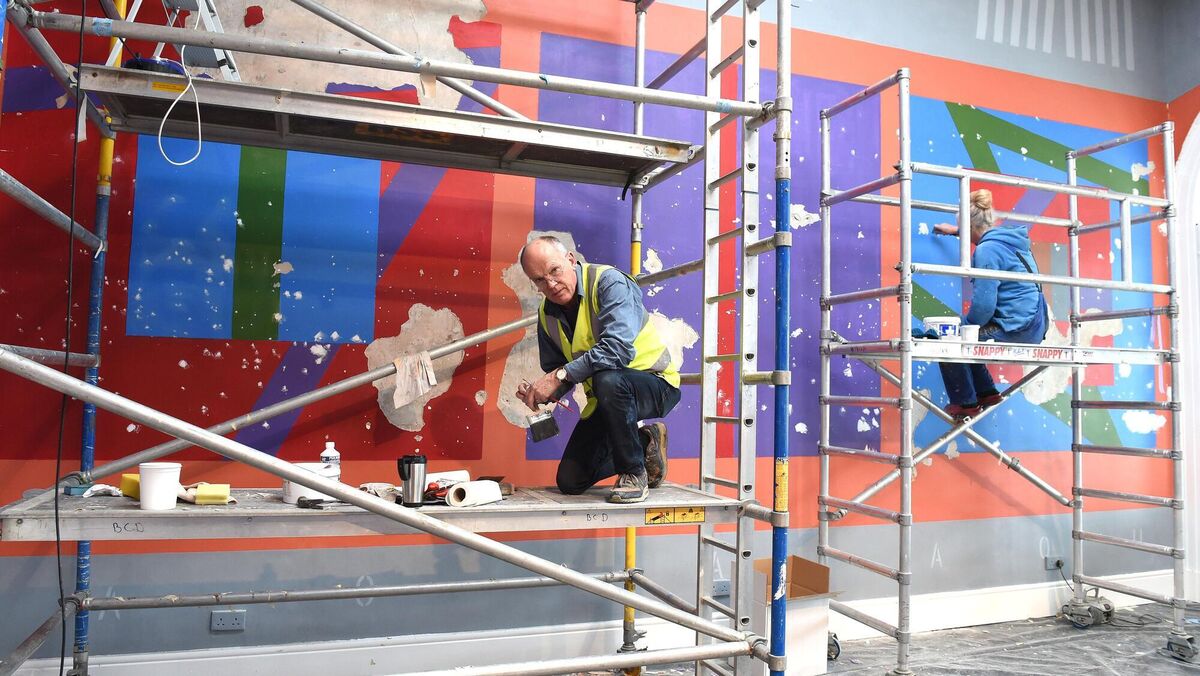
O’Doherty’s Borromini’s Corridor project at the Crawford opened in September 1995, and then he set to work on painting his murals at Sirius. Hoping to commemorate the thousands of emigrants who had passed through Cobh as he himself had done, he decided to base his paintings on the ancient Irish ogham alphabet.
“There’s a whole collection of ogham stones in UCC,” says Murray. “It’s a very minimalistic language, based on dashes and dots and parallel lines, that was mainly used to mark gravestones; it codified Latin in the landscape.”
The project, which took O’Doherty the best part of a year to complete, was opened by David Ross, Director of the Whitney Museum of American Art in New York, on 8th June, 1996, and remained in place for a year.
“Brian wanted it to be a permanent installation,” says Murray, “but that would have stymied Sirius’s regular programme of exhibitions, so we decided to cover it up. We used heavy duty wallpaper, and then painted it white. We installed steel rails for hanging pictures, and asked visiting artists not to drill into the walls. But over the years, of course, they did.”
When Driscoll took over at Sirius, she invited a team of conservators to investigate whether the murals might still be intact. “We peeled back some of the paper, and discovered the paintings underneath,” she says. “We couldn’t tell if the whole series had survived or not, but we decided to do our best to restore them.”
Driscoll met with O’Doherty in New York to secure his approval for the project, and then began fundraising to bring it to fruition. “I tried raising funds in the States,” she says. “But honestly, I had far more success in Ireland. We had great support from the Dept of Culture and Heritage. They saw it as a heritage project because the artwork is on the fabric of an old building. Cork Co Council and the Arts Council also got behind it, and Colourtrend and a few other small companies were very supportive.”
Finding the right conservator was a crucial part of the project. “We got Don Knox on board, and he was amazing. Don’s approach to restoration and conservation is like, really, as far as you can, leave the work as it was done originally. He took the paper down, and filled all the holes. In some places he had to do a bit of plastering, in other areas he just had to wash the wallpaper paste off. But then, basically, he touched up the murals, but left some of the flaws. The work was really beautiful. Brian had painted it by hand, and you could see the brush strokes. In some places, you could even see his original pencil drawing. Don exposed that in a really sensitive way. The murals looked just as they had done originally.”
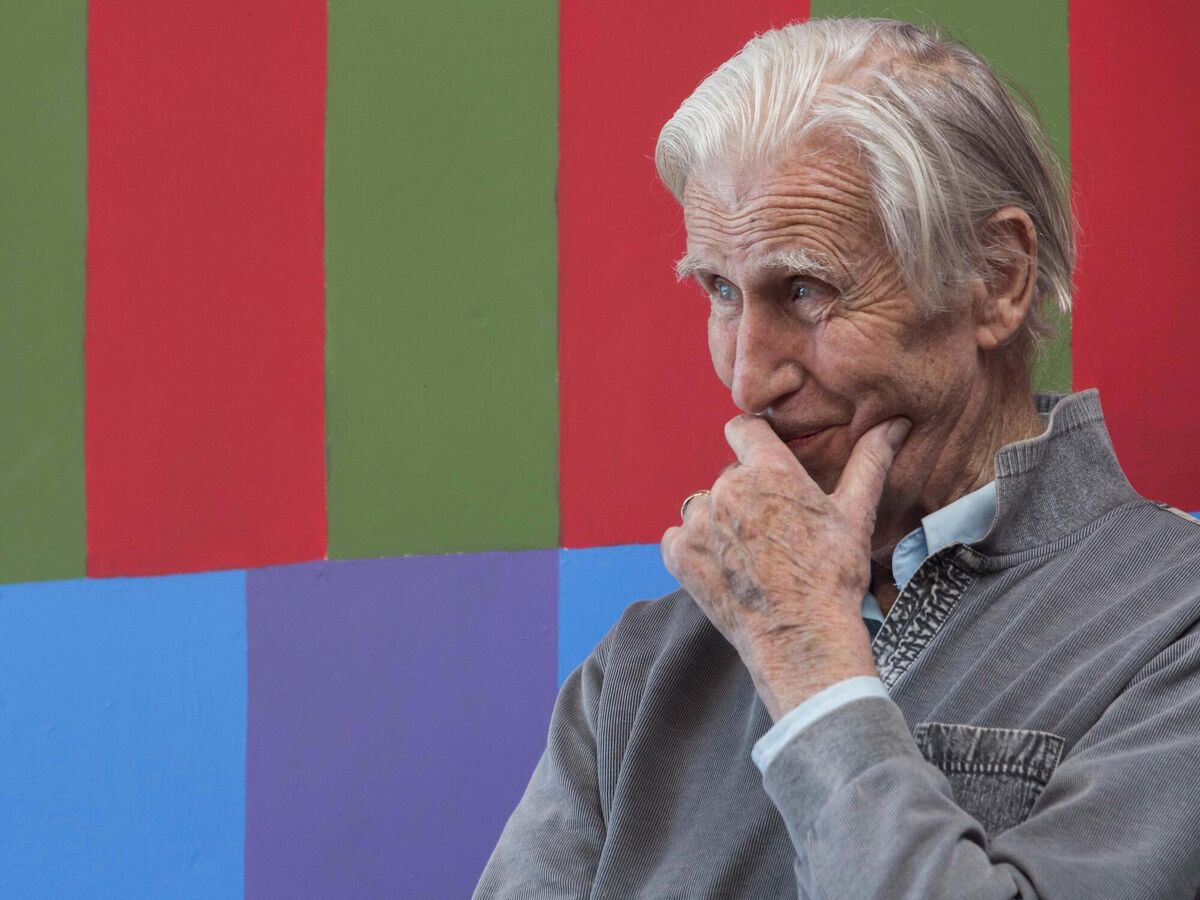
In 2008, after the British Army was withdrawn from Northern Ireland, O’Doherty buried an effigy of his Patrick Ireland alter ego in the grounds of the Irish Museum of Modern Art in Dublin, and began signing his art with his birth name once more. As he had completed the murals while working as Patrick Ireland, their restoration was promoted as One Here Now: The Brian O’Doherty / Patrick Ireland Project.
O’Doherty and his wife flew in from New York for the unveiling, which coincided with his 90th birthday on 20th April 2018. “They came over twice, as it happened. Once for the launch of the project, and a second time for the launch of the book we produced to commemorate it.”
One Here Now featured a year-long programme of events, including a public interview with O’Doherty, exhibitions and musical performances, after which the work was covered up again. “We built new walls to protect the murals. There’s a little bit of breathing space between them; in the future, anyone who has a mind can come along and take those walls down again. It would be a lot easier and cheaper than the project I did. I hope it will have many lives.”
Driscoll left Sirius in 2019, and took up a new position as director of the Solas Nua arts centre in Washington DC the following year. “I think the experience of working with Brian on the One Here Now project in Cobh may have planted the seed for my own departure for America. But thankfully, I’m still very involved in the Irish arts scene over here. My mission now is to break Irish artists in the US, essentially.”
O’Doherty will be 94 in April. He still lives and works in New York.