'We were a natural pairing': Paul Brady and Andy Irvine on their 1976 classic
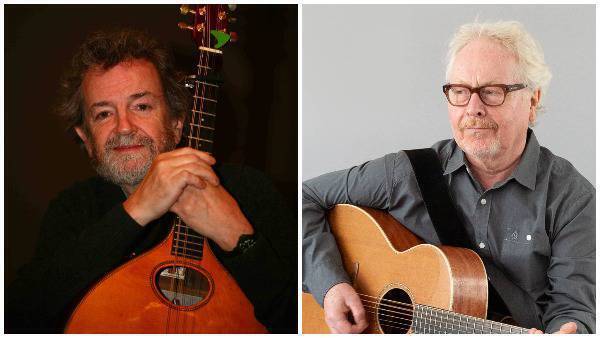
Andy Irvine and Paul Brady.
One of the greatest musical adventures of Andy Irvine’s life began with a boatman leaving him high and dry on Sherkin Island in West Cork in the late summer of 1976.
“We were on Sherkin playing a festival. At the time there was a special ferry to Baltimore,” the esteemed folk musician remembers. “We were due to take a flight from Cork to Bristol. Our instruments were handed down into the boat. Then the boatman must have decided the boat was getting over full. Without changing his expression, as we looked at him, he slowly steamed out of the quay.”
It was August 1976 and Irvine was in West Cork with Dónal Lunny, his former bandmate from trad supergroup Planxty. They were due to travel to southeast Wales, to the iconic Rockfield Studios – a state-of-the-art residential facility where, 12 months previously, Queen had recorded Bohemian Rhapsody. Irvine, who did eventually reach Rockfield, was planning a rhapsody of his own in the form of a collaboration with another former Planxty comrade, Paul Brady.
“It seemed like a good idea to make an album [together] at the time,” recalls Brady. “Rockfield was one of the up-and-coming studios on the British rock scene. We were probably the first folk act to ever record in it. We worked there for about two weeks. We made up the music as we went along. We did a lot of our arranging and rehearsing in the studio. What came together was totally new to us.”
The resulting album, Paul Brady/Andy Irvine, was released in December 1976 on Lunny’s label, Mulligan Records. The project saw the duo applying a fascinating Old Timey American folk sheen to standards such as the Plains of Kildare and Arthur McBride, an anti-war ballad from the 1840s to which Brady gave a feverish new arrangement.
It was met with instant acclaim. The real surprise, though, is that the record has endured and has been discovered by subsequent generations. “One of the greatest albums ever of traditional Irish songs,” says All Music of Brady/Irvine. “Their unique sound will stay with you long after the music has stopped”.
“A milestone in the maturing of the folk tradition,” agreed folk music academic Katrin Pietzonka in her 2013 study of the importance of music in achieving peace in the North. “The album included some songs that had so far been unknown to the general public. Amongst these were some taken from the Irish folk song collector Sam Henry’s comprehensive collection of Ulster songs, which the artists arranged in a radically different style.”
Covid restrictions allowing, Brady and Irvine will play the record in its entirety at Cork Opera House later in 2022. To whet appetites, here is the story of how this remarkable meeting of minds came to be.
Brady, from Strabane, Co Tyrone, had started playing in r’n'b groups while studying at UCD. Joining popular close-harmony folkies The Johnstons as singer and guitarist he relocated to New York in the early 1970s. But by 1974 he’d come home and was invited to join Planxty. The hugely influential folk ensemble had been formed by Christy Moore, Dónal Lunny, Liam O’Flynn – and by Andy Irvine, the London-born son of a mother from Lisburn and a father from Glasgow.
“I came in at the latter stages to replace Christy,” say Brady. “I came back to join the band in the summer of ’74. Christy remained in the band until October. I spoke to him recently about that: he more or less said that he wanted to stay in the band long enough until I was established. He didn’t want to leave the band floundering without anybody singing. He stayed to tide us over and left that October.”
Planxty were superstars of Irish folk. However, life on the road was tough. And with so many big personalities in the ranks – and even with Moore exiting for a solo career – the collaboration had a natural lifespan, which came to an end in 1975.
“Everyone was tired,” says Irvine. “We didn’t seem to have any sense of direction. At the same time you had bands in Britain like Steeleyed Span, Fairport Convention. They had big management and a whole sense of direction. Planxty didn’t really have someone minding us to that extent. We found it difficult and we split up.”
But Brady and Irvine had a natural musical chemistry. “We got on very well,” says Irvine. “It wasn’t really a surprise after the band split up that we said, ‘why don’t we do something, the two of us?’. At the time it seemed a really good idea. And it was: it flourished.”
“We were a natural pairing,” agrees Brady. “I was into [old time string band] the New York City Ramblers and [mid 20th-century folk singer and folklorist] Mike Seeger and people like that. Before I joined Planxty I was doing a lot of country blues and stuff. We had a good rapport, Andy and I. I also was very much impressed by his grasp of Eastern European music. I wanted to learn as much about that as I could. The album was the result of our first year, year and a half touring together. Neither of us would have a clue that over 40 years later it would be an iconic record.”

Neither Brady nor Lunny can say for sure who decided to record at Rockfield. Their sense is it was probably Dónal Lunny’s idea. The studio was in the deep countryside and a 50-minute drive from Bristol.
“We were picked up and drove into the middle of Wales,” says Brady, who was 29 at the time.“It was one of the first live-in studios that had started to spring up all over the UK. “At the time we were recorded for Mulligan Records. Perhaps Mulligan had a contract there. It seems a strange choice now in retrospect.”
Lunny’s involvement was central, Brady says. “He was the producer and he played guitar on a few songs. He played on Andy’s Autumn Gold [the record’s solitary completely original composition] as far I recall.”
The process wasn’t always smooth. “The one memory I was always come back to was on the day Paul recorded Arthur McBride. He did a really good take of it. We listened back and were horrified to find Paul had mispronounced a word,” says Irvine, who was 34 at the time of the sessions. “The word was ‘proud’. And he said ‘froud’. Shortly after that, with the technique of editing recordings, we’d have said, ‘that’s easily fixed, we’ll just get a 'p' for somewhere else and substitute it for the 'f'’. In those days you couldn’t do that. We had to do the whole song all over again.”
Brady would move into contemporary songwriting with 1981’s Hard Shoulder and go on to release a series of successful singer-songwriter records and to collaborate with artists such as Richard Thompson and Bonnie Raitt. Irvine, for his part, recorded his first solo LP at Windmill Lane, Dublin in 1979. He had by then already reunited with Moore, Lunny and O’Flynn, who reformed Planxty in 1978 and would play together until 1983. In the decades since, both artists have been surprised by the enduring appeal of the Paul Brady/Andy Irvine LP. To their shock it has become part of their legacies.
“Taking on a life of its own – that’s a good phrase,” says Irvine. “It’s very odd. I’m not sure whether other musicians have the same feeling: one often views these things from a little bit of a distance. Objectively rather than subjectively. Generally, I would have to say that I’m amazed anything I had a hand in should have been such a success. That sounds like too humble for words – but was ever a surprise.”
“There are a lot of great records out there that never get noticed,” says Brady. “We weren't expecting ours would be particularly successful. This was the music we were making at the time. We did our best to record it the way we wanted to. Whatever else happens, happens. It was successful [in 1976]. People did like the record. It sold. We did not expect it would become this legendary thing.”
- With the January date postponed, Paul Brady and Andy Irvine still hope to play Cork Opera House later this year