Jack Dee: comedy's resident grouch on becoming an agony uncle

Jack Dee: "It is appropriate to perhaps fly the flag for stoicism, if that isn’t a contradiction in some way"
One of Jack Dee’s guilty pleasures is reading agony aunt columns. “I seek them out,” says the laconic stand-up and veteran of British comedy. “I’ve always been intrigued by the different nature of the problems people write in about. And also by self-help books. I read a lot of them.”
Dee is one of Britain’s most successful comics. So he clearly isn’t reading The Seven Habits of Highly Effective People or Who Moved My Cheese? because he needs help with his career. The fascination for him flows from what they tell us about human nature — about our hopes and fears, our desires and insecurities.
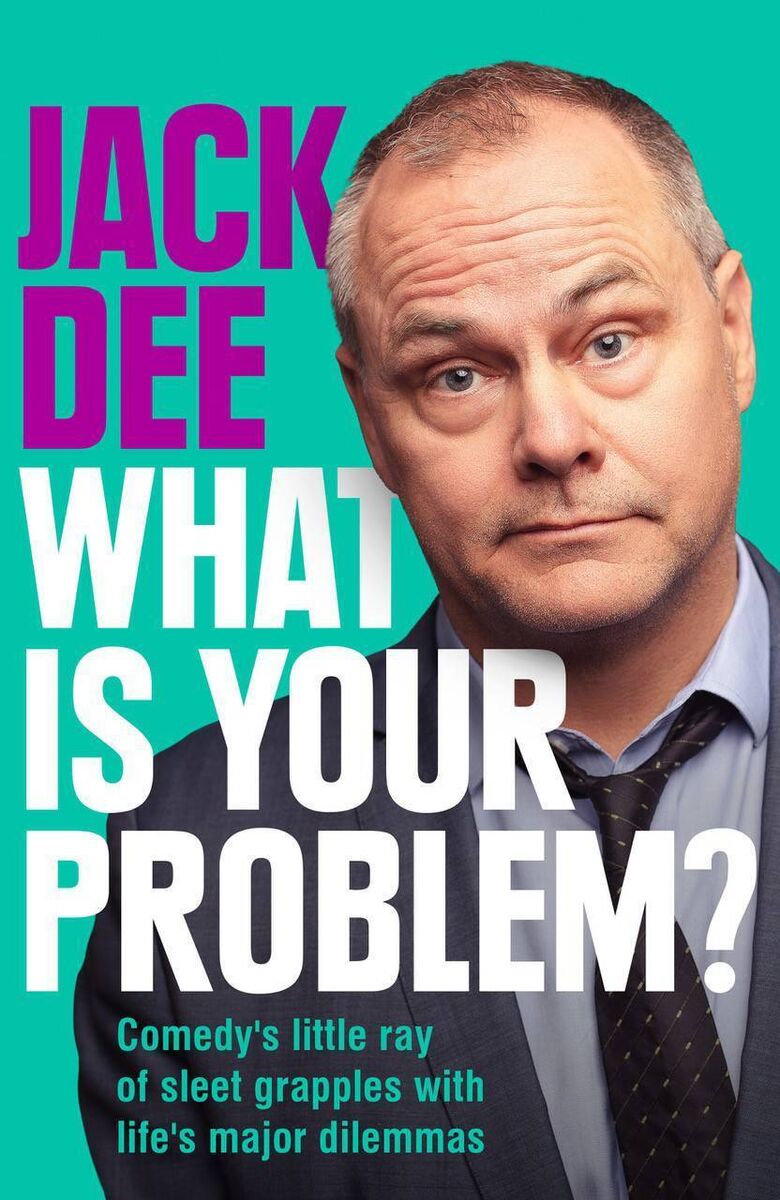
This is also, in a way, the subject of his wonderful new book What Is Your Problem?. Written during lockdown it is both a parody of and sneaking love letter to agony aunts and the self-help industry.
“They can be genuinely helpful. I think people get solace from the fact that their particular issue is a thing,” he says. “And that it is written about and that you can find good pointers in these books and in agony aunt columns. I don’t think they’re snake oil at all. It is what friendship is supposed to be about; being able to talk to someone. And that’s what they provide.”
In What Is Your Problem? Dee casts himself as the agony uncle from hell. He fields questions sourced by his publishers — crises that run from badly-behaved children to money woes and relationship angst. Crucially, none of the scenarios are especially tragic. The fun comes from Dee offering sidesplittingly truculent advice.
“I suggest you buy a swear box and a sick bucket,” he tells a woman whose husband has taken up cooking and, despite existentially horrifying results, thinks he’s the second coming of Gordon Ramsay.
“Most work-related texts are unbelievably dull and are about things like sales targets,” he writes to another correspondent. This by way of assuaging the man’s fear that the huge volume texts his wife is receiving from her boss is a sign she is having an affair.
Dee intends for What Is Your Problem? to be amusing and it is in places excruciatingly funny — especially if you’re a fan of the grouchy persona he has cultivated through his career. Yet it betrays, too, a slight impatience with people who believe that their specific woes are among the biggest challenges civilisation has ever faced. If the book has a message it is that we should all take a breath and get over ourselves.
“It is appropriate to perhaps fly the flag for stoicism, if that isn’t a contradiction in some way,” he says. “You should cope, should take responsibility, for as much as you possibly can in life. If you can deal with a problem in your life without resorting to calling it a mental health issue you’re ultimately going to benefit from that. You’re going to benefit from finding a way through that doesn’t involve terming yourself a sort of victim because that is never going to be good for you. “
He fears that by diagnosing every set-back and challenge as a mental health one we risk discrediting the term. Not every personal crisis is a mental health crisis.
“We don’t want to devalue the term ‘mental health issue’. That’s a very, very serious thing. We should get back to using words like ‘anxious’ and ‘stressed’ and ‘sad’ and ‘low’. Instead of all these very loaded terms that imply we’re in some way mentally ill. In fact, what we’re going through is a completely legitimate set of emotions that you ought to be feeling if you hate your job or just split up with someone. It’s absolutely normal that you should be very low. And I’m for reclaiming those terms and not labelling ourselves as victims just because we’re going through something that we are understandably feeling.”
Dee was born in September 1961, in Bromley, Kent, the same London suburb that gave the world David Bowie, Enid Blyton, and Billy Idol. His early ambition was to be an actor. He also briefly considered training as an Anglican priest (the prospect of an audience hanging on his every word appealed). But, encouraged by his mother to take up a trade, he instead became a waiter.
He was, however, always destined for the bright lights. Dee broke into comedy in 1986 when he performed at an open mic night at the Comedy Store in Soho in London. From the outset he seemed to have a perfectly honed alter-ego of cynical outsider who’d seen it all and was slightly fed up with the world.
He soon had his own Channel 4 series, The Jack Dee Show, and in the 2000s wrote and starred in the bone-dry sitcom Lead Balloon (a sort of British Curb Your Enthusiasm only funnier). Comedy has, of course, changed a great deal since he started out. It is currently dominated by a debate about ‘cancel culture’. Just recently there was an outcry over a David Chapelle Netflix special. Chapelle was accused of making anti-trans jokes — which he denies.
Dee fears that certain comedians are not receiving the exposure they deserve because their perspectives on various issues are regarded as transgressive or taboo. Being pro-Brexit, for instance, shouldn’t be enough to get you cancelled.
“It’s very depressing. There are comics out there who are being excluded from various parts of the comedy circuit because and simply because their viewpoint is at odds with the sort of mainstream political view. That is a shame because if you listen to what they’re saying … they’re not saying anything offensive. At the most you could say they’re being ironic.”
What should be seen as a plus — having a diverging viewpoint — has somehow become a negative. How did we get here?
“And I’d argue that that gives them a bit of edge and makes them a bit more interesting. There are comedians out there who really deserve to be seen and watched.
“They deserve to be supported … I’ve not ever seen anything that shouldn’t be out there. It deserves to be seen on a wider platform and should be on telly more. Those people are good comedians with good instincts and funny gags.”
He feels that some comedians are being denied a career that might once have been theirs for the claiming.
“Why shouldn’t they be out there? It is a terrible pity if that gets any more traction — that attitude. It’s quite serious for some of those guys and girls out there.
“The important thing to remember is that it doesn’t threaten anyone; it’s just comedy. It’s just another way of looking at stuff. And I would always fight against the idea that we should not look at something in a different way.”
Dee’s life on stage has also run in parallel with the boom in Irish comedians in Britain, from Dylan Moran to Aisling Bee, via Father Ted, Dara Ó Briain, and Sharon Horgan. He feels that Irish people’s garrulousness and love of a tall tale makes them natural comedians.
“There is the Irish tradition of spoken word and storytelling. It seems to me to be much more recently alive than certainly in England. The lilt is very good, too. The Irish accent I’m sure has informed the American accent in a big way. I always say that American is the mother tongue of stand-up comedy. But actually, maybe it’s Irish.”
- What Is Your Problem? by Jack Dee is out now.