Book Review: Coastal Atlas of Ireland is a stunning achievement
"This is an astonishing work of erudition and will take its place in the many great works of scholarship that this country has produced"
Book Review: Coastal Atlas of Ireland is a stunning achievement

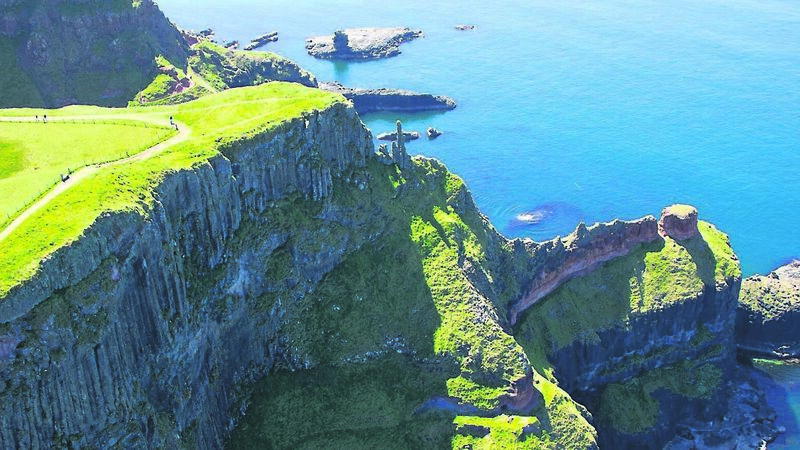
The fundamental thesis of ‘The Coastal Atlas of Ireland’ is that the sea has formed us and that almost every aspect of our lives has to be evaluated through the lens of the coast. Pic: Gordon Dunn

  • Coastal Atlas of Ireland
  • Edited by Robert Devoy, Val Cummins, Barry Brunt, Darius Bartlett and Sarah Kandrot
  • Cork University Press, €59

This enormous book is the result of years of scholarship from dozens of contributors some of whom are at the peak of their careers. Its scope is the interface between the sea, the land, and the atmosphere: that many-formed, mutable, timeless, and magnificent concept we know as the coast. From the very first people to arrive here by boat, to the billions of animals that exist in the intertidal shore, the coast is endlessly appealing to a myriad of disciplines. Virtually all are found in this heavyweight production by Cork University Press.

The book’s fundamental thesis is that the sea has formed us and that almost every aspect of our lives has to be evaluated through the lens of the coast. It is divided into themed sections. We start with the physical, biological, and human settings. This encompasses the geology, coastal waters, agriculture, blanket bogs, ancient shorelines, and underwater surveys.

The second major theme is the coastal environment itself including rocky coasts, beaches, estuaries, lagoons and salt marshes.

This is followed by a section on people and the coast and records man’s influence on the land from the earliest mesolithic settlers to the Irish Naval Service.

The fourth section concerns itself with resources, communications and industry, and the penultimate deals with management of the coasts and marine environments. Were any of these very sizeable chapters turned into books in their own right they would get due recognition. That they are under the one umbrella adds yet more substance to the project. The final brief section is the very topical subject of climate change and its implication for the country.

Robert Devoy, Andrew J Wheeler, Barry Brunt and Kieran Hickey take us through the geologic history of the island differentiating between generic systems: rock-dominated, wave-exposed settings, and estuaries. During the last major glaciation our sea levels were much lower and much of what is now under water was exposed. The shelf gives way to the abyssal plain which is still Irish territory and which encompasses an area known as the Donegal Fan and the Porcupine Bank.

These waters are subject to ongoing research projects such as that of Infomar’s which has explored its submarine canyons and sedimentary forms - “an entire submarine world of complex features and biological habitats”. The project, which runs until 2026, also looks at climate change and the effect it will have on us. Fundamental changes to the planet are likely from a probable 3C rise in temperature. 

This Anthropocene (dominated by humans) era will compel societies including Ireland’s to live in very different ways. Demographics and food security are two mega issues where we will encounter massive changes. Throw into the mix a cooling Gulf Stream and ocean acidification and and it is clear the future will possibly be incomprehensibly different for Ireland.

Nicholas Allen’s recent ‘Irish Literature and the Coast: Seatangled’ reoriented the interpretation of Irish literature from the perspective of the sea and rivers: Through Joyce’s Anna Livia Plurabelle to Kevin Barry’s wanderings in Clew Bay, water is seen as an omnipresent factor in our identity. So with human geography and the earliest people to settle these shores.

Padraig Ó Tuama’s poem ‘Poetry Voisinage Arrangement’ opens the volume and encapsulates the human presence on the rock: “And people swim in waters that divide them, in histories that deny them their shared longing, held up by salt that licks the cuts that we’ve inflicted on out living here”.

In a fascinating contribution on the Greek mapmaker Ptolemy, Mick Monk relates what was known of Ireland to the literate world at this time, around 150AD. Ptolemy gathered information passed on to him and to others by travellers who recorded geographical features in their own language, including Celtic, Gaulish, Greek and early Latin. Ptolemy’s map of Hibernia “marks the very beginnings of Ireland’s emergence into history.” Hiram Morgan looks at the Spanish Armada of 1588 when at least 21 ships were wrecked on the coast from the Dingle Peninsula to Co Antrim; 3,750 drowned, 1,500 were killed by the English or their Irish collaborators, and 750 survived. The killings of desperate men struggling ashore was tantamount to a war crime, argues Morgan.

Cork University Press launches the latest in its Atlas series - The Coastal Atlas of Ireland.In the Aula Maxima UCC for the launch were the editors: Robert Devoy, Sarah Kandrot, Barry Brunt, Val Cummins and Darius Bartlett.Pic Michael Mac Sweeney/Provision

Connie Kelleher examines the incredible proliferation of piracy that developed especially, in Co Cork, in the confederacy involving sea captains and local rulers who could provide safe harbour as well as a distribution network for contraband goods. Baltimore, Schull and Crookhaven were referred to as the “Nursery and Storehouse of Pirates”. Some of the infrastructure of this era survives in the form of steps cut into the rocks: to wit, Dutchman’s Cove at Castlehaven and Streek Head at Crookhaven. And of course the irrepressible Grace O’Malley makes an appearance in a short essay by Barry Brunt.

A huge part of Ireland’s maritime heritage came about through the settlement of coastal areas by various peoples. John Sheehan and Michael Potterton scrutinise the Norman and Viking invasions.

Annaleigh Margey looks at the establishment of English plantations which from the 1580s “emerged as a core English strategy in Munster”. One such settler was Walter Raleigh who was granted huge states along the Blackwater River and developed a flourishing timber business. 

In the renewed settlement of 1601 Raleigh’s lands were bought out by Richard Boyle, the future earl of Cork, who acquired the growing Bandonbridge (Bandon) south of Cork City. This site was chosen to avail of the trading route to Kinsale and beyond made possible by the wide river. By the mid-17th century the plantations had “become a significant tool of British expansion in Ireland”.

In an essay on memory and coastal names Patrick O’Flanagan outlines how the enormous loss of population as a result of the Great Famine had a deep cultural impact in addition to the long-term economic and social vitality of the west of Ireland. Abandoned areas and those that became anglicised “witnessed a large-scale loss of unrecorded placenames”. 

And not just English placenames were assigned but seafarers’ maps from the Basque Country, Galicia and Portugal had names for Irish coastal features. Flanagan points out the placenames are more than just signifiers for the name of a place but “serve as archives for local communities and help evoke strong linkages with their surroundings”.

John Borgonovo writes a riveting account of gunrunning in the revolutionary period of 1914 to 1923 which included shipments landed at Larne and Howth. The shape of the coastline was a vital consideration in bringing in the guns: essentially, it had to suit the covert nature of the operations. And Irish naval bases were critical in defeating “the menace of German submarines” in World War II. A detailed map reveals attacks by the IRA on coastguard stations and lighthouses, especially in the south including Rosslare, Skellig Michael and even the Fastnet Rock.

The editors expressed the opinion that “nowhere in the world has such an all-embracing, multifaceted exploration of a nation’s or an island’s coast been undertaken”. It seems an audacious claim but is probably true. The standard of photography and illustrations which suffuse the book are outstanding - many of them would win competitions in their own right, such as Sherkin Island’s Robbie Murphy.

This is an astonishing work of erudition and will take its place in the many great works of scholarship that this country has produced.

x

More in this section

Scene & Heard

Newsletter

Music, film art, culture, books and more from Munster and beyond.......curated weekly by the Irish Examiner Arts Editor.

Cookie Policy Privacy Policy Brand Safety FAQ Help Contact Us Terms and Conditions

© Examiner Echo Group Limited