Book review: John Bruton gets to grips with 'highly readable' Albert Reynolds biography
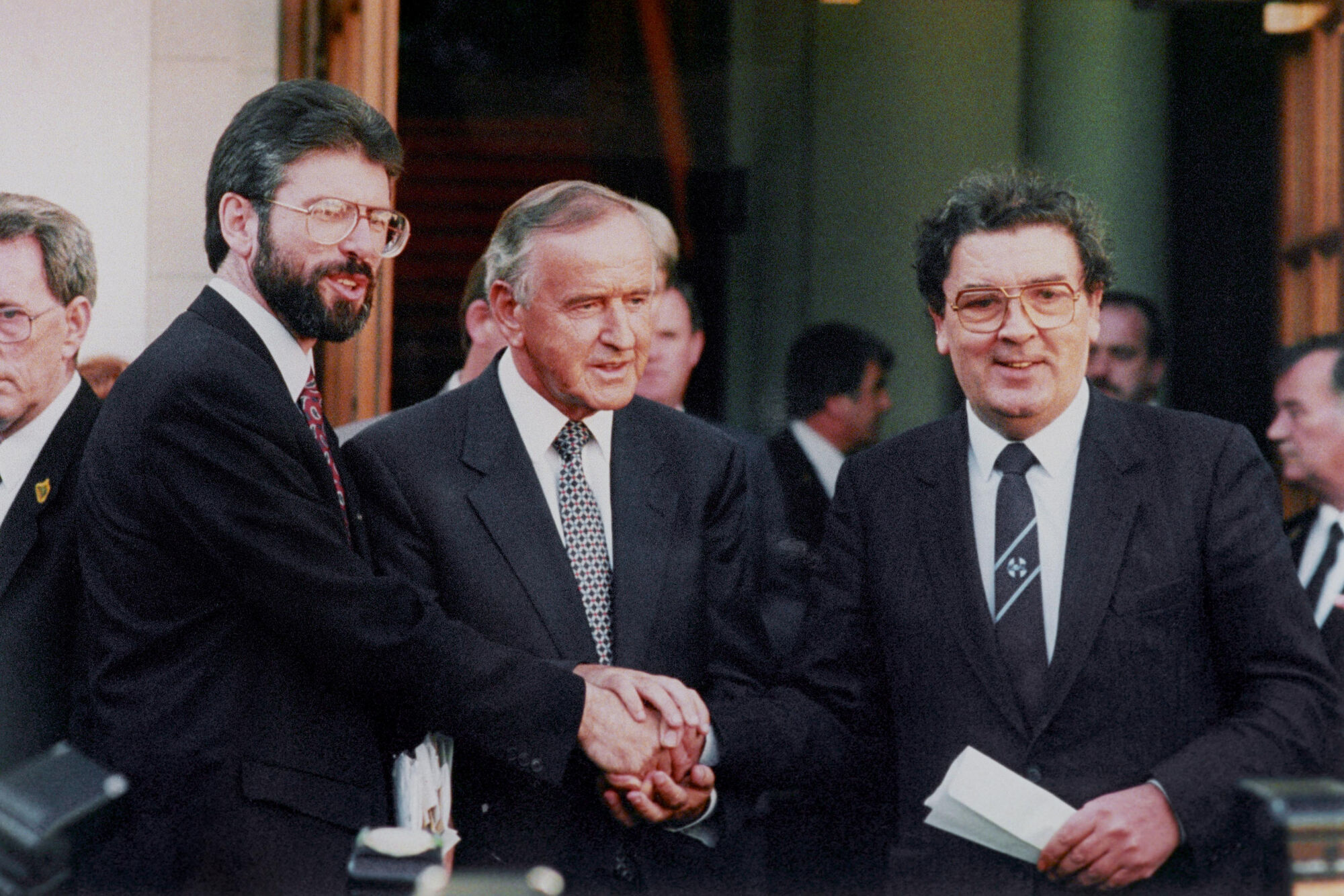
Sinn Féin president Gerry Adams, taoiseach and leader of Fianna Fáil, Albert Reynolds, and Leader of the SDLP John Hume, on the steps of Government Buildings in Dublin in April 1994, during the historic meeting between them which is generally regarded as the first official step of the Peace Process in Northern Ireland. Picture PA/PA Wire
Albert Reynolds was born in Rooskey Co Roscommon. His father, John Reynolds was a coachbuilder/carpenter and farmer. The family do not appear to have been particularly active in politics.
Albert, the youngest of the family, did not have a taste for farm work and went to boarding school in Summerhill College in Sligo.
His mother, Catherine, would have liked him to become a bank official, and obtained an opportunity for him to sit the bank exam. The exam consisted of two papers with an interval between them. After completing the first paper, Albert looked around among the other examinees, and thought they looked to be already part of a clique of which he had no wish to be part.
So, on the spur of the moment, he got up and left, without sitting the second paper. He had apparently done well in the first paper, so he was turning his back on what could have been a secure career.
He then worked in a variety of clerical jobs, including with CIE, before launching himself on what was to prove to be an outstandingly successful business and political career.
This episode of the bank exam illustrates aspects of Albert Reynolds character which were to be manifest in his later public life.
He was socially sensitive to perceived exclusion from real or imaginary cliques. But he had the courage to back his own instinct and make a quick decision, on a hunch. Some of these decisions turned out badly most turned out well.
Albert Reynolds would not have had the temperament to be a careful banker, working within a strict decision making hierarchy, that was the way Irish banks worked in the 1950’s and 1960’s!
His social sensitivity made him a difficult colleague. This was especially so for his coalition partners, Des O Malley and Dick Spring, both of whom came from a more established political and professional background. This sensitivity, combined with a “take it or leave it” attitude, also led to take court cases against business partners and newspapers that might have been avoided.
On the other hand, his capacity for quick decision making, helped him to success in fields as diverse as newspaper proprietorship and petfood manufacturing, and when he went into politics, in modernizing the Irish telephone network, and establishing the National Treasury Management Agency.
But his over confidence also led to bad decisions. One was the allocation of disproportionate amounts of export credit insurance to one beef exporter, at the expense of the taxpayer, and of other competitors. He made some of these bad decisions at meetings, where no officials were present to record what happened. That was poor administrative practice for which he was to pay a price.
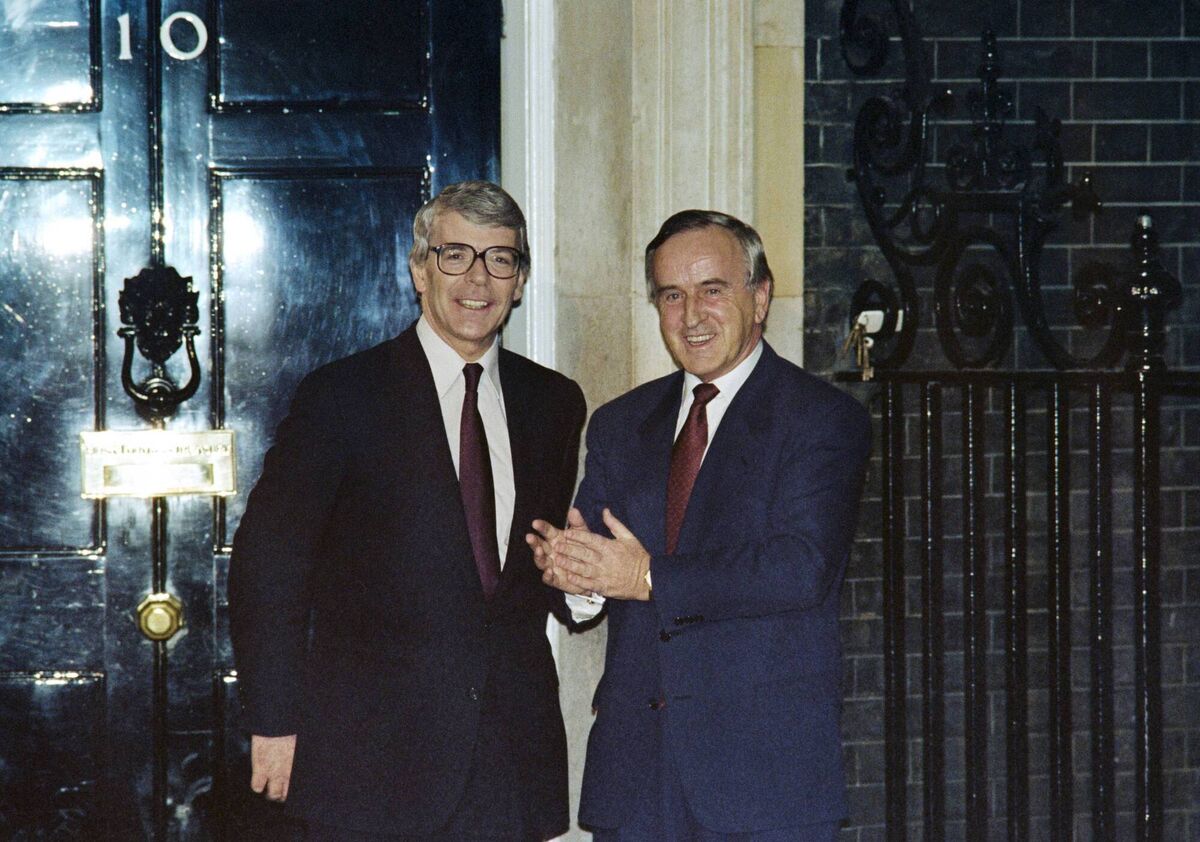
His tolerance of risk taking did, however lead him to back the Hume/ Adams dialogue with the IRA, and simultaneously to reach out personally to the Loyalist paramilitaries. His “take it or leave it” approach helped him secure the agreement with John Major of the Downing Street Declaration of December 1993.
The Downing Street Declaration was, to my mind, the outstanding achievement of Albert Reynolds’ career This Declaration said that there must be a “permanent end to the use of, or support for, paramilitary violence”. It confirmed that, on that basis, democratically mandated parties, with an established a commitment to exclusively peaceful methods, would be free to participate in talks on the future. The Declaration provided and incentive for the IRA and Loyalist ceasefires.
This peace process was hugely beneficial, and we are enjoying these benefits of it to this day. But it came with downsides, some of which are not often explored.
It gave a measure of retrospective political legitimation to armed republicanism, and to the appalling terror it had imposed, and political respectability to its political off shoots. It blurred the line between constitutional and armed republicanism, to the eventual disadvantage of both Fianna Fail and the SDLP.
Albert Reynolds’ habit of agreeing things orally at meetings, where no record was kept, caused problems for those who had to take up where he left off, when he ceased to be Taoiseach.
This book says that Albert Reynold claimed, afterwards, that he and John Major had agreed that Sinn Fein would be included in talks, after just six months of non violence, and without any move towards putting any of their weaponry beyond use and that he had conveyed this to Sinn Fein. This is doubtful. The author does not test this claim.
When I took over from Albert Reynolds as Taoiseach, I was provided with no record of any such assurance having been agreed, or given to Sinn Fein.
For a Taoiseach to give such an assurance would , in any event, have been deeply problematic in view of the clear words of our Constitution which say that “no military or armed force, other than a military or armed force raised and maintained by the Oireachtas, shall be raised or maintained for any purpose whatsoever”.
No head of a sovereign government should connive in the retention of arms by a private army. That would go against a basic principle of democratic government.
A political party that is associated with a private military force is not a normal political party.
Albert Reynolds’ relationship with Charles Haughey is explored, and the various heaves within Fianna Fail are described, with all the attention to colourful detail of a political connoisseur.
The fall of Albert Reynolds’ government over the appointment of Harry Whelehan to the High Court seems to have been the culmination of a series of slights, miscommunications, and misunderstandings. Taking the decision to appoint the President of the High Court at a cabinet meeting, where the Ministers of one of the parties in government had left the room, was a fatal error. The “take it or leave it” approach over reached itself.
Valuable lessons, on how to manage coalitions, were learned from these mistakes by successor governments This is a highly readable biography.
It draws on Conor Lenihan’s personal recollections of working with Albert Reynolds. It uses previously published biographies of Mr Reynolds and others, and interviews with contemporaries (including this writer).
It is difficult to say how much of the material in the book is original, in the sense of not having been published before.
Although it is a sympathetic biography, the author does not seem to have had sought access to Mr Reynolds private papers, or to any other archival material. For example, the various drafts, from different sources, that led to the Downing Street Declaration, and the precise clarifications of it sought by Sinn Fein, are not quoted or analysed.
So the story told is incomplete. It relies on fallible memories rather than written evidence . While many readers will already be familiar with the broad outline of Albert Reynolds career, Conor Lenihan brings it all to life very well.
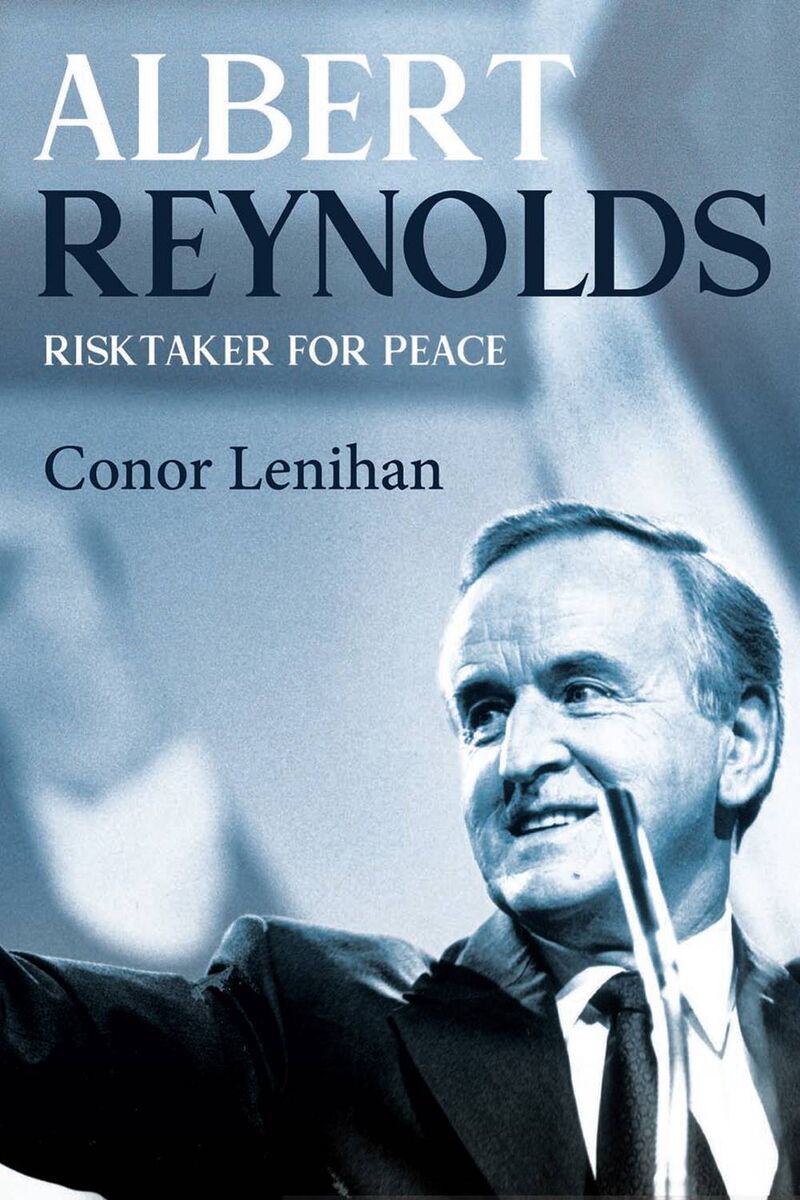
- Albert Reynolds, Risktaker for Peace
- Conor Lenihan
- Merrion Press, €22.95