Book Review: What it felt like to be a Jewish family in Austria amid the rise of Hitler
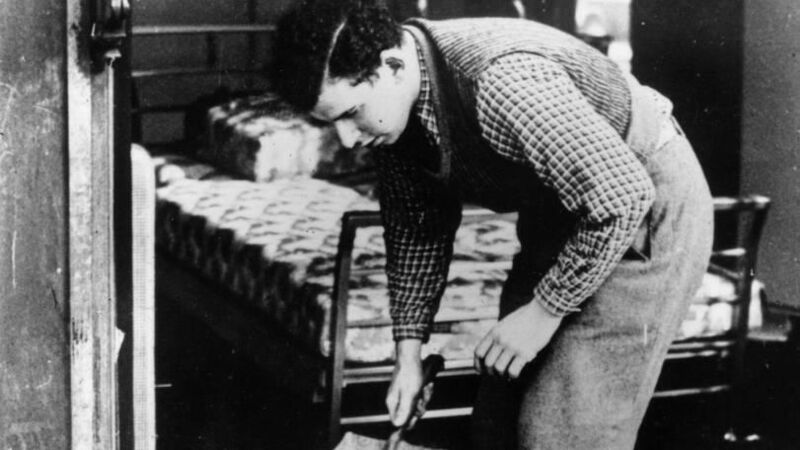
A worker clearing broken glass of a Jewish shop following the anti-Jewish riots of Kristallnacht in Berlin. (Photo by Hulton Archive/Getty Images)
- The Lost Café Schindler: One Family, Two Wars and the Search for Truth
- Meriel Schindler
- Hodder & Stoughton, €23.45
IN the spring of 1938, Franz Hofer, a senior Nazi official, rang the doorbell of Hugo Schindler’s house in the Austrian city of Innsbruck.
Reporting directly to Adolf Hitler, Hofer was one of the most powerful Nazis in Austria.
Hugo was a respected Jewish business owner in the city and was at work when Hofer called.
Hugo’s 12-year-old son, Kurt, was home alone and answered the door.
When Hofer politely asked if he could come in, Kurt hesitatingly showed him around the large house – the Villa Schindler.
A few weeks before Hofer’s visit, Hitler annexed Austria into Nazi Germany and the Reich’s antisemitic legislation that removed Jewish rights of citizenship was quickly extended to Austria.
In July 1938, Hugo was arrested on trumped-up charges of bribery and held in a Gestapo prison.
Hofer threatened Hugo that unless he agreed to sell him the villa, Hugo would be sent to a concentration camp.
Although Hugo was effectively forced to sell the villa to Hofer for a fraction of its value, Hugo never received any of the money.
By the end of 1938, the Nazis, for nominal prices, had stripped Hugo and his family of their entire business – including a distillery, a factory, and the Café Schindler.
Soon, Hofer and his family were living in Hugo’s former home and the region’s Nazi elite were drinking in the repurposed family-owned café, formerly a Jewish venue.
In a double irony, the Café Schindler was founded in 1922 as a relief from the horrors of the First World War.
A Viennese-style coffeehouse and patisserie with live music and dancing, the café became the nucleus of Innsbruck’s social and cultural life in a country convulsed by political instability after its defeat by the Allies in the First World War and the collapse of the Austro-Hungarian Empire.
The café was founded by Hugo. Meriel Schindler, the author of The Lost Café Schindler, is Hugo’s granddaughter and Kurt’s daughter.
Excavating her family’s extraordinary history, Meriel maps the striking intersections between the personal and the political in a memoir that candidly seeks to reckon with the past.
Meriel traces her family history to a Jewish distilling dynasty stretching back to the middle of the 18th century in Bohemia (in the modern Czech Republic, but then part of the Austro-Hungarian Empire) and counts illustrious figures among her relatives.
Meriel is a distant relation of the novelist Franz Kafka and is a grandniece of Eduard Bloc, the Jewish doctor who cared for Hitler’s mother, Klara.
For the six weeks after Klara was diagnosed with breast cancer, Bloc visited her every day at her home in the Austrian city of Linz.
She died in 1907. Bloc wrote that he had never seen anyone so destroyed by grief as Hitler was on the day of Klara’s death.
When Hitler moved to Vienna, he sent Bloc two postcards, one hand painted, writing that the Hitler family were “eternally grateful” to Bloc.
After the annexation of Austria in 1938, the first city Hitler visited in the country was Linz.
Hitler asked an official if Bloc was still alive and allegedly said that “if all Jews were like him [Bloc], then there would be no antisemitism”.
Indicating how closely Schindler’s family felt assimilated into the Austro-Hungarian Empire, Hugo and his brother enlisted in its army in the First World War.
A million soldiers died fighting for that empire.
Hugo and his brother fought on the Alpine front: high altitude trench warfare on the border between Austria-Hungary and Italy.
Remarkably, 60,000 men from Hugo’s regiment were killed by avalanches.
On November 9, 1938, Hugo felt the devastating effects of Kristallnacht, or the Night of Broken Glass, when Nazis attacked Jewish people and property in Germany and Austria.
In Innsbruck, local Nazis broke down the door of Hugo’s flat.
They picked up Kurt’s toboggan, which was leaning against a wall, and smashed it over Hugo’s head.
An iron strip nailed to the toboggan cut a deep vertical laceration down Hugo’s forehead.
While he was on the floor, a gang member with hobnail boots stamped on Hugo’s face and knocked him unconscious.
When Hugo was found, the 10-centimeter gash on his head was bleeding heavily and was deep enough to show his skull.
Throughout his life, Hugo’s son, Kurt (Meriel’s father), recounted seeing the assault on his father.
When, as an adult, Kurt consulted with psychiatrists about his poor mental health, he isolated the traumatic experience of, as a 13-year-old, seeing the Nazis attack his father as a touchstone.
But Kurt couldn’t have witnessed the incident.
Shortly after the Nazis seized control of Austria, Kurt’s mother fled the country with her son.
Meriel’s research established that on Kristallnacht, the night of Hugo’s attack, Kurt was in England with his mother.
She believes that some of Kurt’s lies were “false memories” where he inadvertently incorporated stories that he had heard about others into his life story.
But Meriel also concedes that Kurt deliberately inserted himself into episodes, such as Kristallnacht, to perpetuate deceit and evade responsibility.
This assertion fits with a vital strand of the book.
Meriel had a complicated relationship with Kurt.
“I had spent my entire adult life keeping my father at arm’s length,” she writes, “telling him as little about myself as I could.” Charming and persuasive, Kurt accumulated huge debts in his various trading companies, rarely paying suppliers, and never paying tax.
At the Old Bailey in 1976, Kurt was found guilty of engaging in fraudulent trading to the sum of £370,000.
He was sentenced to five years in prison.
Kurt’s family were evicted from their mews house in Kensington and spent months living in a squat in Ealing.
Kurt’s death at the age of 91 in 2017 triggered this book.
The genesis of The Lost Café Schindler as a family investigation is both a strength and a limitation.
The book is occasionally self-indulgent, straying into areas that are unlikely to interest anyone outside Meriel’s family.
A more rigorous edit would have resulted in a punchier read.
Yet the pulse of the book is Meriel’s gimlet-eyed focus on the intimate consequences of sweeping international events.
Writing in 2000 about the profusion of Irish childhood memoirs that recalled the pain of institutionalism, the historian Catríona Crowe wrote that “the official record can tell us what happened, but rarely what it felt like”.
That resonates with Meriel’s intention here.
By reconstructing – through letters, photos, and archival documents – the specific experiences of her family, Meriel articulates a revealing, often heart-breaking insider’s perspective that illuminates the broader narrative.
The Lost Café Schindler is franked with a surreal postscript.
After the war, Hofer, the Nazi who compelled Hugo to sell him his house under the threat of deportation to a death camp, was a fugitive from justice and living in northern Germany.
In a bizarre reversal of Hofer arriving in 1938 unannounced at the Villa Schindler, Kurt tracked down Hofer in 1950 and knocked on his front door.
After uneasy small talk, Kurt asked Hofer to pay rent for the seven years he and his family lived in the Villa Schindler.
Hofer agreed and for years subsequently, Kurt regularly drove 750 kilometres from Innsbruck to Hofer’s house in Germany and collected Hofer’s back rent before Hofer and Kurt ate dinner together and drank Austrian white wine.
The episode underscores the challenges Meriel faced in trying to comprehend the contradictions of Kurt, a man who initiated this baffling relationship with a prominent member of the party whose policies resulted in roughly 65,000 Austrian Jews perishing in Nazi death camps, including Kurt’s aunt, uncle, and grandmother.
“If I was going to understand this maddening man,” Meriel writes at the start of the book, “I would have to…unravel a larger, longer family history”.
The Lost Café Schindler is Meriel’s admirable attempt to do both.