Maud Cotter: 'There was very little arts infrastructure in the country in the Eighties'

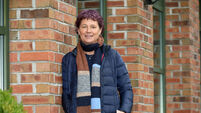
Maud Cotter, in front of her work ‘the moon is falling’ at the Hugh Lane Gallery in Dublin. Picture: Naoise Culhane
Litter on the streets has become a rather large talking point over the past few months, with national and local debate on how best to manage the inevitable disposable detritus of our “outdoor summer”.
Perhaps not many people have been considering the aesthetic qualities of this litter. Except Cork sculptor Maud Cotter.
“If you look at how detritus on the street moves, its different parts become behaviourally quite different,” Cotter says. “Aesthetically, they’re full of richness, and speak to the latency and resource within all materials. That’s kind of my general attitude to matter.
“I have always been interested in looking at what we consider to be inanimate materials as having agency. We have to accept the fact that we’re in this amazing maelstrom of life, across all material.”
Cotter is explaining her general attitude to matter in a room perched above the workshop floor of the National Sculpture Factory (NSF), the institution in Cork she co-founded over 30 years ago, as one of a triumvirate of brilliant young female abstract sculptors to have graduated together from the Crawford College of Art and Design in the late Seventies.
She and classmates Vivienne Roche and Eilís O’Connell, alongside sound artist Danny McCarthy, were responding to a need when they founded the NSF, she says.
Opened in Cork’s former tramway buildings on Albert Road in 1989, the factory continues to provide studio space, educational support and specialist technical equipment to sculptors.
“There was very little arts infrastructure in the country in the Eighties,” Cotter says. “When I graduated, I had only ever seen one artists’ studio; I didn’t even really know what one was. But it created this appetite and desire to realise the National Sculpture Factory. We were proactive, and hungry. You find a dynamic.”
Now in her sixties, Cotter has seen the city change drastically since the NSF came about; a seven-year stint in London in the Nineties came to a natural conclusion and now, although she has worked internationally throughout her prolific career, she lives near Shandon, where she also has a home studio.
“It was a maturation thing,” she says of returning to Cork. “I came to the point where I had learned what I needed to learn, and I really wanted to come back and make a contribution to being in Ireland. Ireland is very important to me: it’s my conceptual base.”
Cork is now about to enter an even more rapid era of change: the NSF is located at the periphery of the city’s docklands, where a €405 million regeneration package is set to radically alter the cityscape.
For Cotter, the creativity of artists and sculptors is a power to be harnessed when envisioning what the city will become.
“The city has always expressed itself as development down the river,” Cotter says. “The key from my point of view is habitation and community. When someone lives in a place, they build intimacy and routine and from that, a web of human engagement builds.
"For me, that’s the life of a city. If I see glazed, corporate modules going up that have no sense of community, I think that’s an opportunity lost.
“We’re amassing huge amounts of commercial goods and there’s a huge agenda to build more and more. I think sculpture shows different strategies for addressing materials, because we’re free from functionality. The critical thing for sculpture is that we are making new ways of behaviour, out of actual matter.”
For the past six years, Cotter has been interrogating her relationship to materials: the Hugh Lane in Dublin is currently hosting the third in a series of three exhibitions, each with the phrase “a consequence of” in their title.
What is the place of sculpture in a world in material crisis, where the impacts of accelerated resource extraction, waste, and habitat loss to human development are becoming increasingly evident?
“I started off calling them ‘a consequence of’ because I was interested in the acceleration of consequence in the modern world,” Cotter says. “We are now inheriting the consequences of our attitude to the environment, to democratic issues etcetera.” “I was asking myself questions about my own practice: is sculpture really radically necessary now? You’re using materials, so you have to ask yourself, is this strictly necessary?”
In the first two exhibitions in this triptych, Cotter explored the nature of physical reality and form in a consequence of - without stilling, moving on to human consciousness in the second, a consequence of - a breather of air.
Now, after the inevitable Covid hiatus, Cotter reaches not a conclusion but, she says, a “point of arrival” with 'A Consequence of – a dappled world'. “A dappled world” is taken from Pied Beauty, a poem by Gerard Manley Hopkins. And like Hopkins, Cotter seems to have arrived at the point of celebrating the aesthetic properties of materials again.
The series is an enormous body of work, a considerable chunk of her professional life. “I needed to get serious,” she says. “I needed focus, and to kind of put myself under more pressure.”
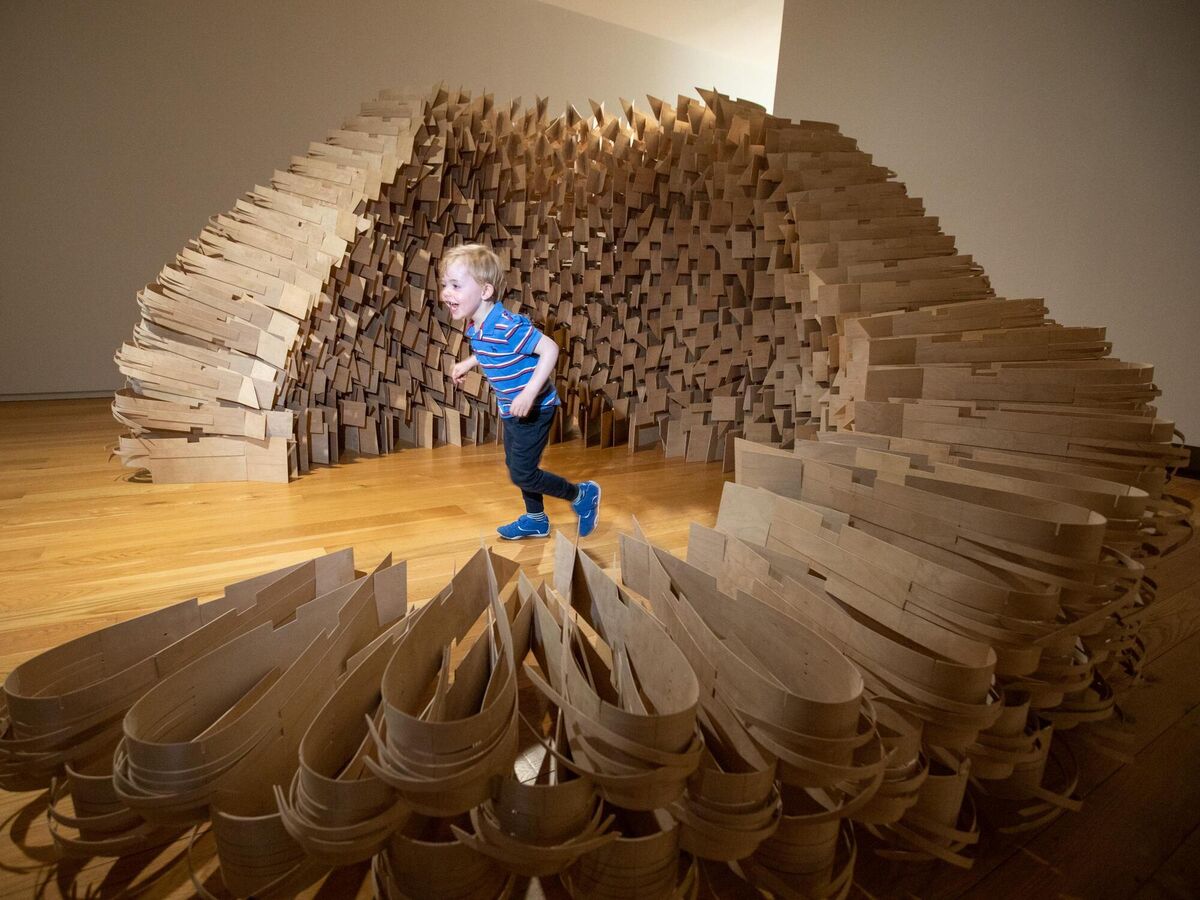
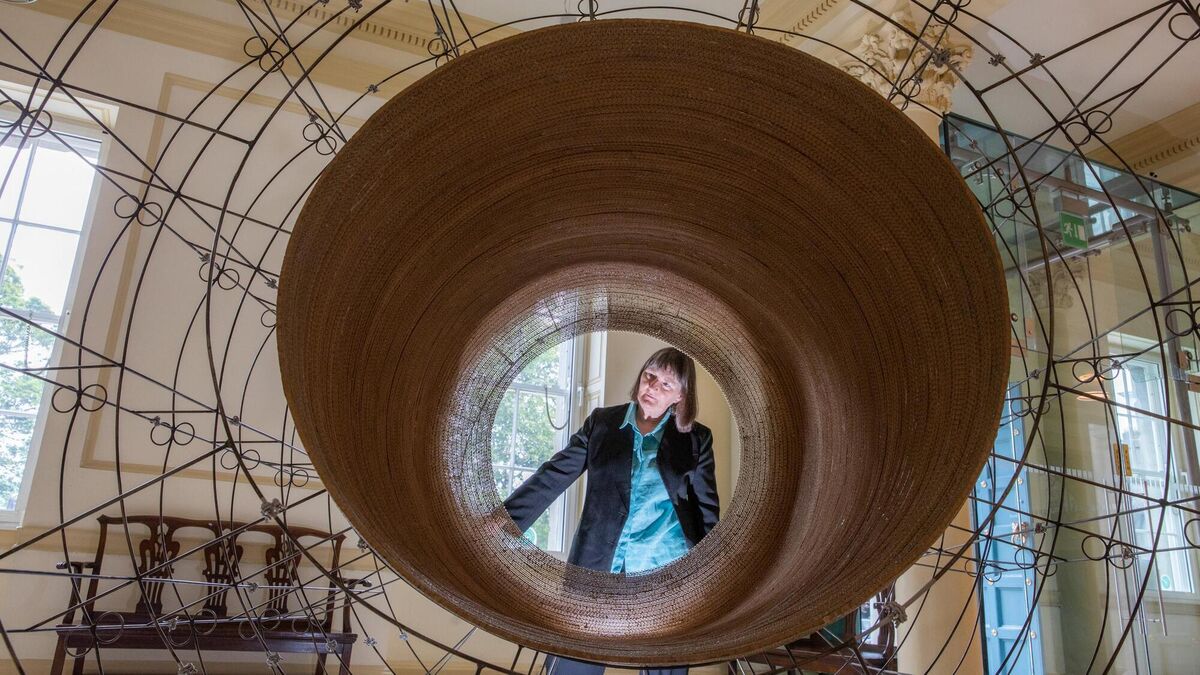
Having begun her career working predominantly in stained glass, Cotter uses everything from Birch plywood to found objects to plastic and styrofoam in her most recent work.
“Glass transcended its own materiality, which was what attracted me to it,” she says. “Yes, I work with a much wider range of materials now, but I expect them to behave: I want that kick, I want them to transcend themselves.”
In The Moon is Falling, one of the pieces installed in the Hugh Lane, Cotter visits in detail a dystopian vision, a morality play of what will happen to humans if we don’t mend our materials crisis.
Pale discs of polystyrene coated in plaster are suspended above a miniaturised cityscape of plastic towers: they are, she says, “habitation platforms, that in the end we’ll have to resort to.
“I used plastic because I kind of believe plastic should be as precious as gold. There are some uses for it that we really need to respect, but we need to disrespect the over-production of it.
"So the plastic presents a corporate front, but it actually represents degradation of the landscape and the reduction into waste, a dead field. We have a second chance to recover. But this dead field is something I felt I had to imagine as an outcome.”
Having completed such a large project, what next? “Tidy the studio,” she says with a laugh. “I have to reorganise. A big project like this is like a big machine that eats your life. It consumed my material base, it consumed my space, my everything.
"I have some ideas, and I’m working on a series of small pieces, but I’m going to try to stop myself working for a while so that I can nurture and organise myself. That’s part of the sustainable model of practise: that you’re not totally burning out all the time.”
- A Consequence of – a dappled world, by Maud Cotter is at the Hugh Lane Gallery, Dublin until Sunday, August 8. http://www.hughlane.ie