Tom Dunne's Music & Me: Long and winding road leads me to Paul McCartney's door
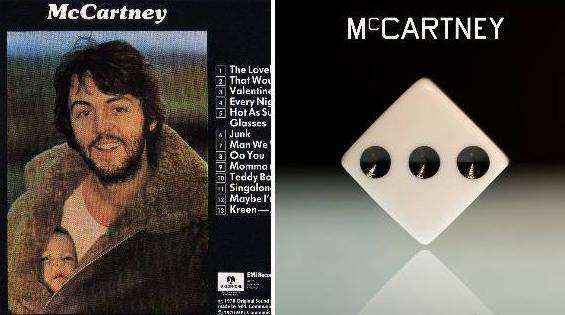
Left, the back cover of Paul McCartney's first solo album in 1970, with baby Mary McCartney peeping out. On right is the cover of McCartney III, which had Mary helping on the photography.
And in year of our Lord, 2020, a year beset not just by plague but also Bon Jovi’s version of Fairytale of New York, the Creator did at last smile on his people. And he did send forth the third instalment of the McCartney solo albums, McCartney III, and he saw that it was good.
‘Good’ is a moot point here. It’s not ‘good’ in the Sgt Pepper way, or indeed a Band On The Run way. But it is still ‘good’ in a McCartney way and as he is the Beethoven of our age, that is a different kind of ‘good’ completely. It’s like an average game by Maradona, average to him, not us.
Not that you will know that by reading the reviews. They will be lukewarm at best, as they have ever been. Because time is the essential ingredient here, you jump to conclusions about his eponymous releases at your peril.
The first of these, McCartney I, was conceived and recorded as The Beatles fell apart. Confused, depressed, embattled, he was adamant it would have nothing to do with them. It was him, a four track recorder and Linda. “Home, Family, Love,” as he said at the time.
Its iconic cover – the first of many photographed by Linda - featured his baby daughter, Mary, peeking out of his jacket.
A US number one in 1970, it was vilified in the press. He was seen then as having “broken up the Beatles”, and for this? an album variously described as “underproduced” and “unfinished”. But amongst its wistful airs were tracks like 'Junk' and 'Every Night', songs, that as time went by, people came to see as having more in common with Bon Iver’s 2007 For Emma, Forever Ago: sparse, unadorned, beautiful. Apparently, indie rock was born.
It marked the end of The Beatles, and in 1980, McCartney II marked the end of Wings, the band Alan Partridge described as “what the Beatles might have been”. As it too fell apart Paul took to the shed and, proving to be not immune to the charms of Kraftwerk, Bowie’s Low and early Talking Heads, produced something unlike anything he’d done before.
John Lennon, hearing Coming Up it on radio, commented, “Is that Paul?” before adding, “It’s great!” It reached Number One and a track Temporary Secretary later became a club sensation. And did Frozen Jap influence Kraftwerk’s Computer Love? Reviews at the time said “aural doodles for children” but today Hot Chip continue to name check it and I’ve heard the phrase, “a futuristic milestone in early British electronica”, bandied about.
So what of McCartney III? It’s more produced than the previous two and if haters want to hate, as his mate Taylor would say, there are many targets here. ‘Lavatory Lil’ is throwaway and ‘Slidin’’ is a work out, but both types of song have featured on Beatles and Wings albums that are now regarded as classics.
There are obvious singles, like Find My Way, and love songs, like Deep Down Winter is a recurrent theme, fitting given both his age and the Covid 19 circumstance of the recording. Birds, an ever present in his work, be they blue or black, are here too, again, in a winter variety.
Then there is Deep, Deep, Feeling. It’s long, and an obvious stand out, but it’s the one that has, in its middle eight, one of those little Macca moments that just catches your breath. The type of change he seems to produce at will, like on the middle eight of A Day in the Life. Little changes, signature genius changes, that just lift the song to a whole new plain.
How much longer will he do this? He is 78 and if his eponymous albums tend to mark the end of something - The Beatles, Wings – then what does this mark? It’s not a thought I can countenance.
He is a world treasure. A good humoured, grounded, loving man who is one of the most significant surviving connections to the most optimistic era in world history. You watch that plane landing at JFK, a Boeing 707, bringing Beatlemania to America. It looks like a world that is gone forever: Black and white TV, Ed Sullivan, JFK, MLK and screaming American youth. And, there in its midst, as his brother would call him, “our kid”.
Photography is by Mary, that little thing peeking out from the cover of McCartney I. It remains now, as it was then: “Home, Family, Love.”