Crawford Art Gallery: When art and science collide for an exhibition of Invisible Light
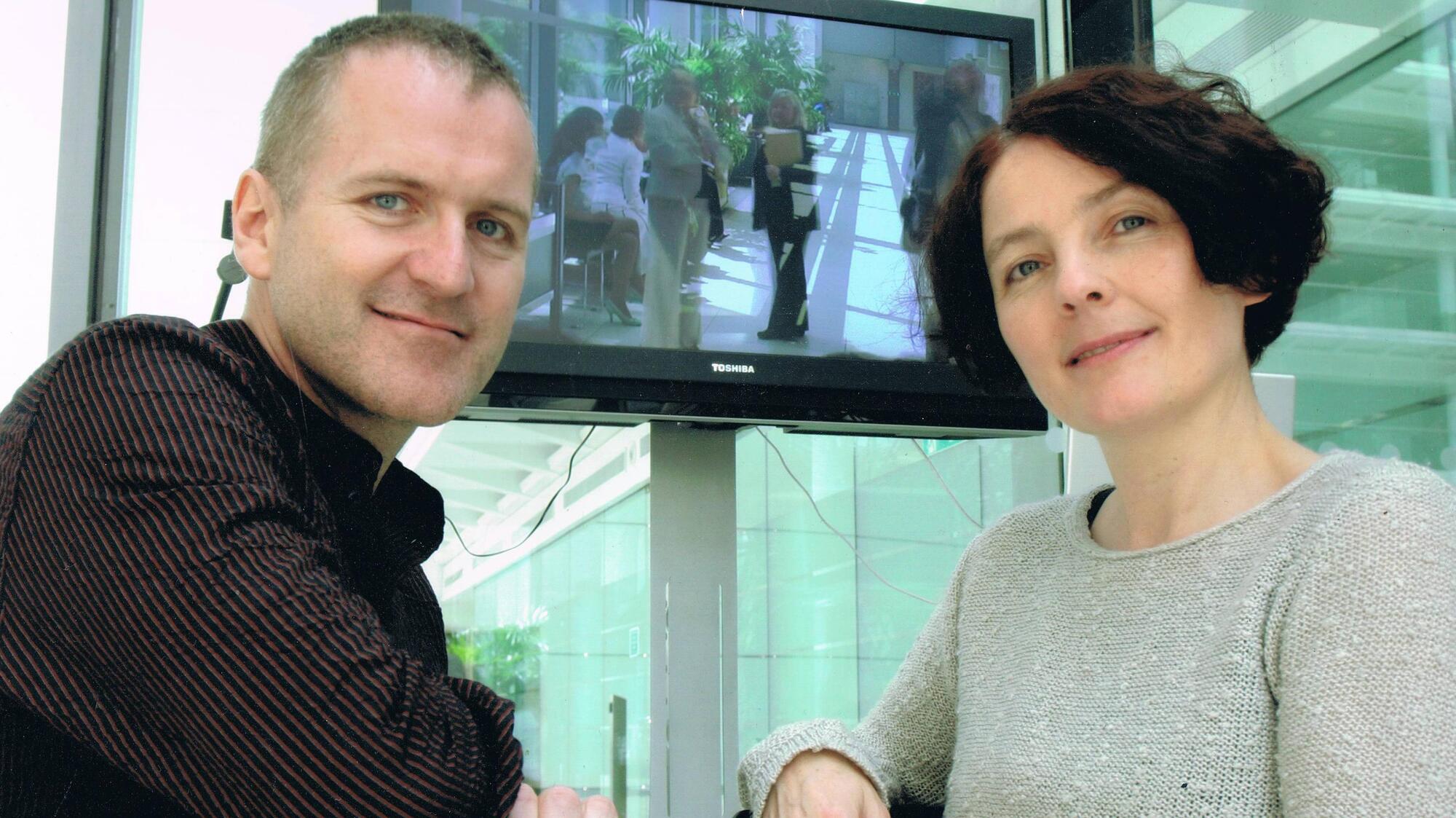
Denis Connolly and Anne Cleary, the artists who work under the Cleary Connolly moniker.
Why is your banana making music? Why, because it’s radioactive, of course. No, this is not Dadaist surrealism. It’s STEAM (science, technology, engineering, arts and maths).
While artists usually work with light within the visible colour spectrum, Anne Cleary and Denis Connolly have applied their distinctive blend of art and science to exploring the invisible light beyond our perception.
Covid restrictions ensured the realisation of their project was unable to complete its run at the Crawford Art Gallery in Cork, but online talks and engagement with schools have formed part of e 'Learn and Explore' component that has kept the exhibition in the public eye.
Two years in the making, Cleary and Connolly’s Invisible Light exhibition saw the artists work with scientists from Cork’s Tyndall institute to capture and render explorable the six kinds of electromagnetic radiation usually invisible to humans: gamma rays, X-rays, microwaves, radio waves, infrared light and UV light.
And bananas, believe it or not, are a source of gamma radiation.
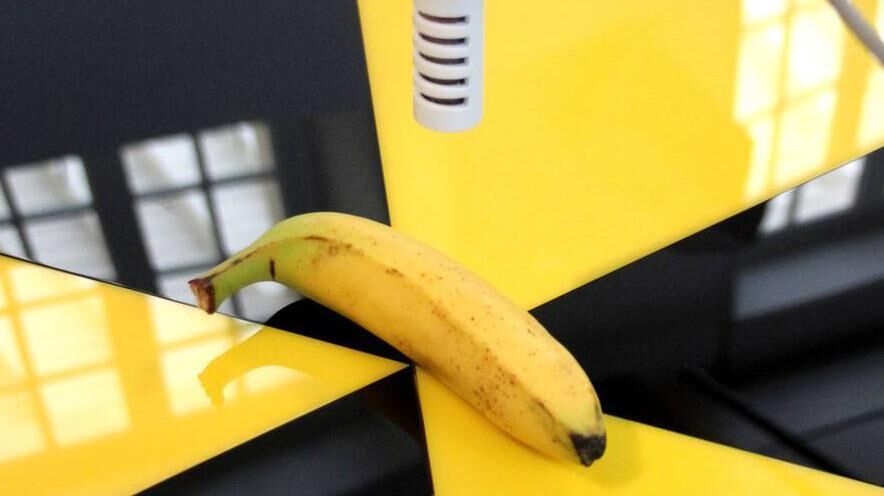
“Gamma rays are so obscure that there are almost no gamma rays anywhere, because it’s nuclear radiation,” Denis Connolly says. “But the one thing that everyone has in their house that emits gamma rays is a banana.
“Bananas contain Potassium-40, a radioactive isotope that produces a very small amount of radiation. Nothing that will kill you; you’d need to eat 10,000 bananas for it to be dangerous.” On a table emblazoned with the yellow and black radiation hazard logo, in the presently deserted Crawford Art Gallery, Cleary and Connolly have positioned a banana and a Geiger counter. The Geiger counter detects photons of gamma radiation from the banana and a computer selects notes from a sample base of Tibetan bowls, translating periodic bleeps from the Geiger counter into music.
“The banana is glowing in invisible light,” Connolly says. “As artists, what we do is work with visible light. This is invisible light which is often only considered to be about science and technology, but we want to make it into art, bring it into the cultural realm and show the beauty of it.”
“Really, it’s talking about all the light in the universe because the area of light that we know is just a small section that’s visible,” Cleary points out. “The spectrum continues on either side. For years, Denis and I were really interested in the role of the spectator in art and light is the medium for that.”
The Paris-based couple, who have two daughters, have been exploring visual perception and blurring the lines between art and science to do it for years under the moniker of The School of Looking. Their commissions have included a set of “historioscopes” installed at Marconi Station in Co Galway and their Metaperceptual Helmets, a series of bizarre polished aluminium helmets that permit the wearer to see the world through a variety of distortions.
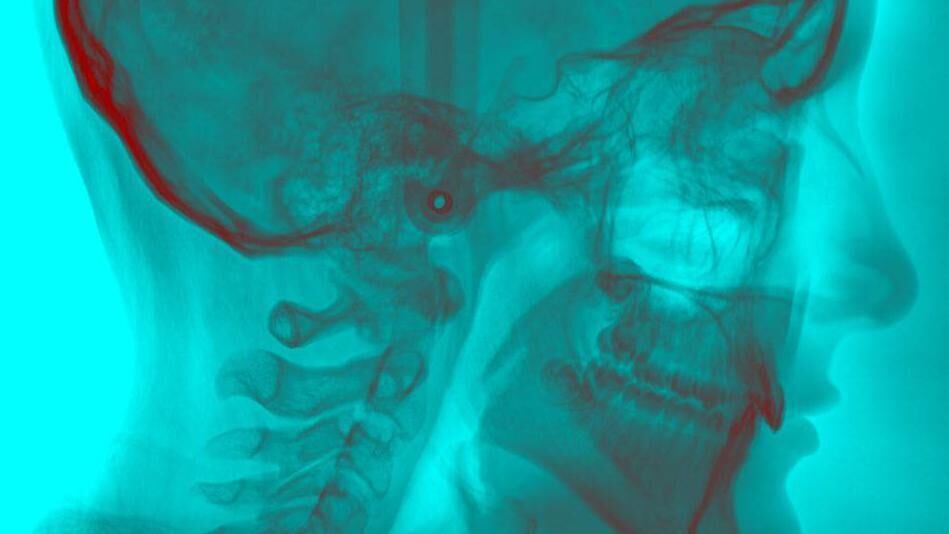
Inviting curiosity and discovery through play, Invisible Light’s installations used tools and imagery normally associated with fields like medicine, astronomy and even military surveillance, to represent the unseen.
“Sacred Relic” is a vast polyvinyl orb onto which has been printed a very special map, a chart of the so-called Cosmic Microwave Background Radiation (CMBR) provided to Cleary and Connolly by the European Space Agency.
“If there’s any religious symbol for all of humanity, it must be this,” Cleary says. “This is the oldest light in the universe. At the big bang, there was a really bright flash and that light has been expanding ever since, spreading out as the horizon of the universe. It’s still perceptible as microwave, using some very sophisticated radio telescopes they use in space stations.” Invisible Light has been supported by the Science Foundation Ireland’s Discover Programme.
Connolly says the divide between arts and sciences, so firmly rooted in our education system, is an artificial one, and that artists and scientists have more in common with each other than they might believe. “If you’re interested in the world as an artist, you’re interested in the science of the world,” he says.
“I find that there’s a complicity between scientists and artists that there isn’t with people, say, with a commerce education. Scientists are very respectful of art and I think they really understand the depth of the research. “
- Artists Cleary Connolly continue their series of free virtual school workshops and lunchtime talks called 'Ray Days' to enable the public to explore the exhibition while the Crawford Art gallery is closed at schooloflooking.org
- There is a separate resource for primary and secondary school children at crawfordgallery.ie/schools
Radio waves are electromagnetic radiation with wavelengths longer than infrared light, generated when charged particles accelerate: lightning and astronomical phenomena can produce radio waves. They travel close to the speed of light in the earth’s atmosphere, giving them countless communication applications and making them the most familiar form of invisible light.
Microwaves are high-frequency electromagnetic waves with shorter wavelengths than radio waves. They can’t pass through most objects and they are absorbed by moisture in the atmosphere. In 1964 radio astronomers Arno Penzias and Robert Wilson first detected the “relic radiation’ leftover from the Big Bang. Originally a high-energy radiation, Cosmic Microwave Background Radiation (CMBR) now falls within the microwave spectrum because of the cooling and expanding of the universe.
Infrared radiation was first detected by astronomer and composer William Herschel using a thermometer, causing him to dub the invisible light that appears beyond the red end of the colour spectrum “heat rays.” Infrared radiation is caused by an object’s molecules vibrating and emitting electromagnetic radiation. The hotter the object, the faster the frequency and the shorter the wavelength of the radiation, visible on an infrared camera as a lighter shade.
Following Herschel’s discovery of infrared, German researcher Johann Wilhelm Ritter sought a corresponding “cooling” radiation at the opposite end of the colour spectrum. Although it proved not detectable using a thermometer, UV radiation was finally isolated using photosensitive silver chloride paper. Many marine animals, as well as bees and flowers, utilise UV-reflective pigments: we are surrounded by sights invisible to us, but visible to other lifeforms.
Gamma rays are photons emitted when radioactive isotopes like Potassium 40 decay. Like X-Rays, they can pass through matter, but their impact is far more penetrating and dangerous. Luckily, they are very rare. Gamma Ray imaging is used in PET scans. Gamma ray bursts are extremely energetic explosions that have been observed in space since the 1960s: it is believed they may be part of what causes a Black Hole to be formed.
X-Rays are electromagnetic radiation similar to visible light, but of such high energy that they are capable of passing through most objects. This can cause harm, including cancer-causing mutagenic impacts in animal cells. Mechanical engineer Wilhelm Conrad Röntgen discovered X-rays in 1895.