Formerly banned novel The Bogman deserves renewed attention
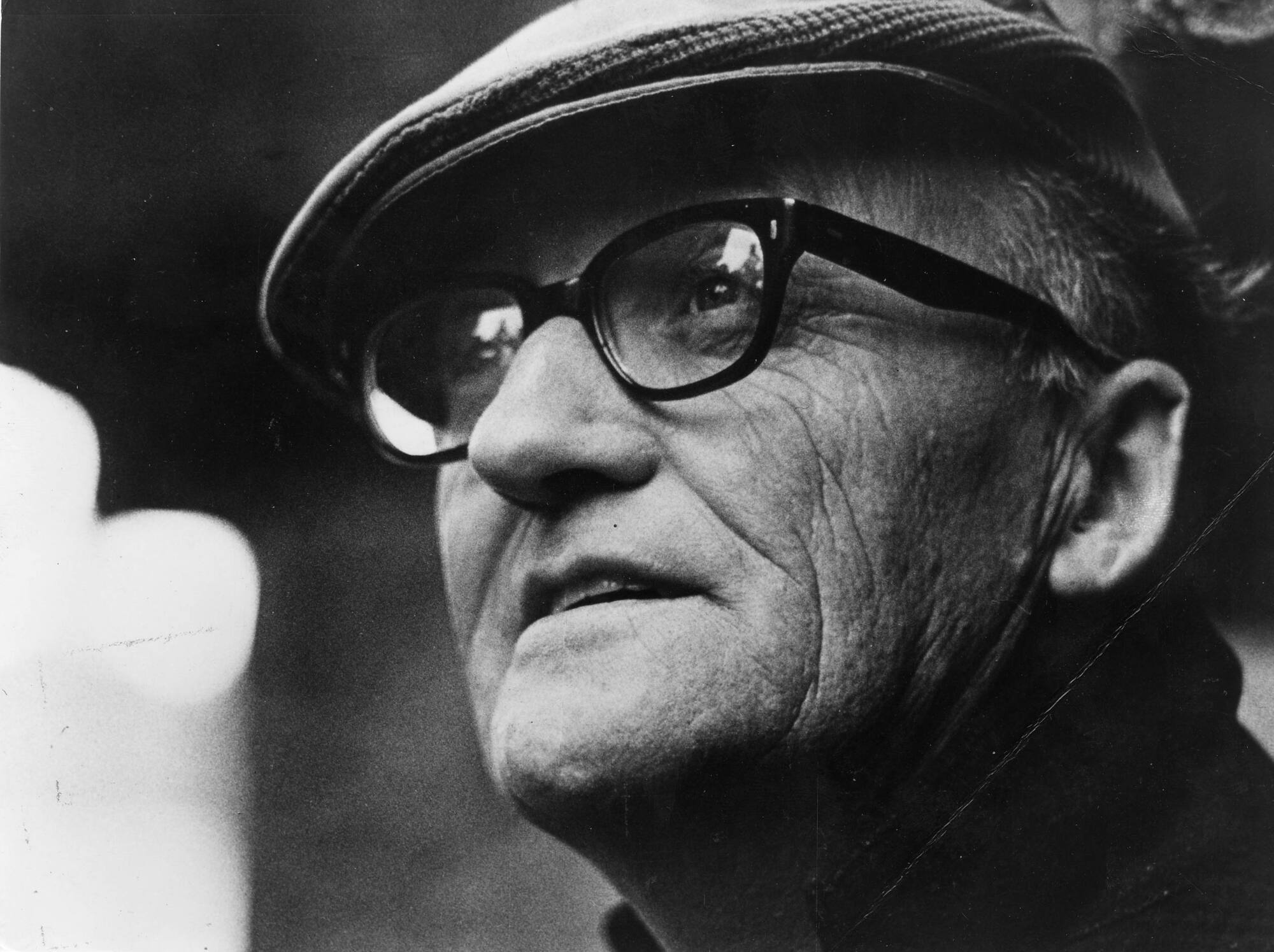
Novelist Walter Macken in 1966: Swerves beautifully into meditative contemplation of competing worlds, the known and the unknown, the actual and the possible.
FOR those who might wonder why the Irish writer Walter Macken seems to have disappeared from our cultural history something like an answer might be found in this novel. It reasserts the often headlong pace of Macken’s creativity which, given his tough physical realism, swerves a little too often into contradiction. There is a sense in these chapters, as in much of his work, that credibility is sacrificed to speed, and no wonder, as this man who wrote nine novels, four collections of short stories and four plays died at 51 years of age. (His book The Flight of the Doves was filmed in 1971.)
These are not a negligible legacy and in their day some publications – including this one - were taken seriously enough by the Irish government to be banned. The pious reasoning for such a prohibition was to protect the innocent Irish readers from an interest in any of the things the Irish people in the books – or plays – were doing anyway. This almost fascist responsibility for public morality must have had some influence on writers such as Macken, Brian O Nolan and Patrick Kavanagh who spiked their work with vengeful ridicule and fantasy, to the enrichment of Ireland’s literary heritage.
In The Bogman the satire is only half disguised. The moral danger presented by Macken was that the fantasy was so realistic as to be not fantastical at all except in what may have been angry exaggerations. The anti-hero (and Macken delighted in anti-heroes) of The Bogman is an illegitimate youth released from an industrial school in order to work as a farm labourer for his grandfather. Today’s readers may sigh at the prospect of yet another industrial-school misery tale but that’s not Macken’s issue; those cruelties are hinted only as formative background. Instead we begin to recognise the kind of community from which such institutions grew; a relationship existing below the revealed society of the story yet inexorably part of it. This may have been Macken’s grander, hidden theme but it remains submerged. It is only gradually that the reader grasps that the community into which Cahal Kinsella, known locally as Kinsella’s bastard, is inserted is not the customary Irish farming village of the fictional 1920s and 1930s.
This townland of Caherlo, based, loosely it is hoped, on the scattered settlements of north-west Galway, is almost totally self-governing and self-centred, depending on small conceits and deceptions to aggrandise itself. There are, for example, no worthies such as the school teacher, the doctor or the priest through whom superstition and suspicion can be filtered. In fact there is a long wait for any priest of significance at all, although when at last the canon is introduced he is worth waiting for. Initially at one with the false camaraderie of his fellows and accepting the brutalities of his grandfather because ‘ he is somebody belonging to me’ Cahal’s intelligence makes him too different to be acceptable even to those who can recognise his admirable qualities. He is a trouble-maker in that he makes trouble without intending any harm; his skill as a satiric balladeer is entertaining for a while but breeds suspicion and almost fatal hatred, much to his own great surprise.

Even as as he desires to belong to the same world as his farming neighbours Cahal realises that he will always be an outlier. For him, as for them, there is no rescue except America, no enemies but themselves, no loyalties except to inherited attitudes hardened into rules as impervious as stone. Thus a threshing meitheal is boycotted: as Cahal looks down the road for the expected help ‘the Murphys decided ”We won’t go over.” They felt no uneasiness about it.’. There is a pragmatic tone to much of Macken’s narrative, even in the very occasional graces of people forever vulnerable to the looming destitution of a bad harvest or an increased rent. Their fellow-feeling can be strong, provided one is a fellow. And when Cahal is betrayed into a made marriage his own capacity for compassion dissolves into relentless contempt for a woman who, with all her faults and misunderstandings, tries to do her best.
In a novel which is always both forceful and implicitly indignant Macken’s indulgence in this episode is puzzling; initially he depicts Julia as a young woman of aspiration, even of ambition, who had been taught about the bettet things and had set out to find them until a dream of home brought her back to Caherlo and her bought marriage. But her married life is that of a barren slave: Cahal sees his wife bringing food to him across the fields and looking at him ‘like a dog begging you to be nice to her.’ He isn’t, and Macken seems to relish the decomposition of Julia, her hair, her skin, her hands and finger-nails, her teeth, her feet in their ill-fitting boots, all succumbing to the demands of an unforgiving farmhouse and of cattle and hens and pigs and men.
The latent misogyny of Caherlo is unmistakably integral to Macken’s diversifying plot. The counterbalance is in his gift for seeing beyond the coarse realities of so many livelihoods, in his offering of an awareness of other ways of being. Cahal’s spirit is revived even in thinning the turnips by glimpses of cattle through a mist as if they were walking on clouds, by an unexpected conversation or encounter and, in passages of controlled lyricism, by such tasks as cutting the turf. Reaching his own bank Cahal ponders the bog-lizards, tiny yellow and gold remnants of the mighty creatures which once peopled the peatlands. And above him the hawks, the larks, the low-flying snipe. In his thronged pages of characters and incidents Macken swerves beautifully into meditative contemplation of competing worlds, the known and the unknown, the actual and the possible.
There is a where-as here: Macken’s verisimilitude and almost palpable wealth of detail - the mart, the holy well, the jennet, the travelling tin-smith and horse-coper, the flood and the American wake, even the sprightly or insinuating dialogue – it all rings true not only to the life he is describing but to life itself. Yet married to the former journalist and editor Peggy Kenny who reputedly read his work as he was writing it, he manages to produce a male heifer and a Sunday morning ritual of a hearty breakfast before going to mass Among other small lapses.
Something of Walter Macken’s real value – and importance – as a writer of Irish life is in his unsentimental adherence to the truth of the characters he has conjured. His romances have few heroes if indeed they can be called romances at all, and here he provides an escape, rather than a future, for Cahal Kinsella and the independent woman for whom he has yearned with typical reluctance. There are other yearnings in this absorbing novel which has outlasted but not outlived its era and, with several of his other titles, deserves a new attention.
- The Bogman
- Walter Macken
- New Island, €11.95